
Pollinators
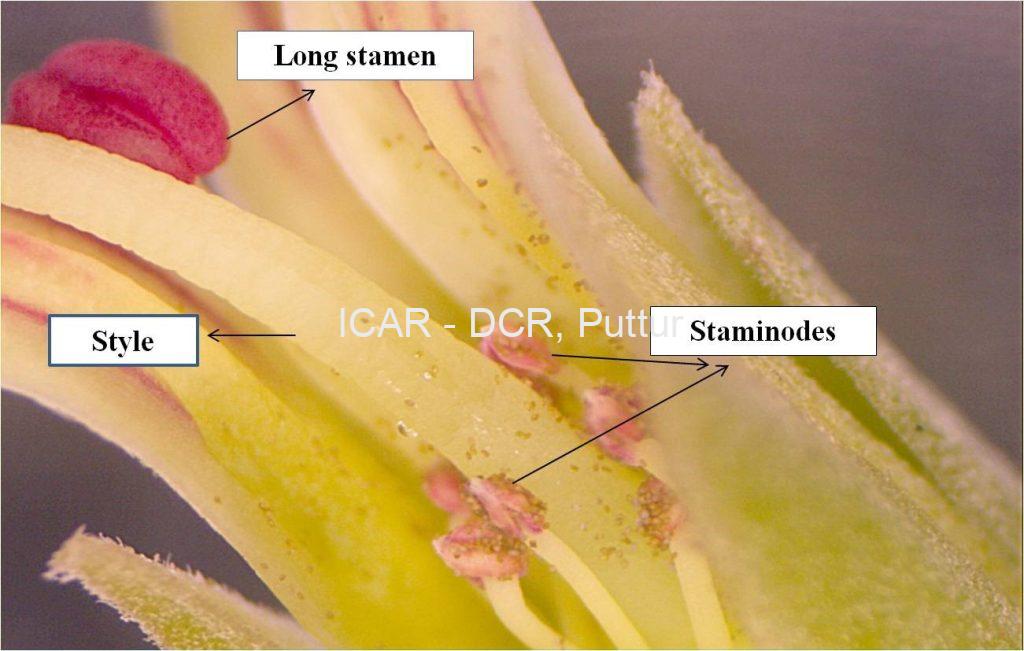
Cashew (Anacardium ocidentale L.) is a cross pollinated tree crop. Cashew bears both staminate (male) and hermaphrodite (bisexual/ perfect) flowers on the same inflorescence. In general, inflorescences last around 100 days in a flowering season that varies from 5-7 months, with each tree producing hundreds of inflorescences during its flowering period. The flowers are pentamerous, small, white or light green at the time of opening, later turn to pink. The androecium consists of a fully developed long stamen and 7 to 9 staminodes with pink anthers. The staminodes posses short filaments and are hidden in the lower half of the flower. In hermaphrodite flower, the long stamen itself has short filament and its anther is far below the level of stigma. Due to coincident flowering of male and hermaphrodite flowers on the same inflorescence, self pollination may also happen to a lesser extent.
Anthesis occurs between 9.00 and 14.00 hours depending on the sun shine and over 80 per cent of the perfect flowers remain open between 10.00 and 12.00 hours. Peak period of anther dehiscence occurs between 9.30 and 11.30 hours. As the pollen grains of cashew are sticky in nature, possibility of wind pollination is ruled out. Though cashew flowers profusely, only less than 10 % are hermaphrodite flowers in majority of genotypes. Several workers have reported that, pollination in cashew is inadequate in nature and the potential yields are not realized. Thus pollinators are very essential in obtaining good yield.
Bees visit the flowers from morning 8.00 hours depending in sunshine, up to 17.00 or 17.30 hours in the evening. Peak foraging activity is between 11.00 am to 1.00 pm. It is important to note that peak foraging period of most pollinator species coincides with peak anthesis, which is very much advantageous for effective pollination in cashew. Hence, utmost care should be taken to avoid spraying of insecticides during the peak foraging period.
As per the available reports, bee keeping is found advantageous in increasing cashew yield.
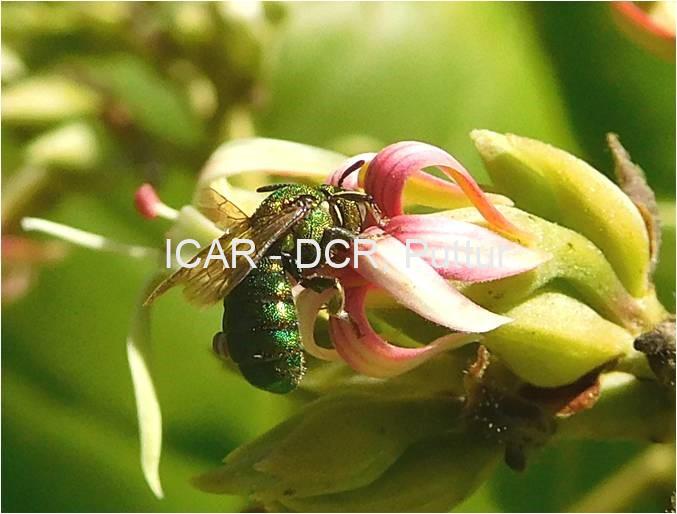
Eight species of bees belonging to Apidae and five species belonging to Halictidae are the important polliantors of cashew at Puttur, Karnataka.
Honey bees
The family Apidae family contains the highly social bees as well as some solitary and communal species. It is the largest family containing around 5,700 species of bees including honeybees, carpenter bees, orchid bees, cuckoo bees and other smaller stingless native bees.
Honey bees (Apis)
Honey bees are eusocial insects, have overlapping generations, cooperative brood care and reproductive castes.
Apis cerana indica (Apidae: Hymenoptera) (Indian hive bee/ Asian bee)
Indica are the domesticated species and are native of India/Asia, found almost throughout India. Adult bee is black in colour with four yellow abdominal stripes. Though, various regional strains exist, hill and plain strains are the two recognized ones. Worker bees of the plains are comparatively smaller and yellower, but at high altitudes, larger and darker bees are found. If there is abundant food resources and large colony size, swarming takes place. These bees are larger than A. florea, but smaller than A. mellifera.
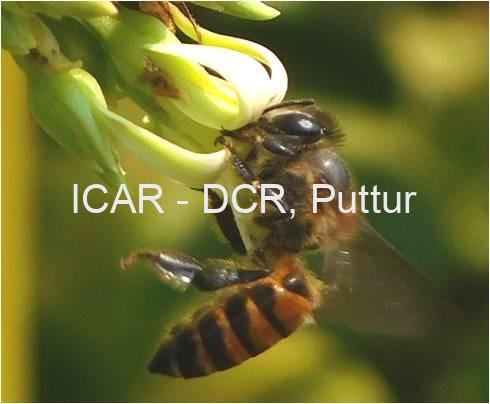
It is a common bee species visiting cashew flowers. Its activity can be noticed from early morning (8.00 am onwards depending on sun shine) till 6.00 pm. Its main foraging reward is nectar. It forages more on fresh flowers, but also visit one and two days old cashew flowers for nectar. When the bees sit on the flower petals, the anthers of long stamen in male flowers comes into contact with abdomen of the bees most of the times (Fig. 9), thereby pollen grains get adhered on its body parts which further get transferred to stigma of the hermaphrodite flowers upon subsequent visits by the bees, thus ensuring pollination.
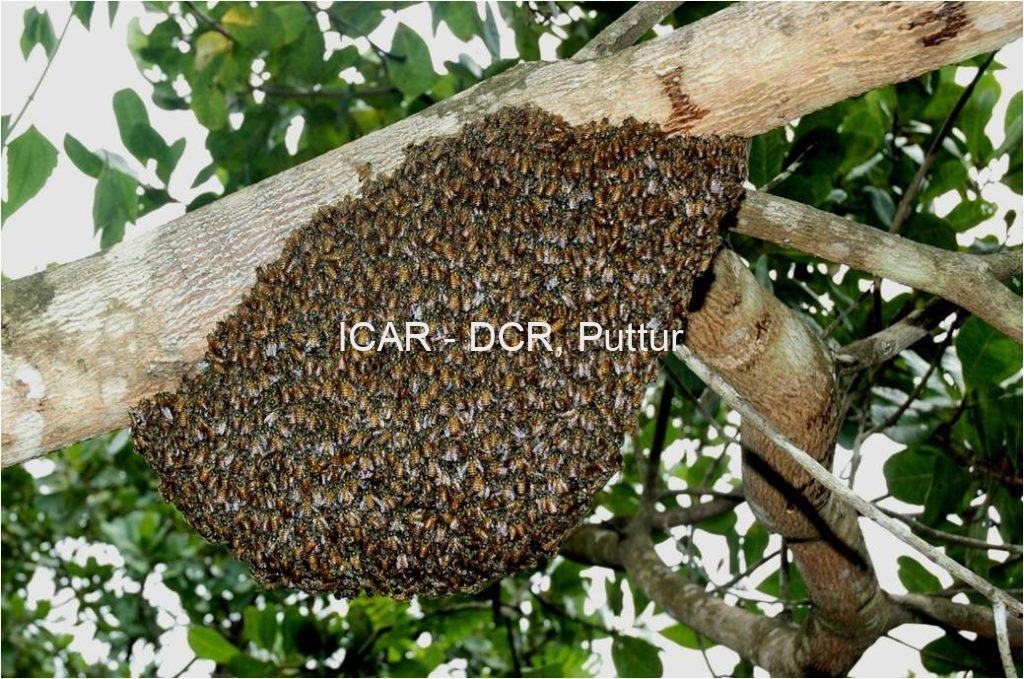
Cerana indica colony on a cashew tree branch and the bee foraging on the flower.
Apis florea (Apidae: Hymenoptera) (Little bee / Dwarf honey bee)
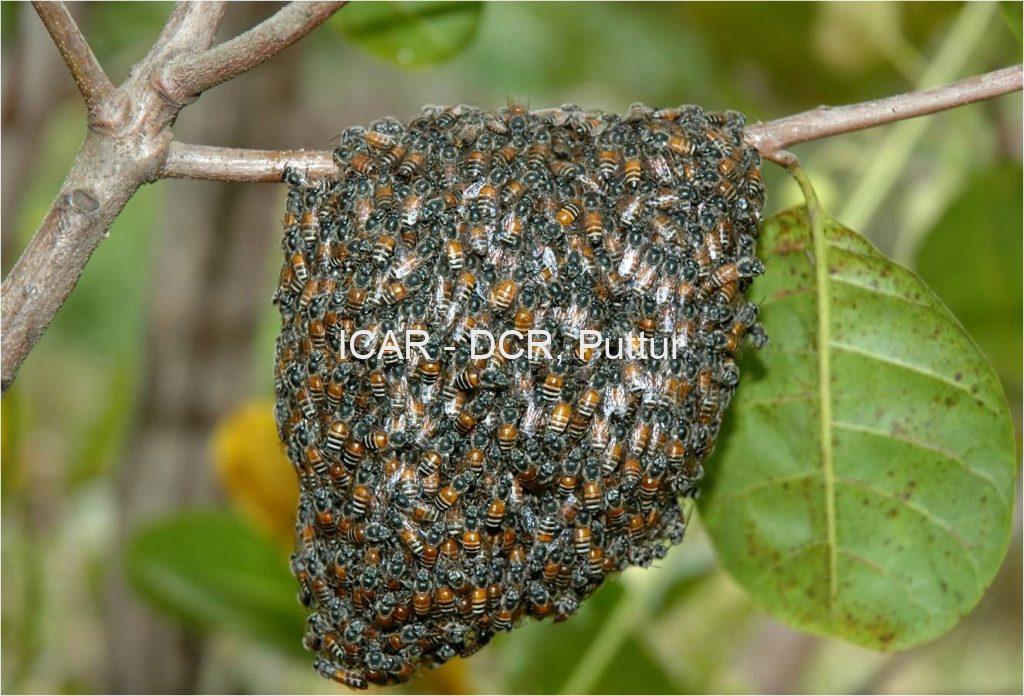
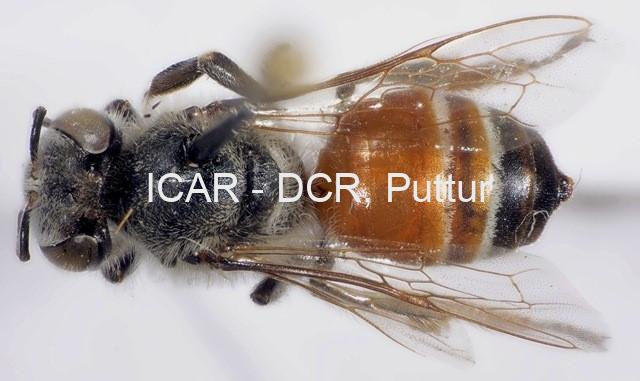
A. florea build a single-comb nest, vertical, usually fairly low down in bushes, or in the open, suspended from a branch. Their nests are small, often not larger than 150-200 cm wide. They also construct comb in branches of bushes, hedges, buildings, caves, empty cases etc. This bee species is not rearable as it frequently changes its nesting place. Bees exhibit frequent foraging and long migration range. They tend to build combs at lower elevations, away from direct sunlight and on the peripheral side of plant branches. This species visits cashew flowers from early morning to afternoon hours, but mainly for nectar.
Colony of A. florea on cashew twig and a worker bee
Apis dorsata Fab. (Apidae: Hymenoptera) (Rock bee/ Giant honey bee)
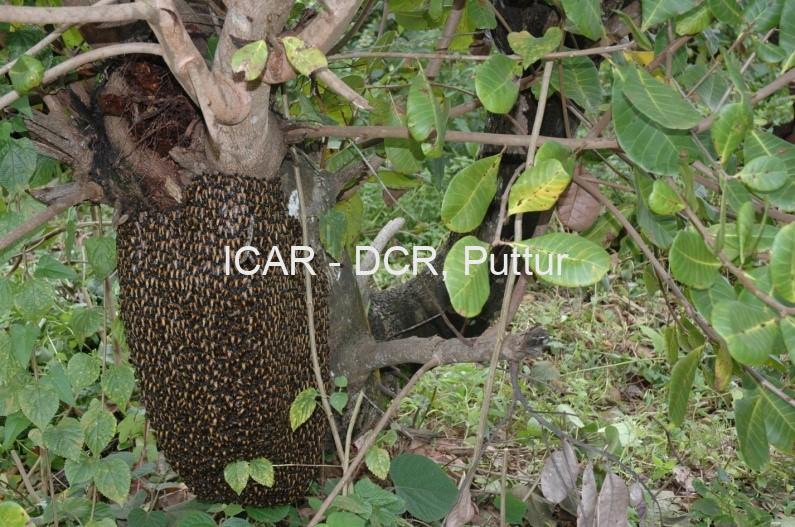
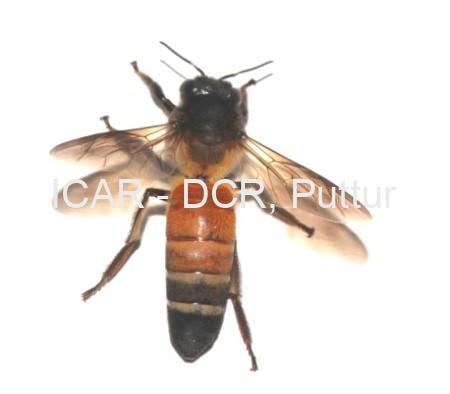
A. dorsata has a widespread distribution throughout southern Asia, and is not found in North America. These honey bees build a single, large, exposed comb under tree branches, high hedges, under cliffs, rather than in cavities. These bees are highly ferocious and are very difficult to rear. These bees are the largest among the bees described. Compared to A. melliferaworkers, A. dorsata seems to live significantly longer, especially during migration. Some of the major crops thought to be heavily dependent upon A. dorsata pollination include: cotton, mango, coconut, coffee, pepper, star fruit, and macadamia. Its visits are very rare on cashew flowers, hence could not be important pollinators.
Colony of A. dorsata on cashew tree trunk and the worker bee
Apis mellifera (Apidae: Hymenoptera) (European bee / Italian bee/ Western bee)
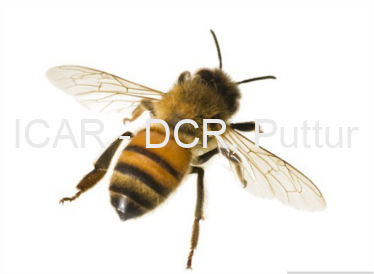
A. mellifera is indigenous to Africa, Europe and the Middle East and largely introduced in to other parts of the world. They are bigger than cerana but smaller than A. dorsata. A. mellifera are red/brown with black bands and orange yellow rings on abdomen i.e., three abdominal stripes but comparatively less pronounced than A. cerana. There are different races of A. mellifera, vary in sizes of individual bees and colonies. Like A. cerana, they also build parallel combs. They are less prone to swarming and absconding. This particular species is reported as major bee species visiting cashew in east coast region of India especially Tamil Nadu and also in Brazil and parts of Africa, but not found in Puttur, Karnataka.
A. mellifera
Stingless bees: Tetragonula sp. (Apidae: Hymenoptera) (Stingless bees/ Dammer bees)
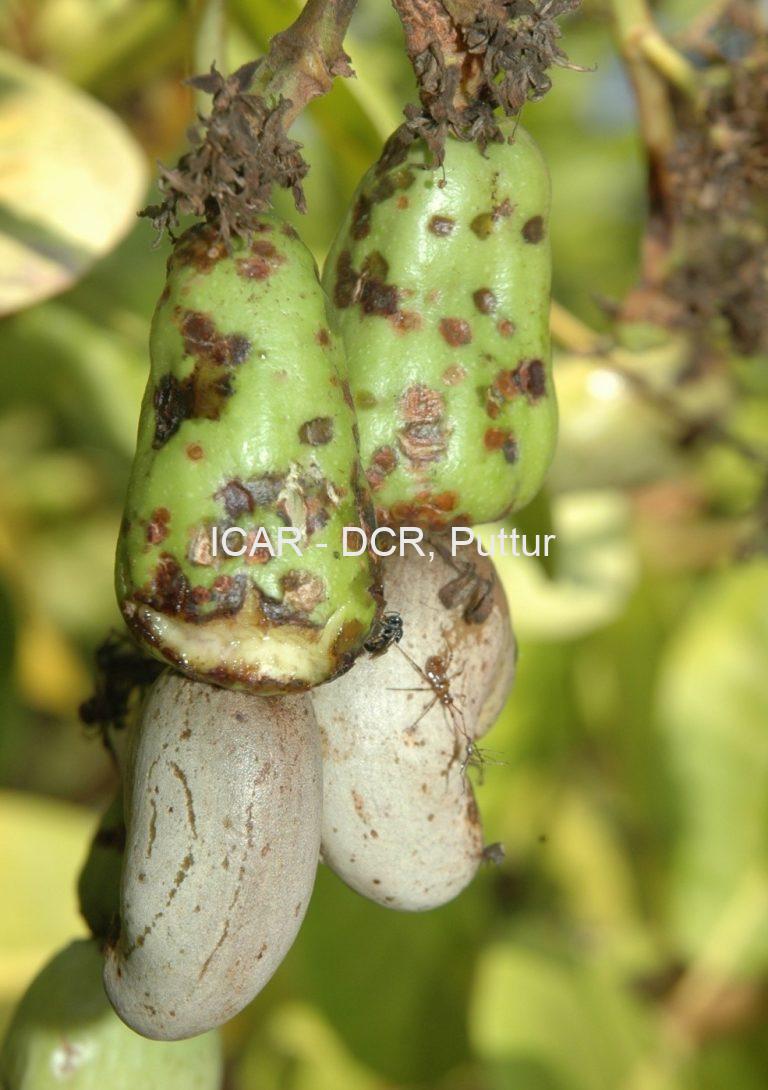
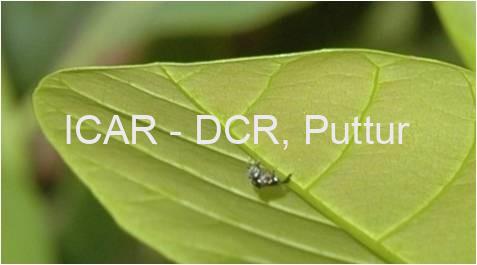
Tetragonula species are stingless and are harmless to human. They are the smallest of the honey-yielding bees. The entire body is black to blackish-brown. These bees build irregular combs of wax and resinous substances in crevices and hollow tree trunks. Bees collect nectar and pollen from a number of different flowers. They do not sting, but bite their enemies or intruders. It can be domesticated, however the average honey yield per hive per year is very less and the extraction of honey is difficult. This bee species visits cashew early in the morning and forages till evening. Collects lot of pollen grains during early flowering period. Also forage on leaves, inflorescences, developing nuts and fruits mostly for extra floral nectarines (Fig.). During fruiting season, the bees also collect juice from the cracks of matured and ripe cashew apples.
Tetragonula sp. collecting fruit juice from cashew apple and nectar from extra floral nectarines of cashew leaf Tetragonula sp.
Wild bees/ Native bees
Braunsapis sp. (Apidae: Hymenoptera)
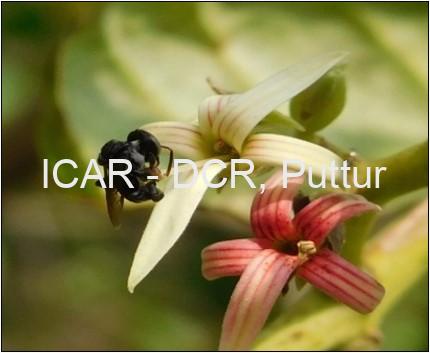
Braunsapis is a genus of bees in the tribe Allodapini. It is the largest genus of the tribe and is known for its array of social behaviours. A total of 14 species of Braunsapis have been recorded from India. Braunsapis bees are quite lean and black, and are less than 1 cm in length. There are some species having red abdomen or light colour. Females have a sting, but they are not aggressive and sting only if handled. These species are solitary and nest in stems and twigs, preferably pithy stems. There is continuous brood production throughout the year, but relatively more broods are present from September to March. These tiny bees forage on cashew flowers by its characteristic short vibrant movements. Many a times, bees land on the anther lobes directly and collect pollen grains and then move towards the flower base for collecting nectar.
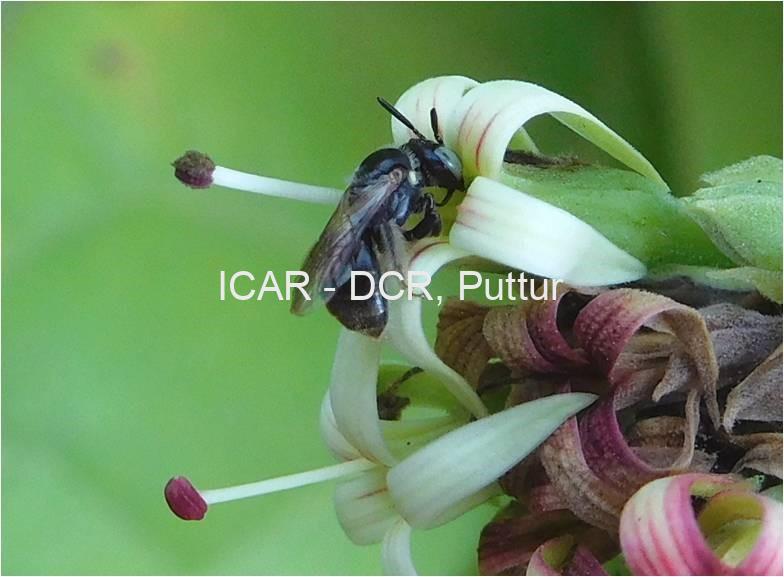
Ceratina hieroglyphica Smith (Apidae: Hymenoptera): Small carpenter bee
Ceratina hieroglyphica is also a predominant bee species visiting cashew flowers in the Indian subcontinent. It is a stem nesting bee, exhibiting subsocial nature. No distinct longitudinal impression is seen in the clypeus of C. hieroglyphica. It is commonly seen on cashew flowers at Puttur region. This bee also makes nests in hollow or pithy stems. Nests of these bees can be located in cashew and Mussanda. The bee collects lot of pollen grains so as to feed its larva.
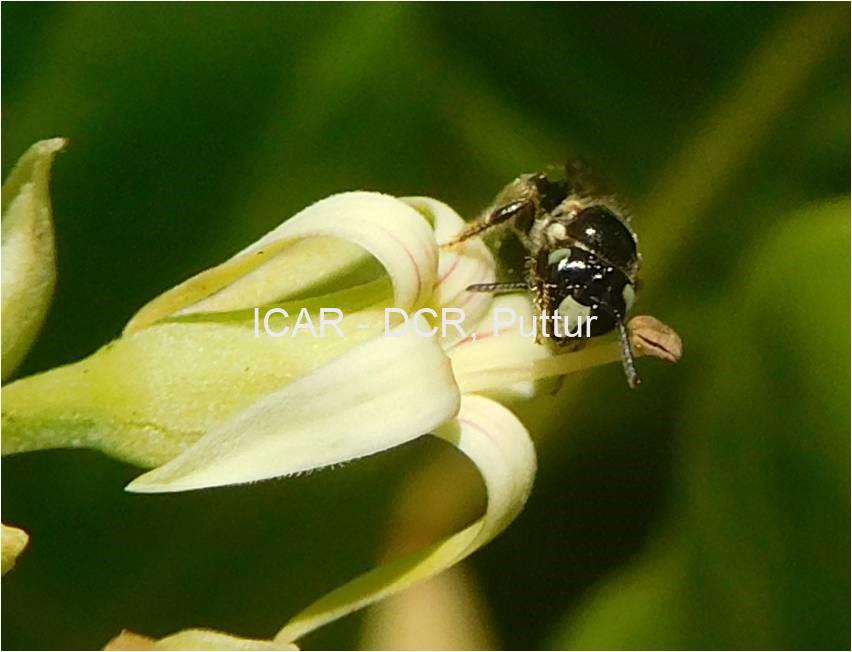
Braunsapis picitarsus (Cameron) (Apidae: Hymenoptera)
This is the most common bee visiting cashew in Puttur region. Male bees are simple, black and usually have yellow or white spot on the clypeus. This is the most abundant bee species visiting cashew flowers at Puttur. The peak foraging activity occurs between 10:00 am and 1:00 pm. Nests of B. picitarsus are commonly found in dry tiny sticks as well as pruned cut ends of cashew and Mussanda sp.
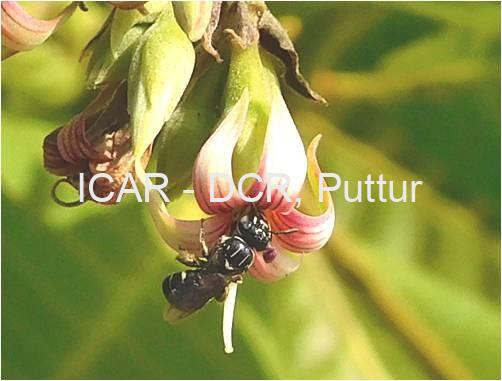
Ceratina binghami Cockerell (Apidae: Hymenoptera)
This species is slightly more bluish than the other closely related species. The female bees resemble that of C. smaragdula so much, but not the males. Bees are bright metallic green in colour, partly slightly golden green; with more bluish sixth abdominal tergite. Yellow spot is present in the clypeus region. The bees nest in hollow reeds and thatch, excavate tunnels in dried pithy branches of trees. Its nests are also located inside the pruned cut ends of dried cashew stems.