Report of Intensive Awareness Campaign for the Adoption of Science Based Nutrient and Other Input Management
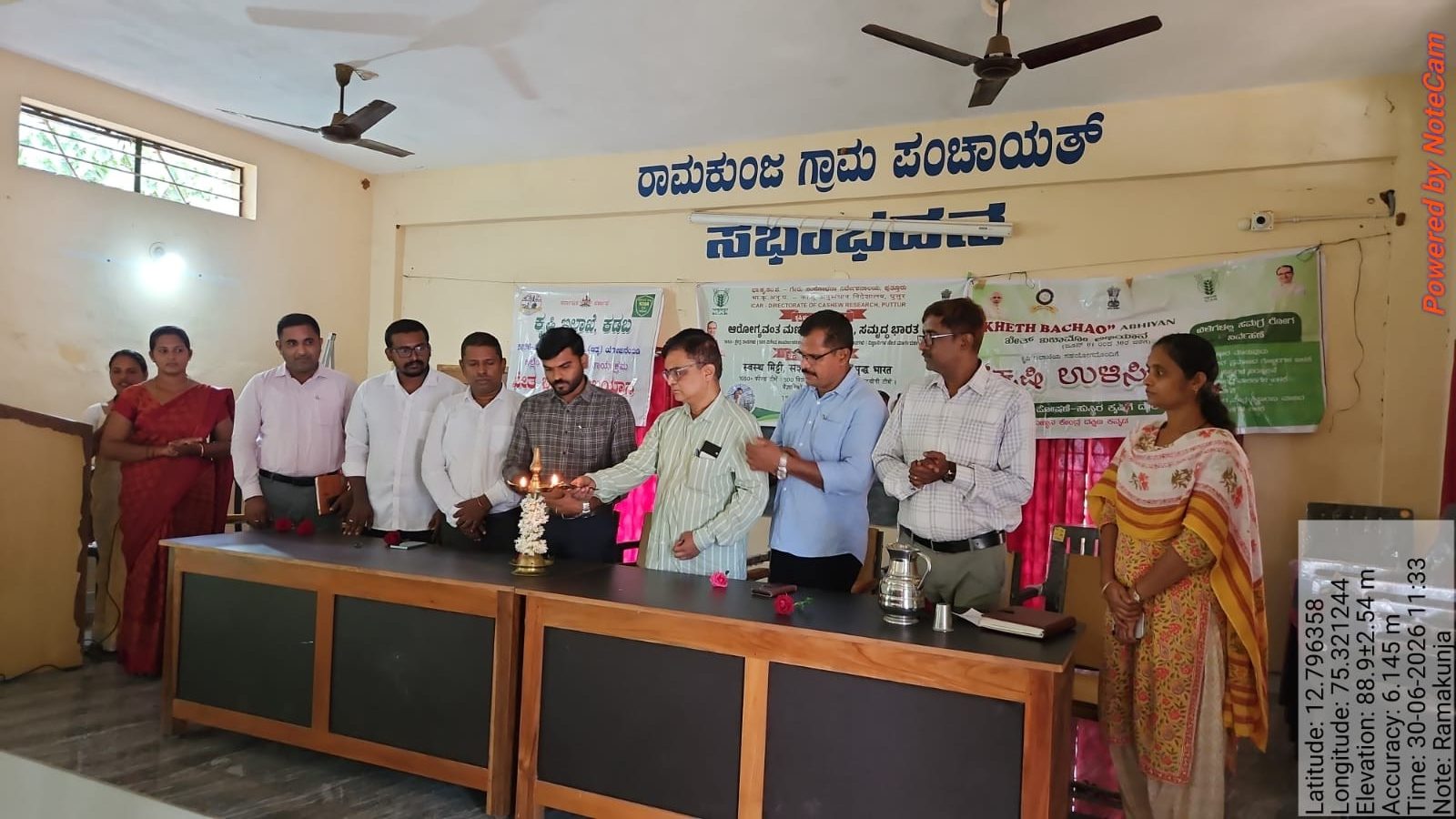
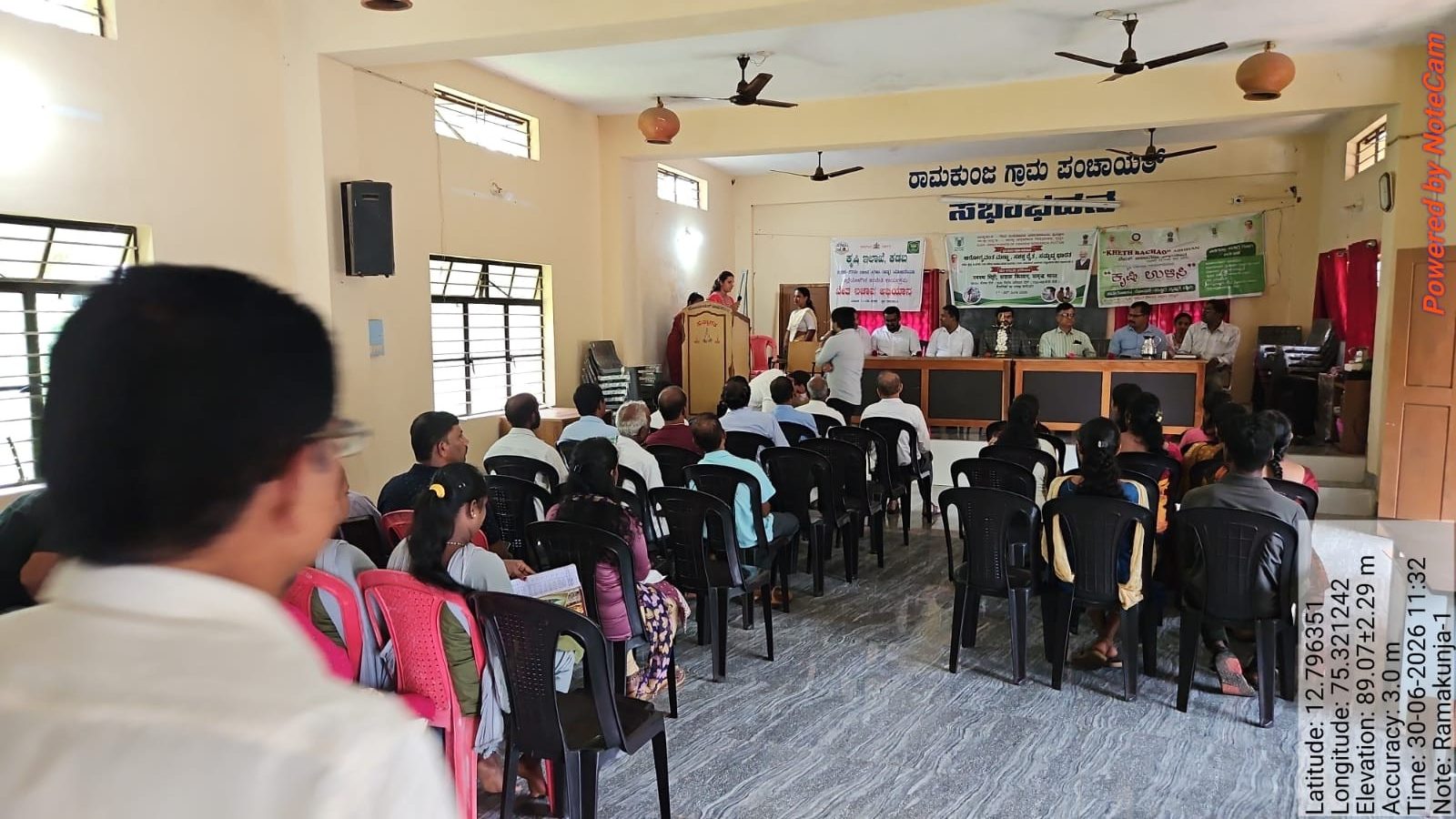
As part of the National Campaign on Khet Bachao Abhiyan, a field-level awareness programme was organized at Ramakunka, Dakshina Kannada district, Karnataka, to promote scientific and balanced nutrient management practices and encourage the adoption of vermicompost, biofertilizers, and green manuring for the restoration and conservation of soil fertility. The programme was conducted by a team of scientists comprising Dr. Venkatesh M.S., Principal Scientist (Team Leader), Dr. Vanitha K., Senior Scientist (Team Member), and Dr. Manjunatha K., Scientist (Team Member), in collaboration with officials from the Department of Agriculture, including Mr. Chaluvarangappa, Assistant Director of Agriculture (ADA) and Mr. Yashas, Agriculture Officer, as well as officials from KVK Mangalore, namely Dr. Ramesh, Head, KVK Mangalore, and Mr. Dharanish, Subject Matter Specialist (SMS), KVK Mangalore. The programme commenced with an introductory address by Mr. Chaluvarangappa, Assistant Director of Agriculture (ADA), who outlined the objectives of the campaign and emphasized the importance of balanced and judicious fertilizer application for sustainable crop production and long-term soil health. He also highlighted the role of green manure crops in plantation systems and explained the various schemes offered by the Department of Agriculture for the benefit of farmers.
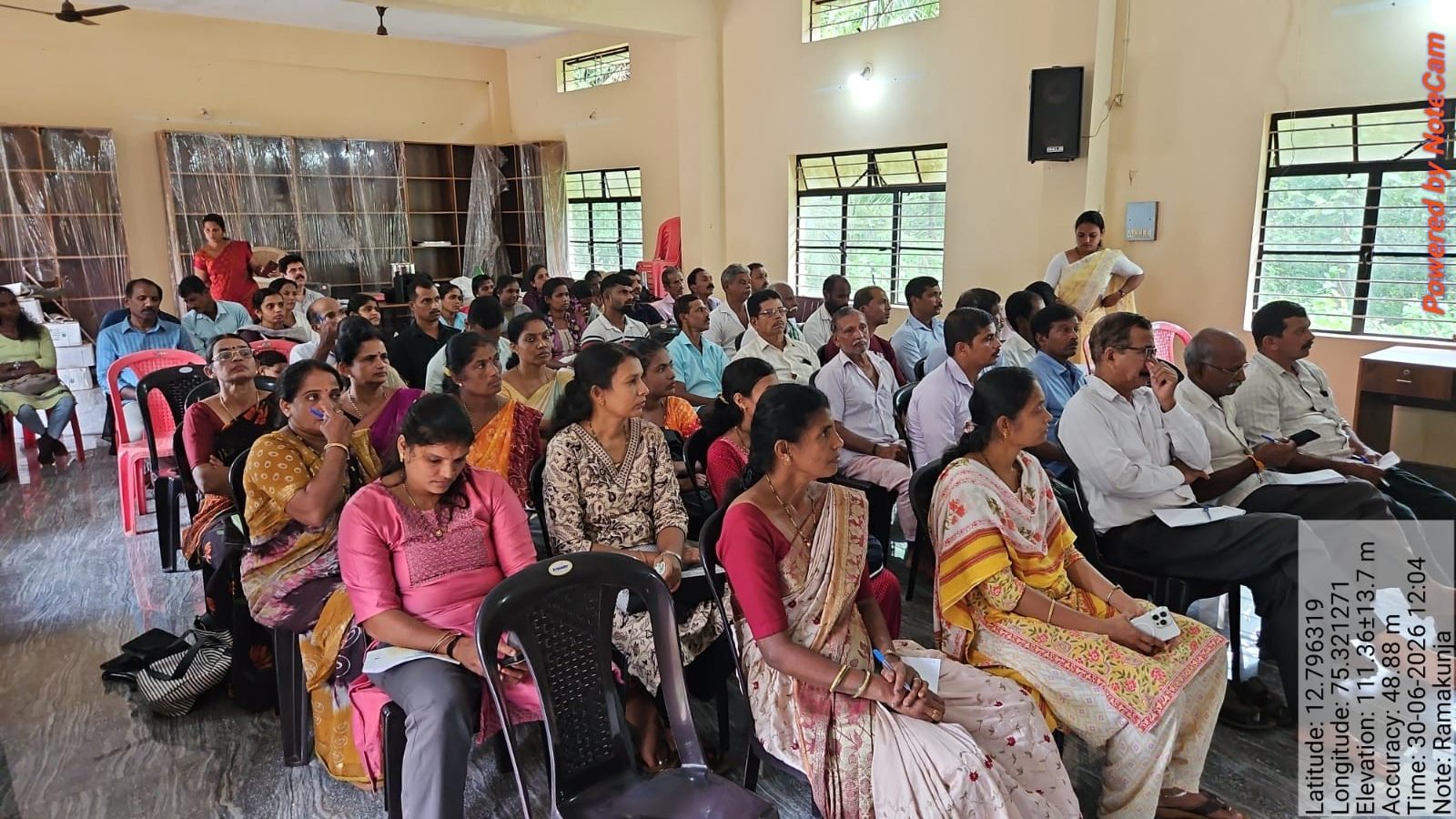
Dr. Venkatesh M.S. delivered a technical session on the importance of soil testing, standard procedures for soil sample collection, interpretation of soil test reports, and soil test-based fertilizer recommendations, with special emphasis on efficient nutrient management in cashew orchards. Dr. Vanitha K. discussed the integrated management of major insect pests in cashew and explained the safe and judicious use of plant protection chemicals, including essential precautionary measures during pesticide application. Dr. Manjunatha K. presented the improved cashew varieties suitable for cultivation, opportunities for value addition of cashew apple, and the mechanization technologies developed for cashew processing, particularly the cashew apple and nut separation machinery. He also briefed the participants on the activities and entrepreneurial support provided through the institute’s Agri-Business Incubation (ABI) Centre. The programme was attended by 76 participants, including 44 male farmers and 32 female farmers, who actively participated in the technical discussions and interacted with the experts on various aspects of cashew cultivation and soil health management.
Organizing Institute: ICAR-Directorate of Cashew Research, Puttur, Karnataka
Scientific Team: Dr. Balasubramanian D, Principal Scientist, ICAR-DCR, Puttur, Karnataka
Dr. Babli Mog, Senior Scientist, ICAR-DCR, Puttur
Dr. Veena G L, Senior Scientist, ICAR-DCR, Puttur
Dr. Bhagya H P, Scientist, ICAR-DCR, Puttur
Date of programme: 25.06.2026
State: Karnataka
District: Dakshina Kannada
Village name: Kudipadi
Number of participants:32 (Male -9 Femele-23)
Awareness programmes undertaken during visit:
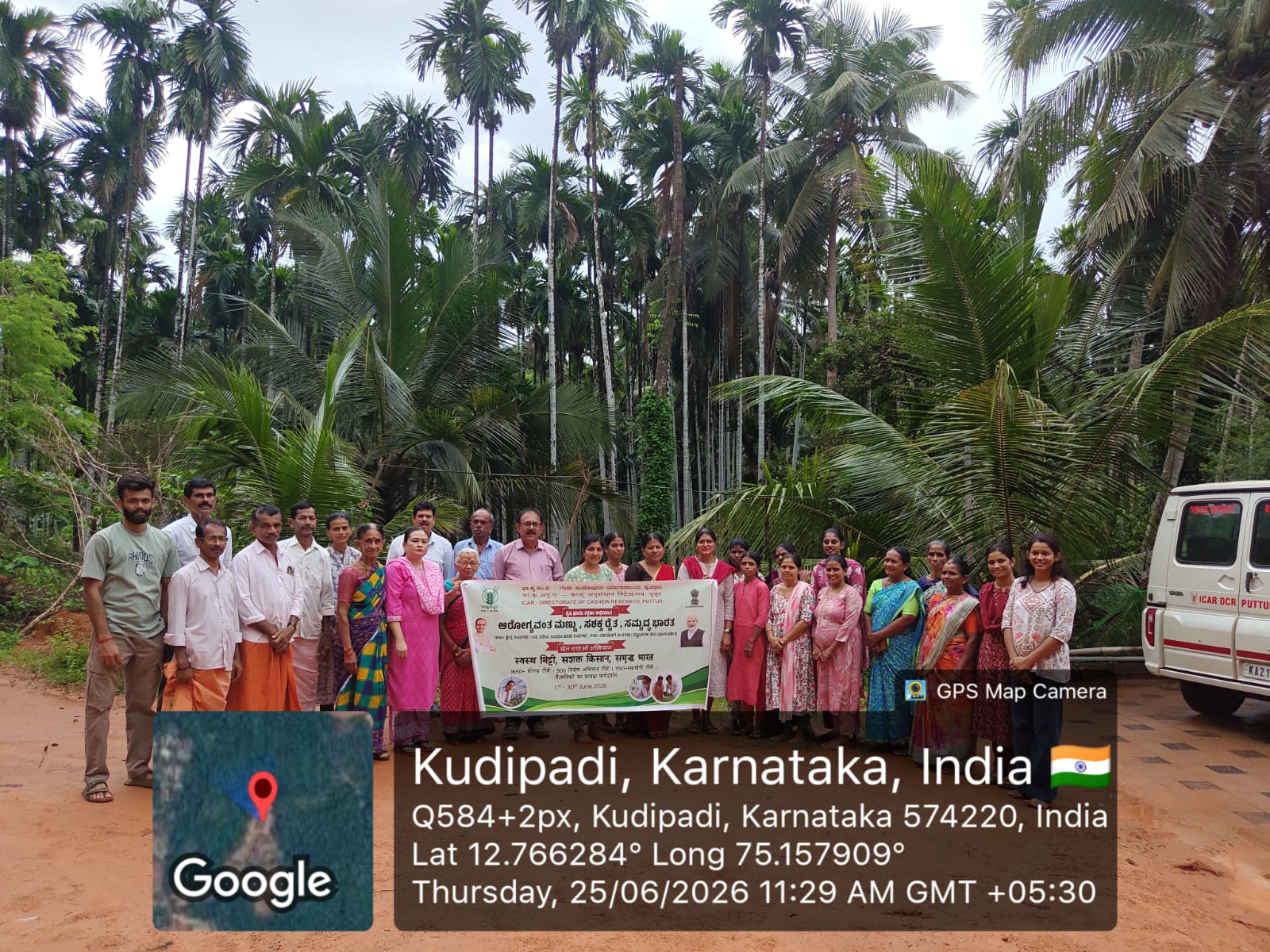
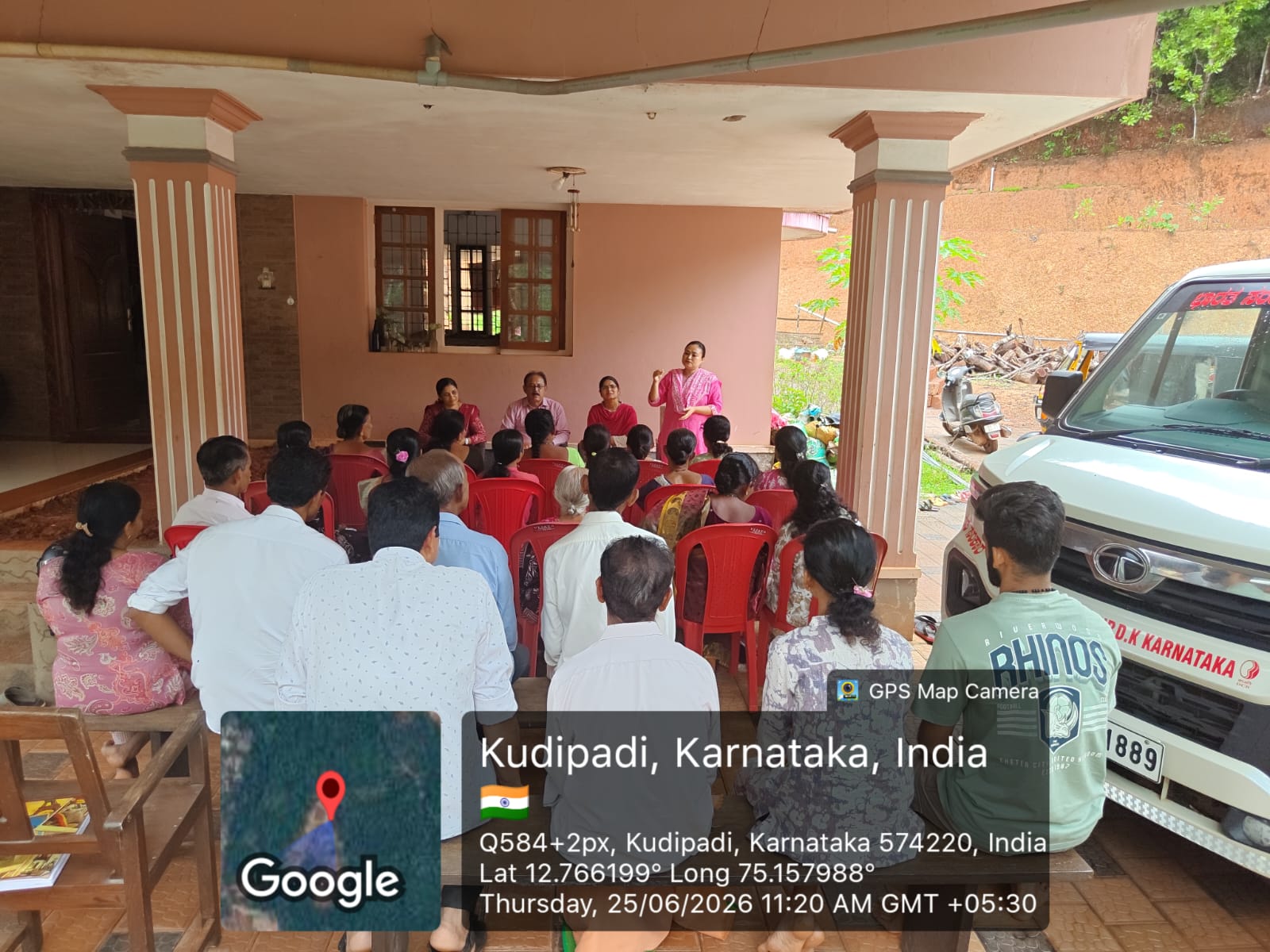
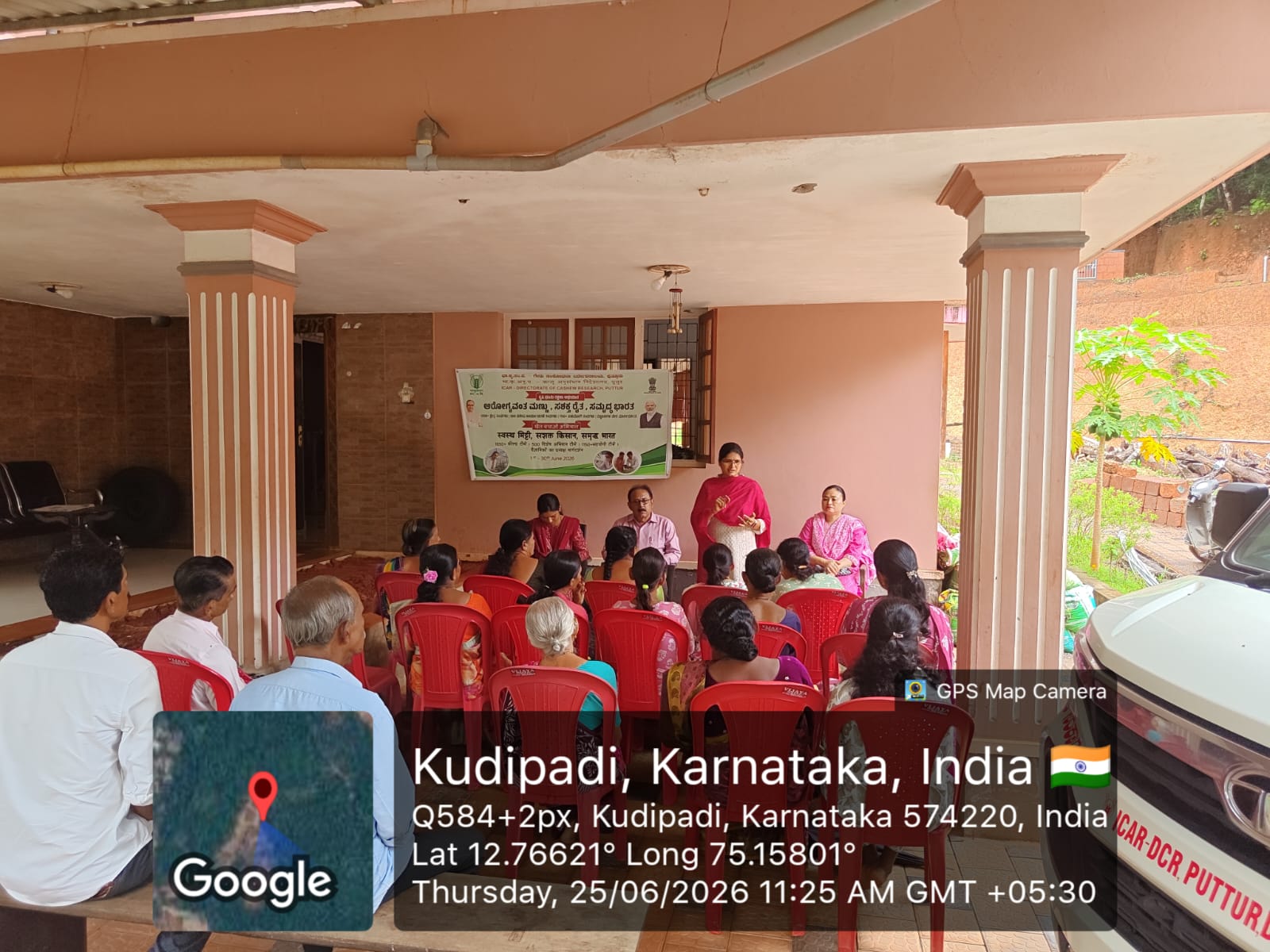
An awareness campaign under the Khet Bachao Abhiyan was successfully conducted at Kudipadi Village in Puttur, Karnataka. The programme focused on creating awareness among farmers about the importance of maintaining soil health and adopting sustainable agricultural practices. During the campaign, the significance of soil as a vital natural resource was emphasized, highlighting its crucial role in ensuring long-term agricultural productivity and environmental sustainability. Farmers were sensitized to the benefits of using organic inputs such as farmyard manure, green manure, vermicompost, compost, biofertilizers, mulching materials, and other organic amendments for improving soil fertility, enhancing microbial activity, conserving moisture, and reducing dependence on chemical fertilizers.
The resource persons stressed that protecting soil health today is essential for securing the future of agriculture. Participants were encouraged to adopt integrated soil management practices to maintain soil quality, enhance crop productivity, and promote ecological balance. The campaign also highlighted the close relationship between healthy soil, healthy crops, healthy food, and healthy life, reinforcing the message that soil conservation is fundamental to sustainable farming and the well-being of future generations. The programme witnessed active participation from farmers, who interacted enthusiastically and expressed their commitment to adopting soil-friendly agricultural practices. The campaign successfully disseminated knowledge on sustainable soil management and contributed to strengthening awareness regarding the conservation and protection of agricultural lands.
During the awareness campaign, farmers were advised to adopt soil test-based fertilizer application for their crops to ensure balanced nutrient management and to minimize the adverse effects of indiscriminate fertilizer use on soil health. The importance of applying fertilizers according to soil nutrient status was emphasized as a key strategy for maintaining soil fertility, improving nutrient-use efficiency, reducing input costs, and enhancing crop productivity in a sustainable manner. A practical demonstration on scientific soil sampling methodology was conducted in the field. Farmers were trained on the proper procedures for collecting representative soil samples, including the selection of sampling locations, sampling depth, collection techniques, sample processing, labeling, and submission for laboratory analysis. The demonstration enabled participants to understand the importance of accurate soil testing for making informed nutrient management decisions. An interactive session was also organized on the management of horticultural crops, with special emphasis on cashew cultivation practices, including nutrient management, canopy management, soil and water conservation measures, pest and disease management, and sustainable production techniques. Farmers actively participated in the discussions and sought clarifications on various aspects of crop management. The programme received an encouraging response from the farming community. All participating farmers expressed their appreciation for the awareness campaign and found the information shared to be practical and beneficial for improving farm productivity and soil health. The interactive nature of the programme facilitated effective knowledge exchange and strengthened farmers’ awareness regarding sustainable agricultural and horticultural practices.
Number of participants: 27 (M:24, F: 03)
Interaction with the input dealer: No
Interaction with Panch / Sarpanch: No
Awareness programmes undertaken during visit: Khet Bachao Abhiyan
Any demonstration of green manuring: No
Biofertilizers: No
Any Local Learning/Observation Recorded: It was observed that only a limited number of farmers had adopted vermicomposting practices. Some farmers were found to be utilizing gobar gas slurry/sludge as an organic nutrient source in their farming systems, indicating awareness of sustainable nutrient management practices and the potential for wider adoption of organic waste recycling technologies.
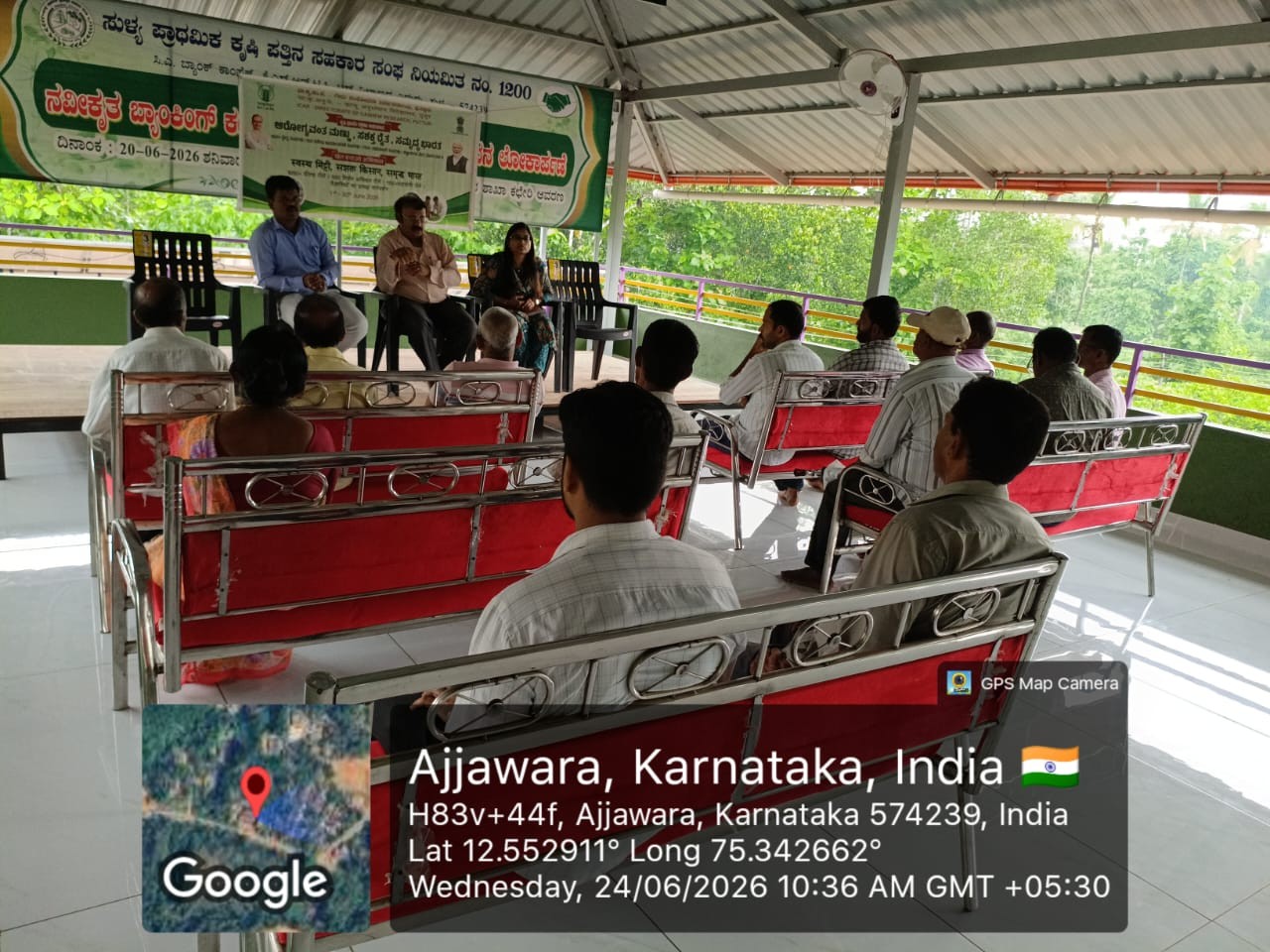
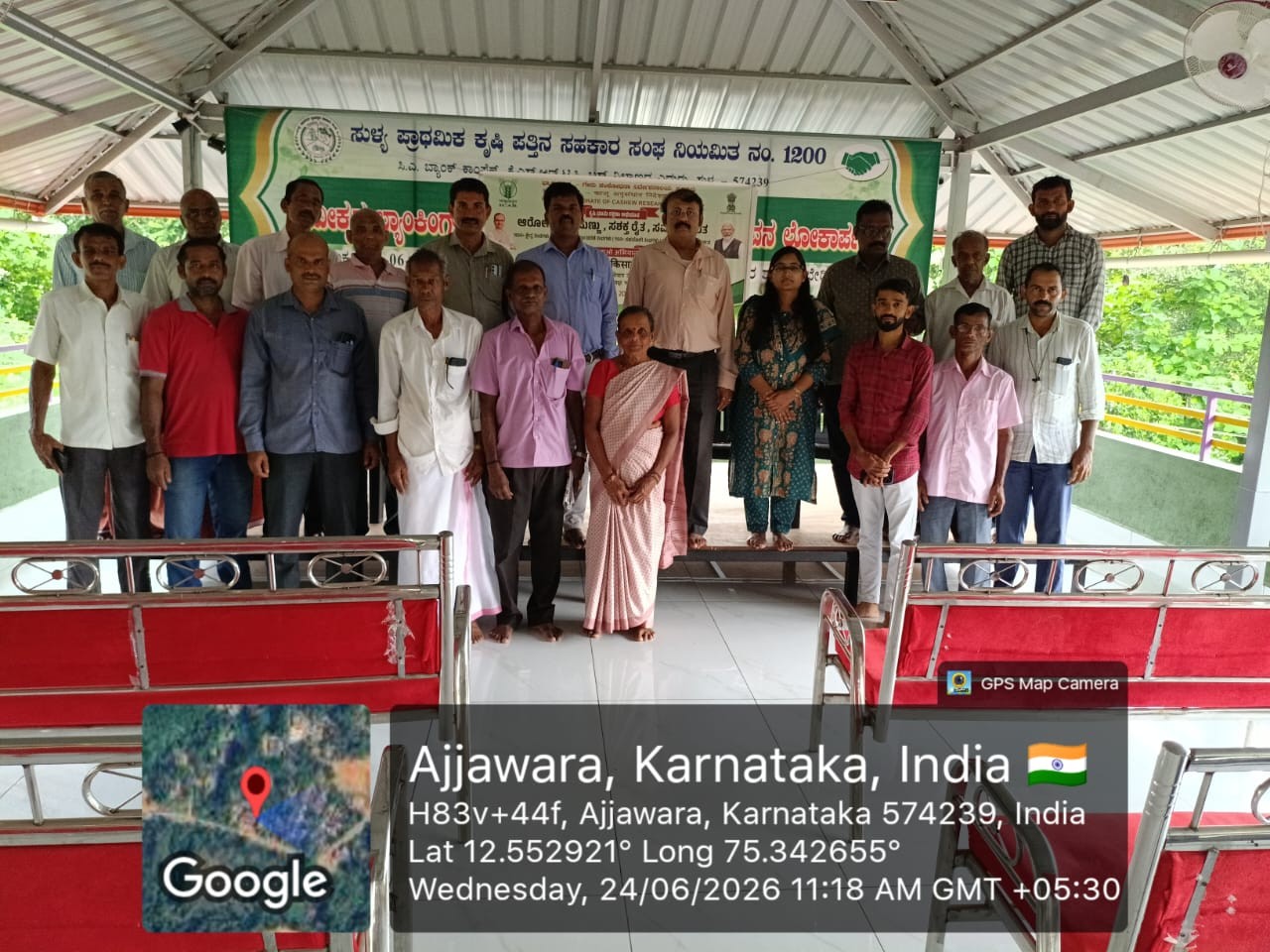
A farmer awareness programme under the Khet Bachao Abhiyan was organized at Ajjawara, Sullia, on 24 June 2026 to promote sustainable nutrient management practices and judicious use of agricultural inputs in horticultural crops. The programme aimed to enhance farmers’ understanding of scientific nutrient management strategies for improving soil health, increasing crop productivity, and ensuring long-term agricultural sustainability.
The programme commenced with a welcome and introductory session by Dr. T. N. Raviprasad, who outlined the objectives of the campaign and highlighted the growing importance of maintaining soil fertility through sustainable farming practices. He emphasized the need for adopting scientific and environmentally responsible approaches to crop production. Dr. Rajashekara H. and Dr. Jyoti Nishad elaborated on key principles of nutrient stewardship in horticulture. The experts discussed the importance of soil testing for determining crop nutrient requirements, balanced fertilizer application, integrated nutrient management, and efficient utilization of farm resources. They also explained how these practices can improve nutrient use efficiency, reduce input costs, and sustain soil productivity over time. Importance and opportunity in cashew apple value addition was also discussed during the program.
An interactive session followed, during which farmers shared their experiences and sought clarification on issues related to fertilizer management and crop nutrition. The resource persons addressed their queries and provided practical guidance on appropriate fertilizer selection, timing of application, and maintenance of soil fertility through regular soil testing. The discussion also focused on reducing nutrient wastage and limiting excessive agrochemical use to protect both soil and environmental health.
The programme witnessed the participation of 27 people, comprising 24 male and 03 female participants. The attendees actively engaged in the discussions and appreciated the information shared by the experts. The programme concluded with a vote of thanks acknowledging the contributions of the resource persons and the enthusiastic participation of the farmers.
[Organisers: Dr TN Raviprasad, Dr. Rajashekara H. and Dr Jyoti Nishad].
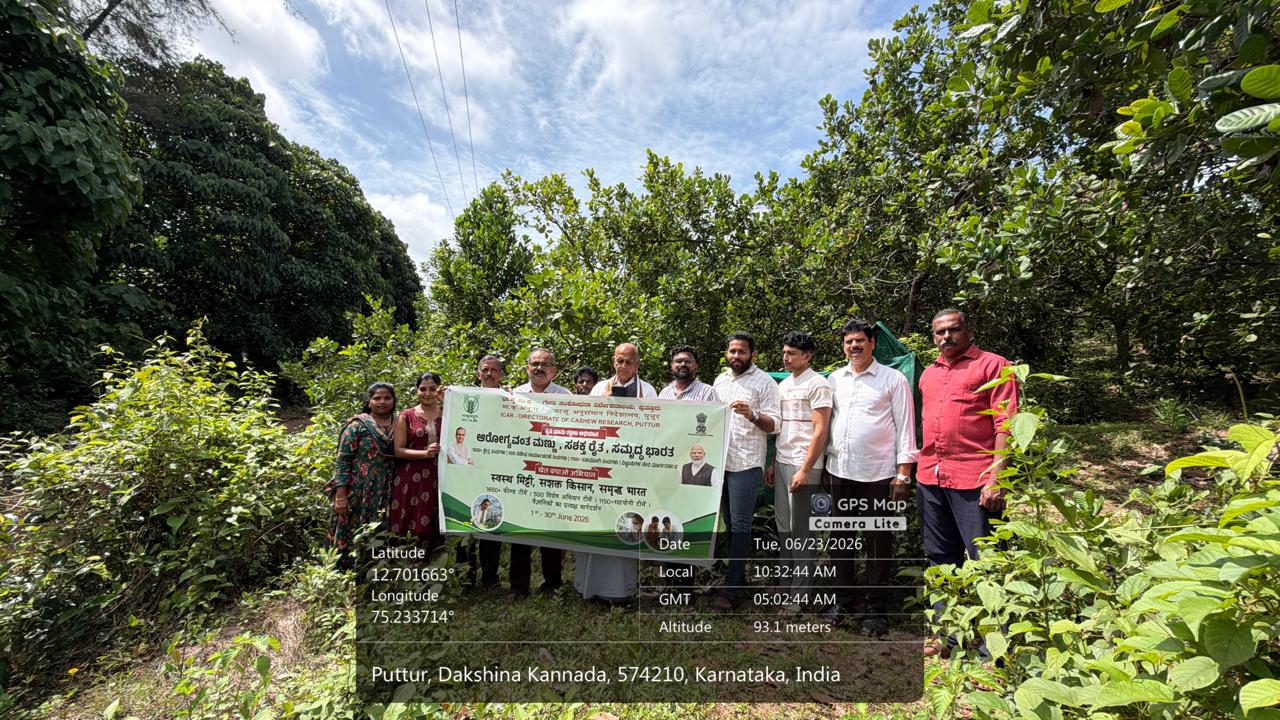
An awareness program on the above subject was conducted at Olamogru, Perpunja Village, Puttur Taluk, Dakshina Kannada District, Karnataka on 23.06.2026. The program commenced with a brief introduction about the objectives of the Khet Bachao Abhiyan campaign.
The program focused on the importance of soil testing, scientific methods of soil sample collection, and soil test-based nutrient management for improving crop productivity. Farmers were also sensitized about the scope of cashew apple value addition, profitable utilization of cashew apples through value-added products, and successful market examples of cashew apple juice.
An interactive discussion was held on the major problems faced by farmers in cashew cultivation and suitable recommendations and solutions were provided. Other relevant information related to cashew cultivation and management was also discussed with the farmers.
A total of 22 farmers (18 male and 4 female) participated in the campaign. In the end, the program concluded with a vote of thanks.
[Organisers:Dr. Mohana, G. S. Dr. Manjesh, G. N. Dr Thondaiman V ].
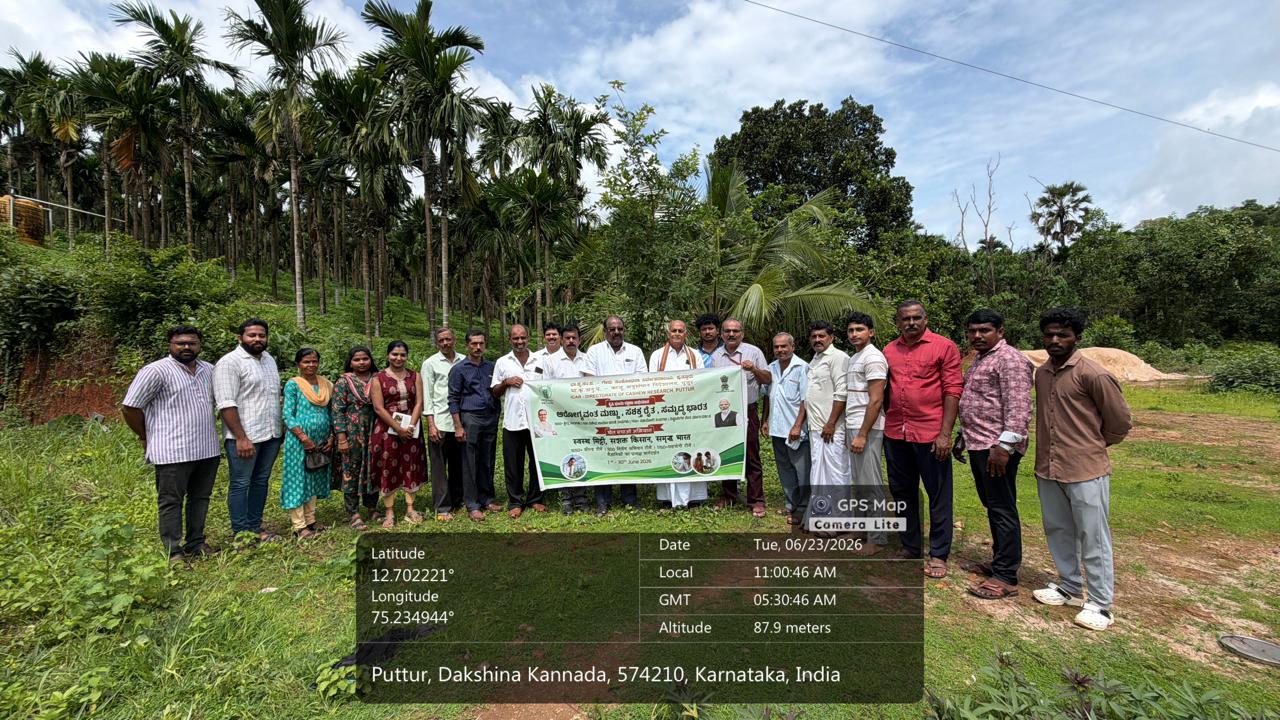
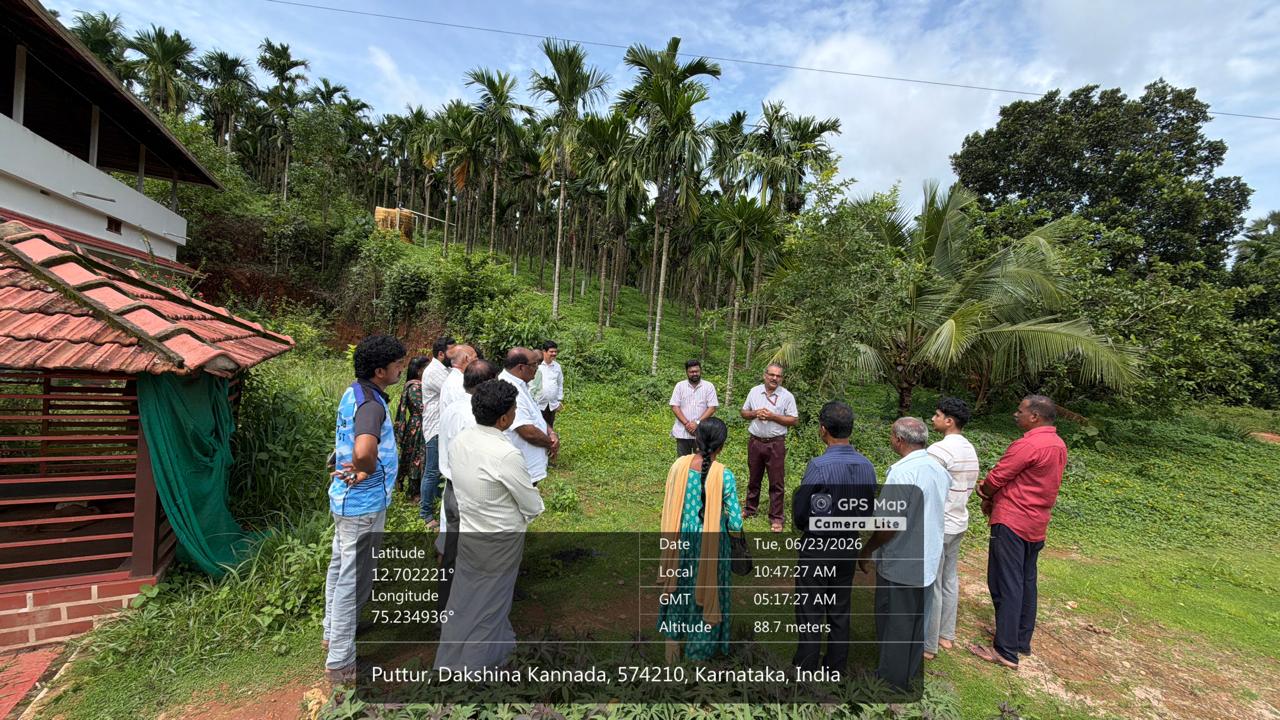
As part of the National Campaign on Khet Bachao Abhiyan, a field-level awareness programme was organized at Bisilumale, Alletty Village, Sullia, Dakshina Kannada district, Karnataka, with the objective of promoting scientific and balanced nutrient management practices and encouraging the adoption of vermicompost, biofertilizers, and green manuring for the restoration and conservation of soil fertility. The programme was conducted by a team of scientists comprising Dr. Venkatesh M.S., Principal Scientist (Team Leader), Dr. Manjunatha K., Scientist (Team Member), and Ms. Vijetha, YP-II. The programme commenced with an introductory address by Dr. Venkatesh M.S., who highlighted the objectives of the campaign and emphasized the significance of balanced and judicious fertilizer application for sustainable crop production and long-term soil health. He also elaborated on the importance of soil testing, standard procedures for soil sample collection, interpretation of soil test-based fertilizer recommendations, and appropriate nutrient dosage schedules for efficient cashew orchard management. This was followed by a field visit to a cashew orchard, where a method demonstration on scientific soil sample collection was conducted. Dr. Manjunatha K., discussed the major insect pests and diseases affecting cashew plantations and explained the recommended integrated management practices for their effective control. A practical demonstration on scientific soil sampling techniques was carried out by Mrs. Vijetha, YP-II (Soil Science), providing farmers with hands-on training on the proper methods of collecting representative soil samples. Soil samples from farmers’ fields were also collected for laboratory analysis to facilitate the preparation of location-specific nutrient management recommendations. A total of 18 participants attended the programme, comprising 16 male farmers and 2 female farmers.
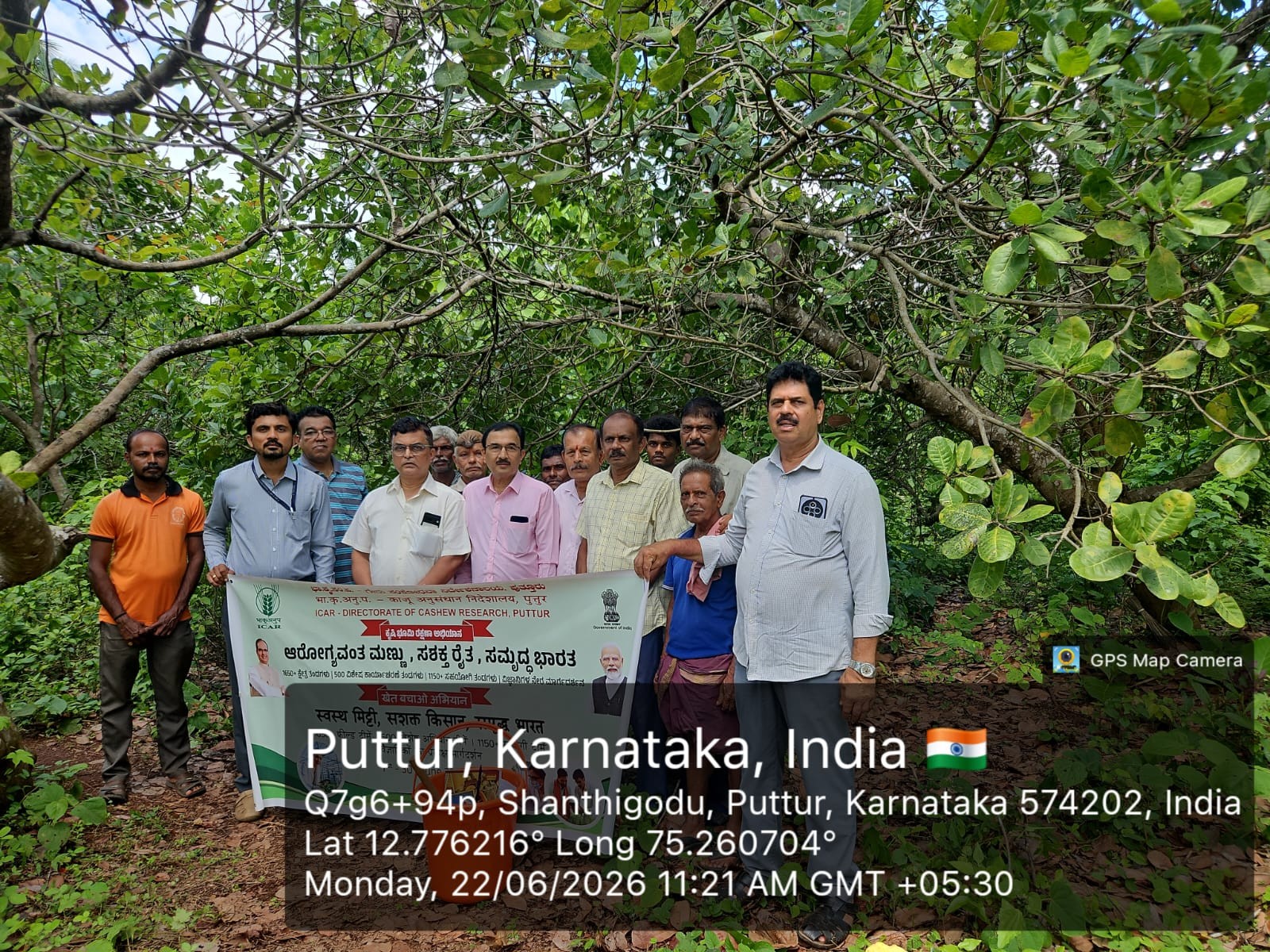
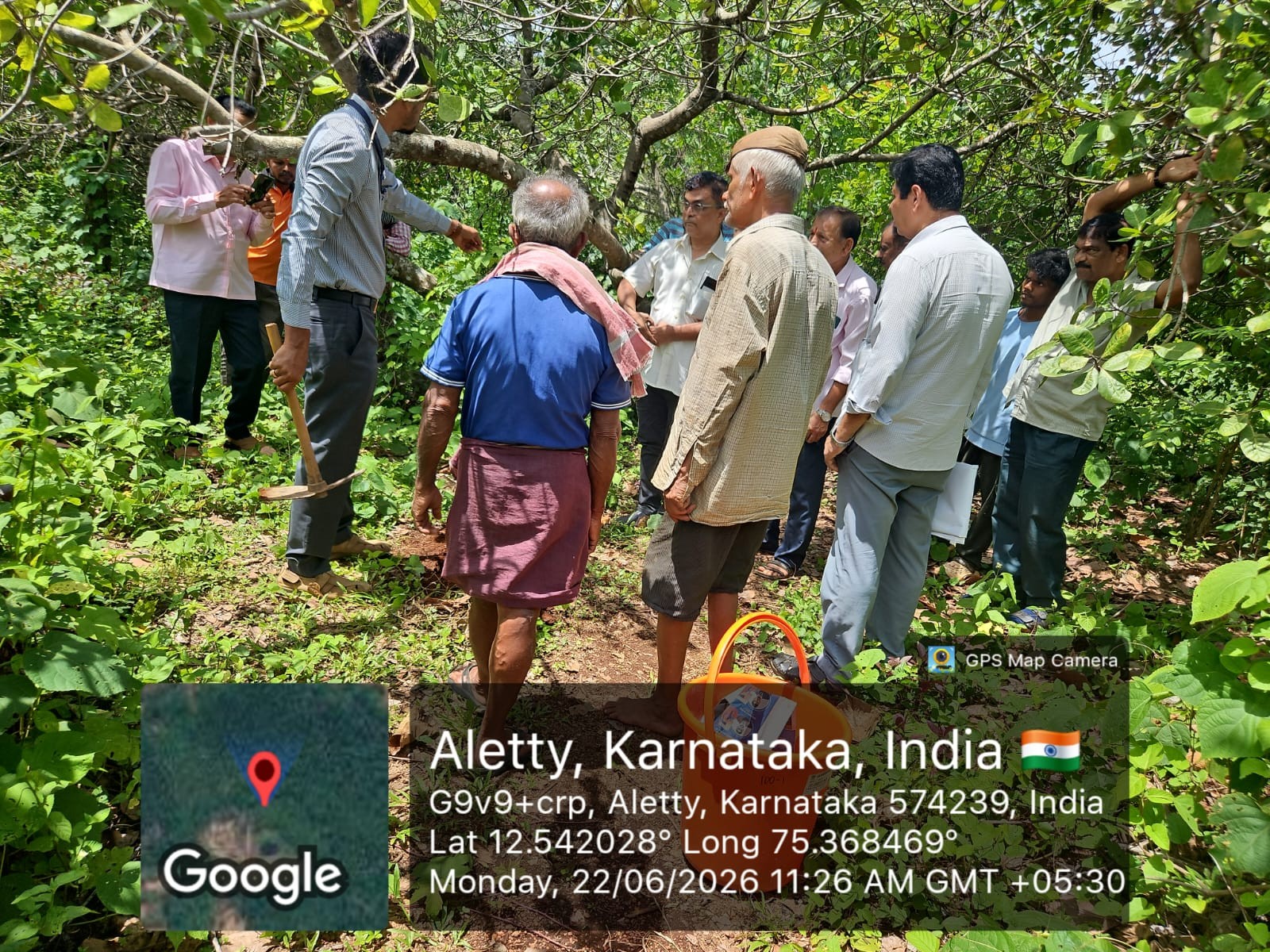
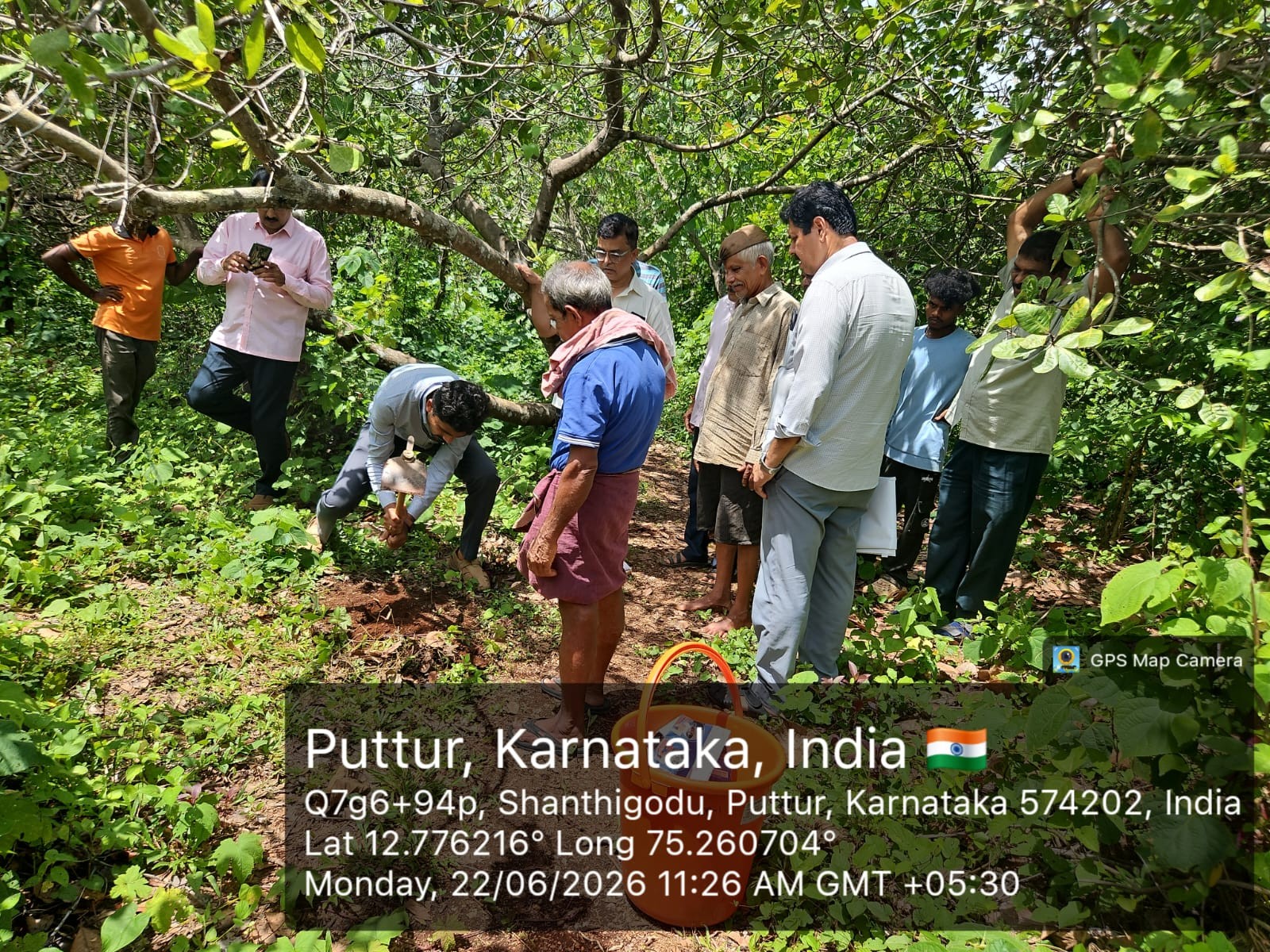
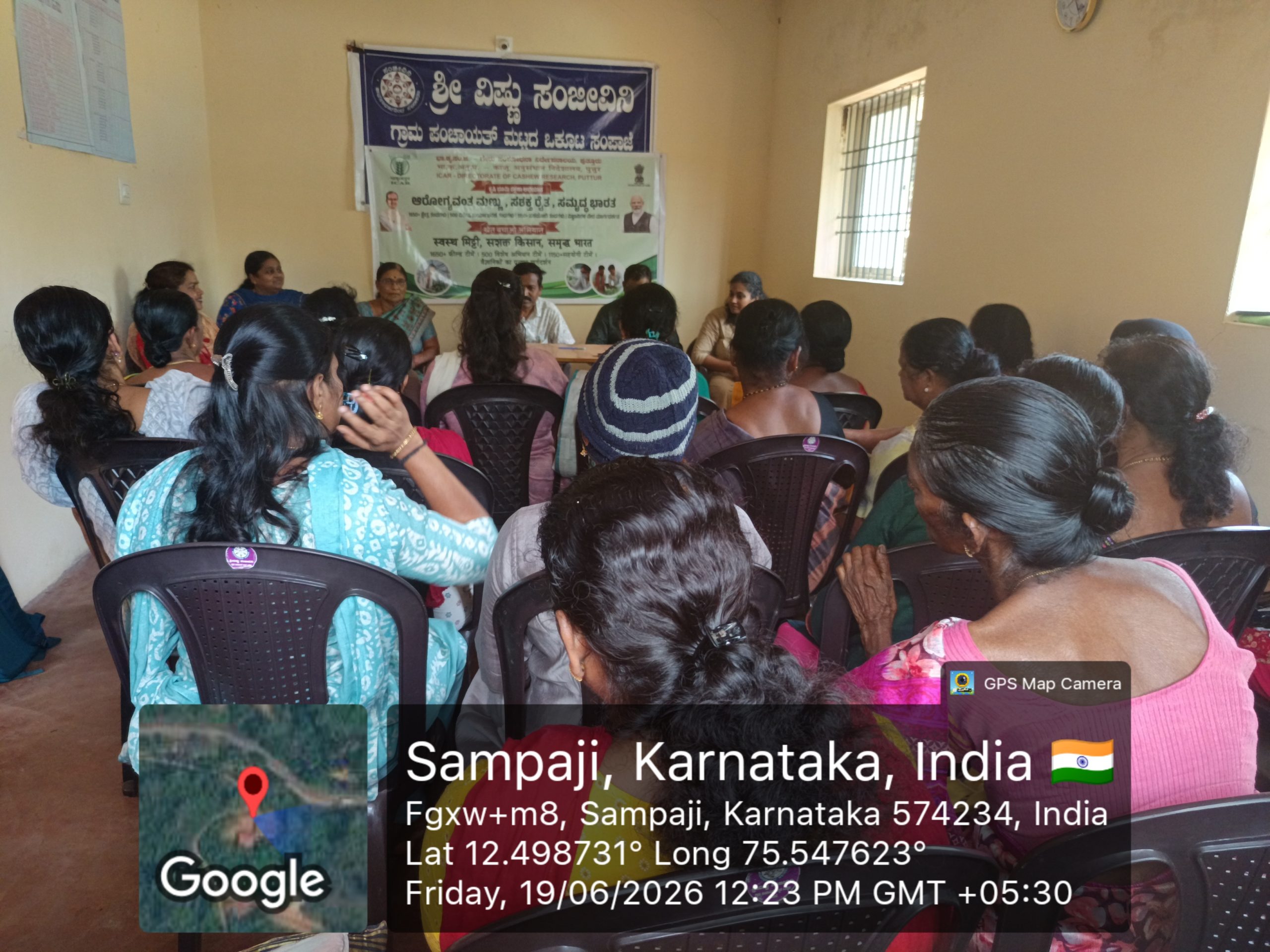
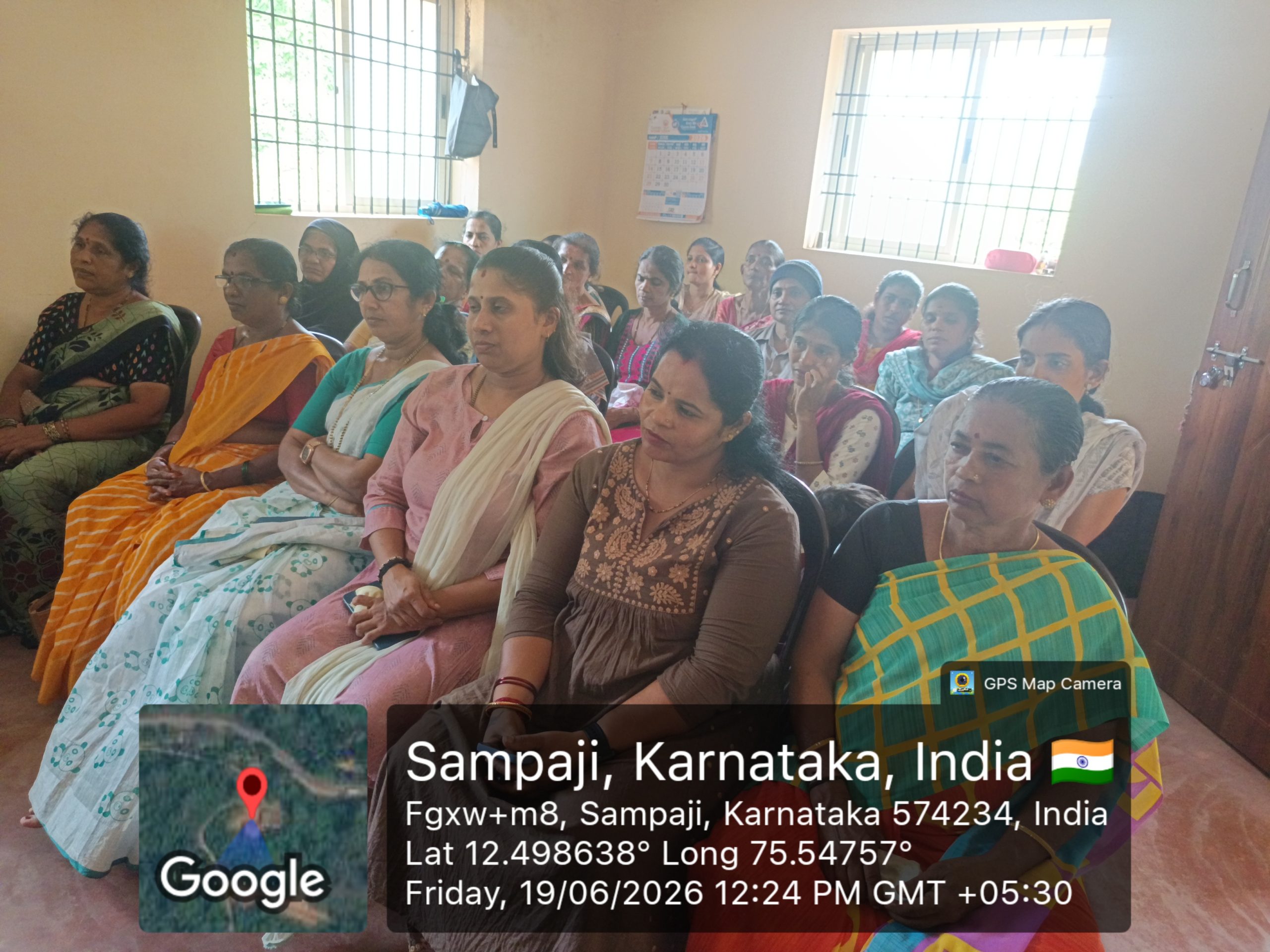
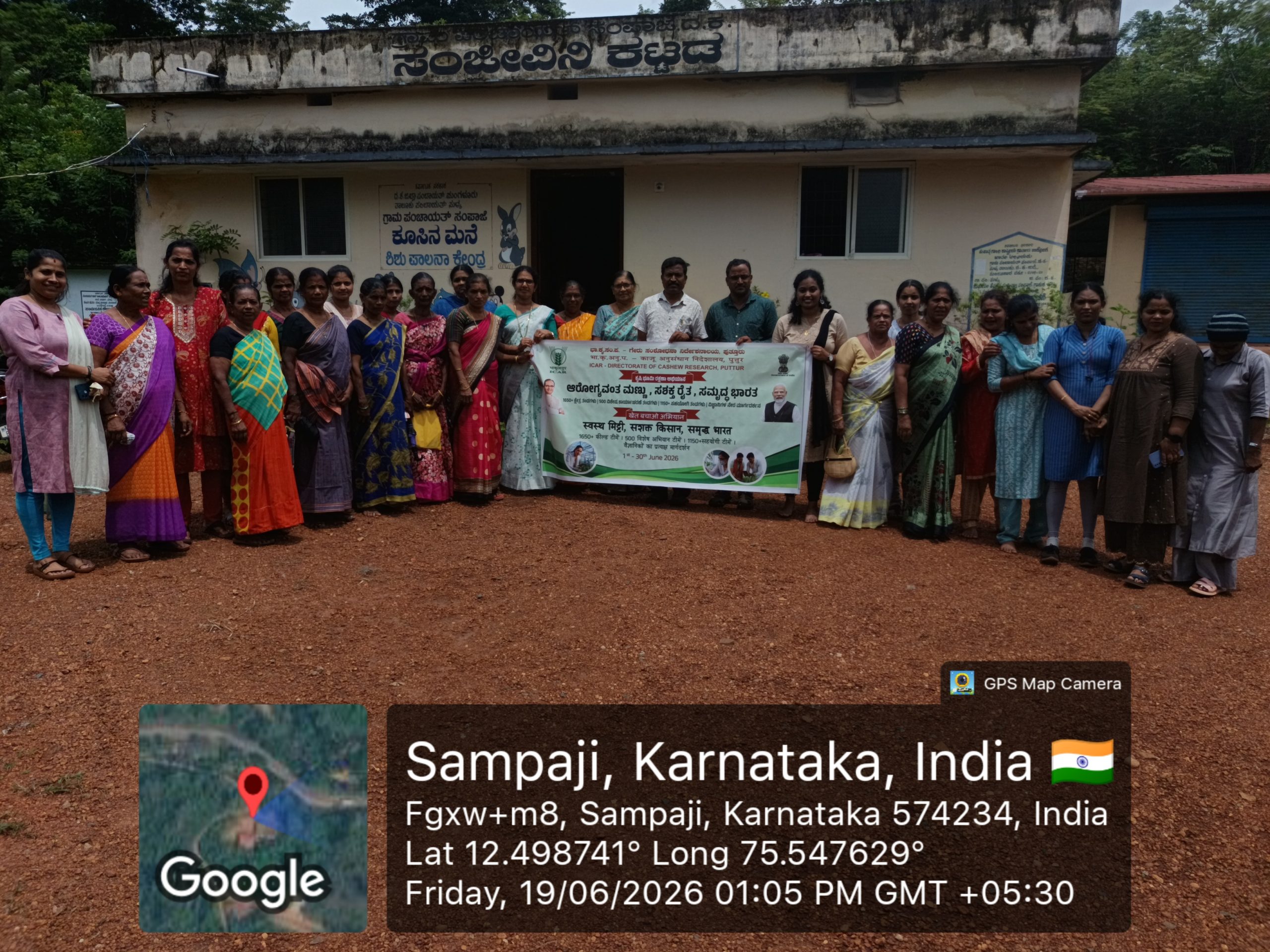
An awareness program on the above subject was conducted in Sampaje village of Sullia Taluk, Dakshina Kannada district, Karnataka state, on 19-06-2026. The program was started with a welcome by Dr Siddana Savadi. This was followed by a briefing about the program by Dr. Aswathy Chandrakumar.
There was a brief lecture on importance of organic farming and hazardous effect of using chemical fertilizer by Dr. Eradasappa E and farmers interacted with the staff regarding pest and disease management of black pepper and cashew. The farmers were advised to soil test based nutrient management for all the crops.
A total of 30 participants including resource persons were present during the meeting.
[Organisers:Dr. Eradasappa E, Dr. Siddanna Savadi. and Dr. Aswathy Chandrakumar].
Scientific Team: Dr. Balasubramanian D, Principal Scientist, ICAR-DCR, Puttur, Karnataka
Dr. Babli Mog, Senior Scientist, ICAR-DCR, Puttur
Dr. Veena G L, Senior Scientist, ICAR-DCR, Puttur
Dr. Bhagya H P, Scientist, ICAR-DCR, Puttur
DNumber of participants:35 (Male -17 Femele-18)
Interaction with VIPs: Dr. A B Patil, Former registrar UHS, Bagalkot
Dr. Mamatha D S Gatti, Chairman KCDC, Mangalore
Dr. H B Hebbar, Director, ICAR-CPCRI, Kasaragod
Dr. Dinakara Adiga, Director, ICAR-DCR, Puttur
Interaction with FPOs, Krishi Sakhi’s and farmers: Vittal, Sulya, Kadaba and Kasaragod.
Awareness programmes undertaken during visit:
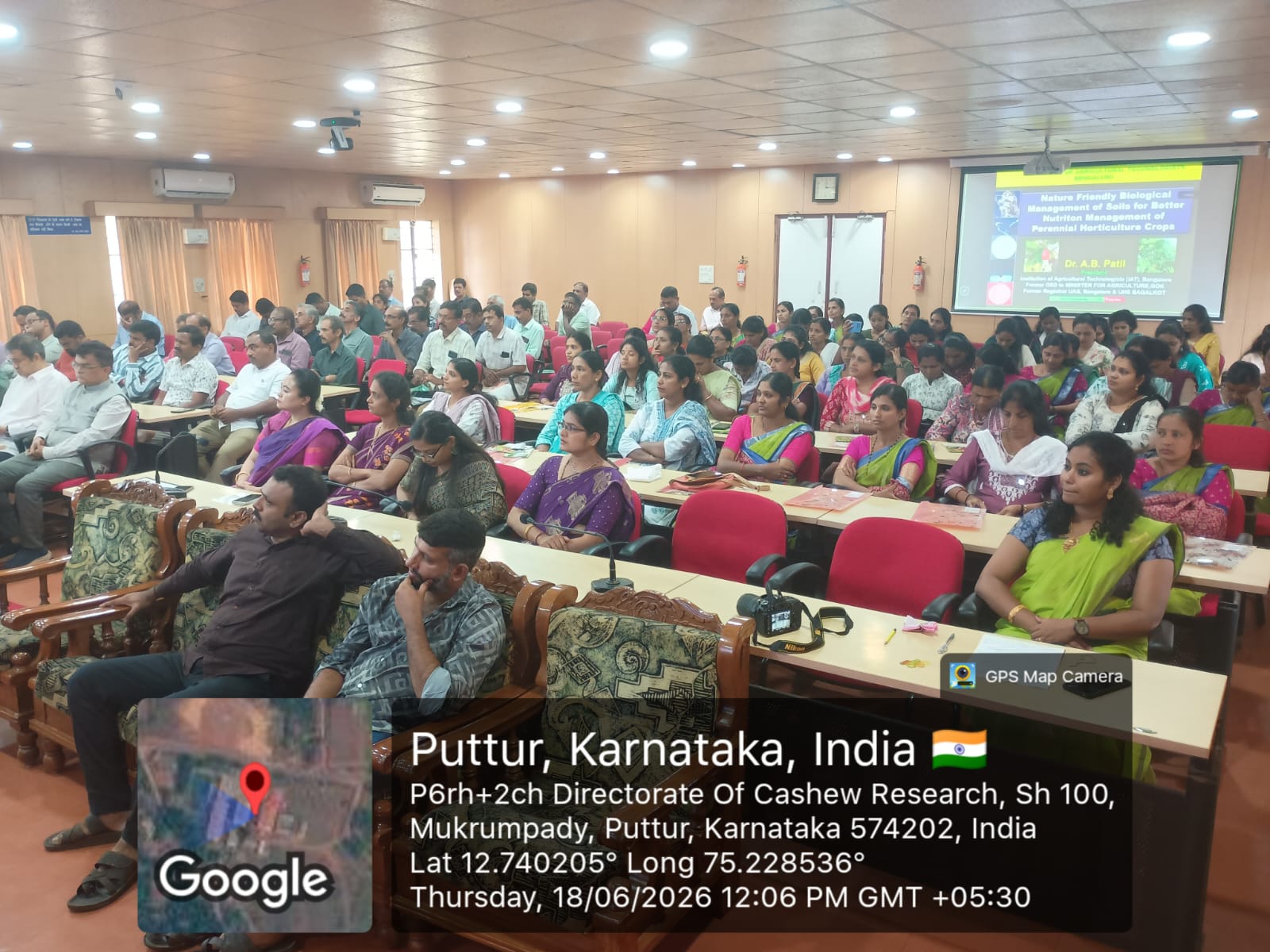
An awareness campaign for the Khet Bachao Abhiyan was conducted at ICAR-Directorate of Cashew Research, Puttur. A guest lecture on nature-friendly nutrition management in perennial horticultural crops was delivered by Dr. AB Patil, Former Registrar of UHS, Bagalkot.
Dr. Patil emphasized the importance of soil health and the use of organic manures, green manure, vermicompost, compost, biofertilizers, mulching, and other organic amendments. He highlighted these practices as essential for protecting soil quality for the future and stressed the critical link between healthy soil and healthy life.
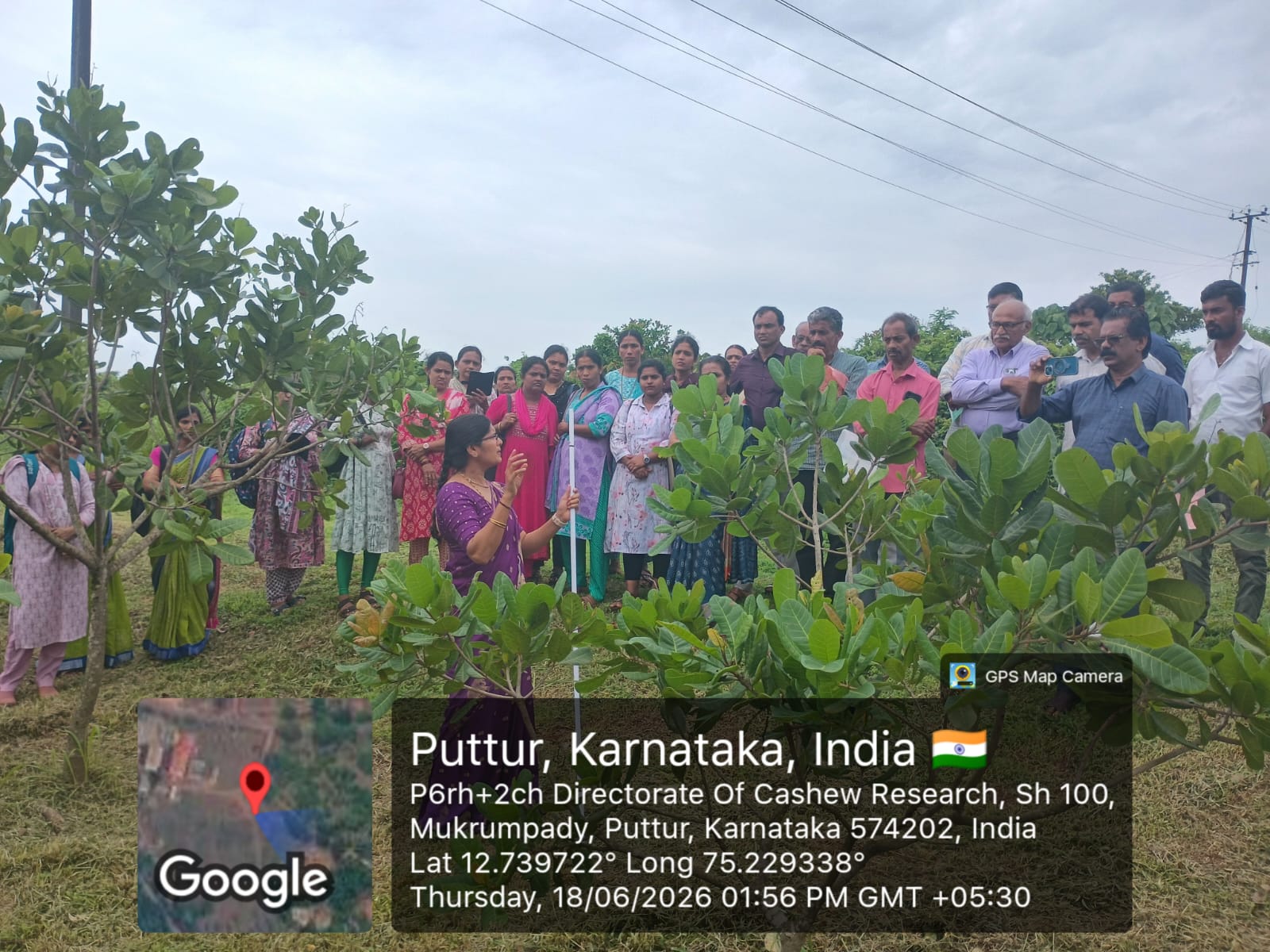
Any demonstration of mulching of pruned biomass:
All the Krishi Sakhis and farmers were taken to the field where a demonstration on training and pruning in ultra-high-density planting in cashew was conducted. Additionally, the use of biomass as mulch in cashew plantations was shown to promoteeffective biomass utilization as manure, helping to conserve soil moisture. This demonstration was led by Dr. Bhagya H P, Scientist, ICAR-DCR, Puttur.
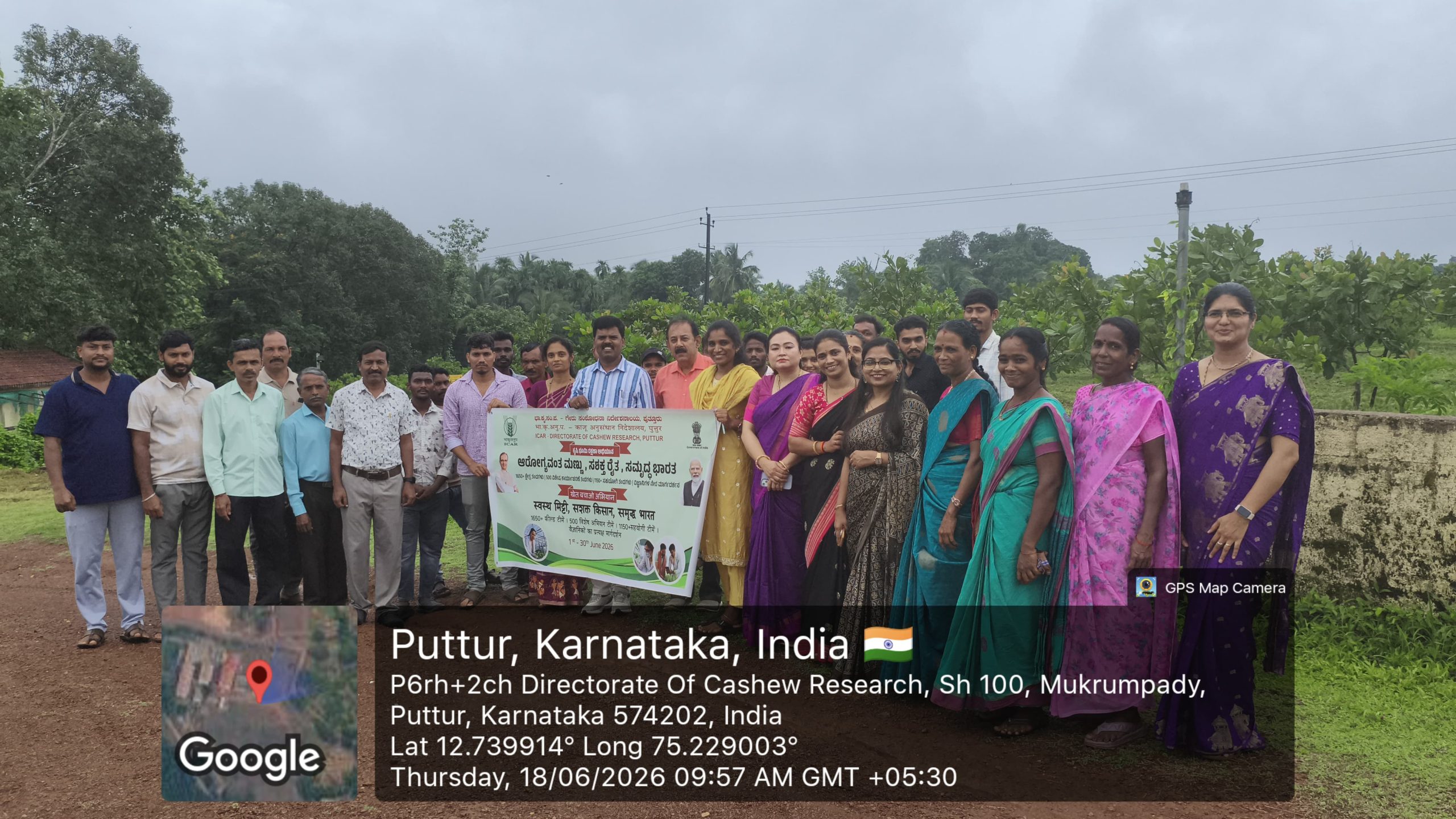
Number of participants: 22 (M:20, F: 02)
Interaction with the input dealer: No
Interaction with Panch / Sarpanch: No
Awareness programmes undertaken during visit: Khet Bachao Abhiyan
Any demonstration of green manuring: No
Biofertilizers: No
Any Local Learning/Observation Recorded: It was observed that a limited number of farmers have adopted vermicomposting practices and had previously utilized gobar gas slurry/sludge as part of their nutrient management practices.
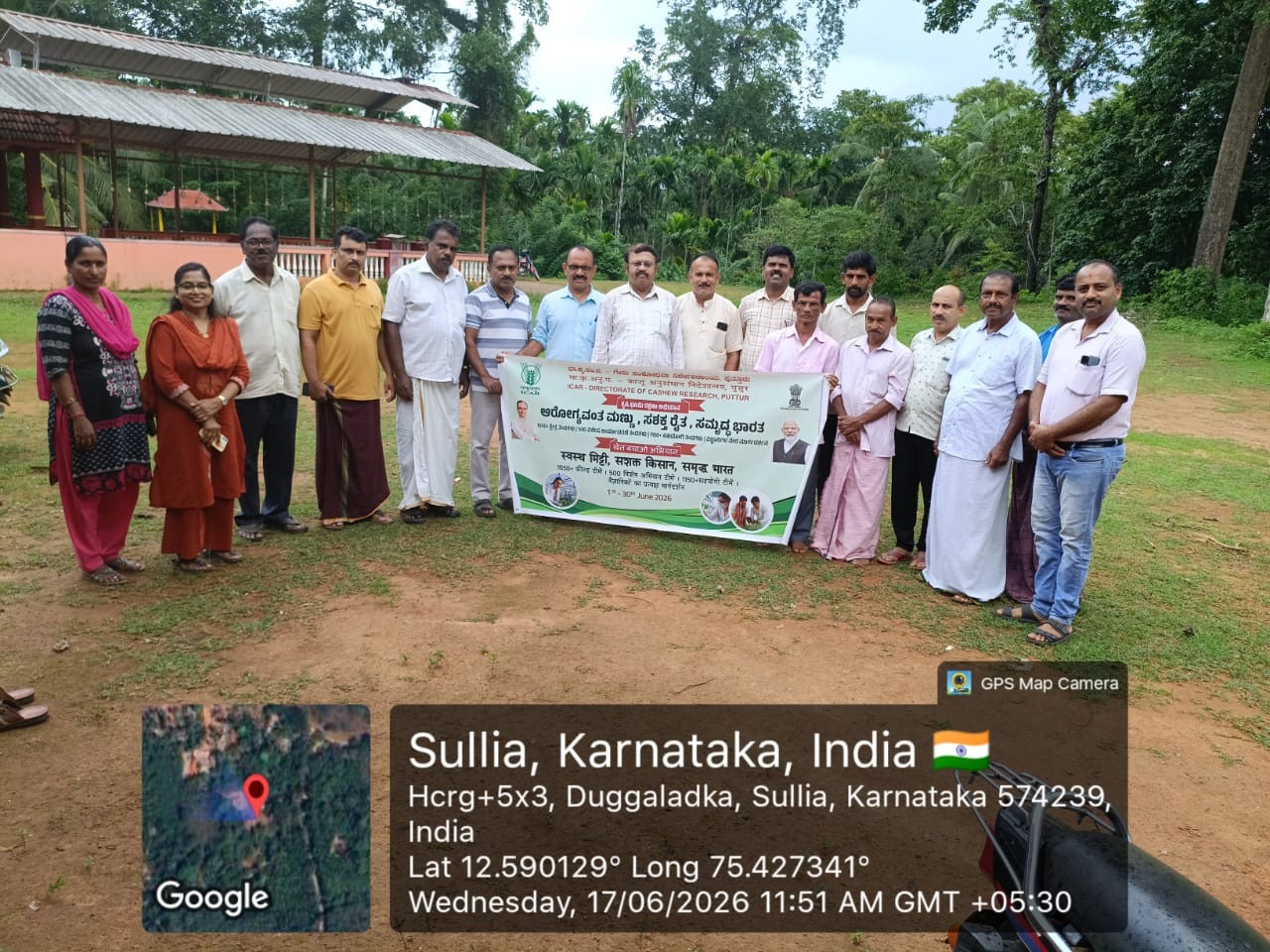
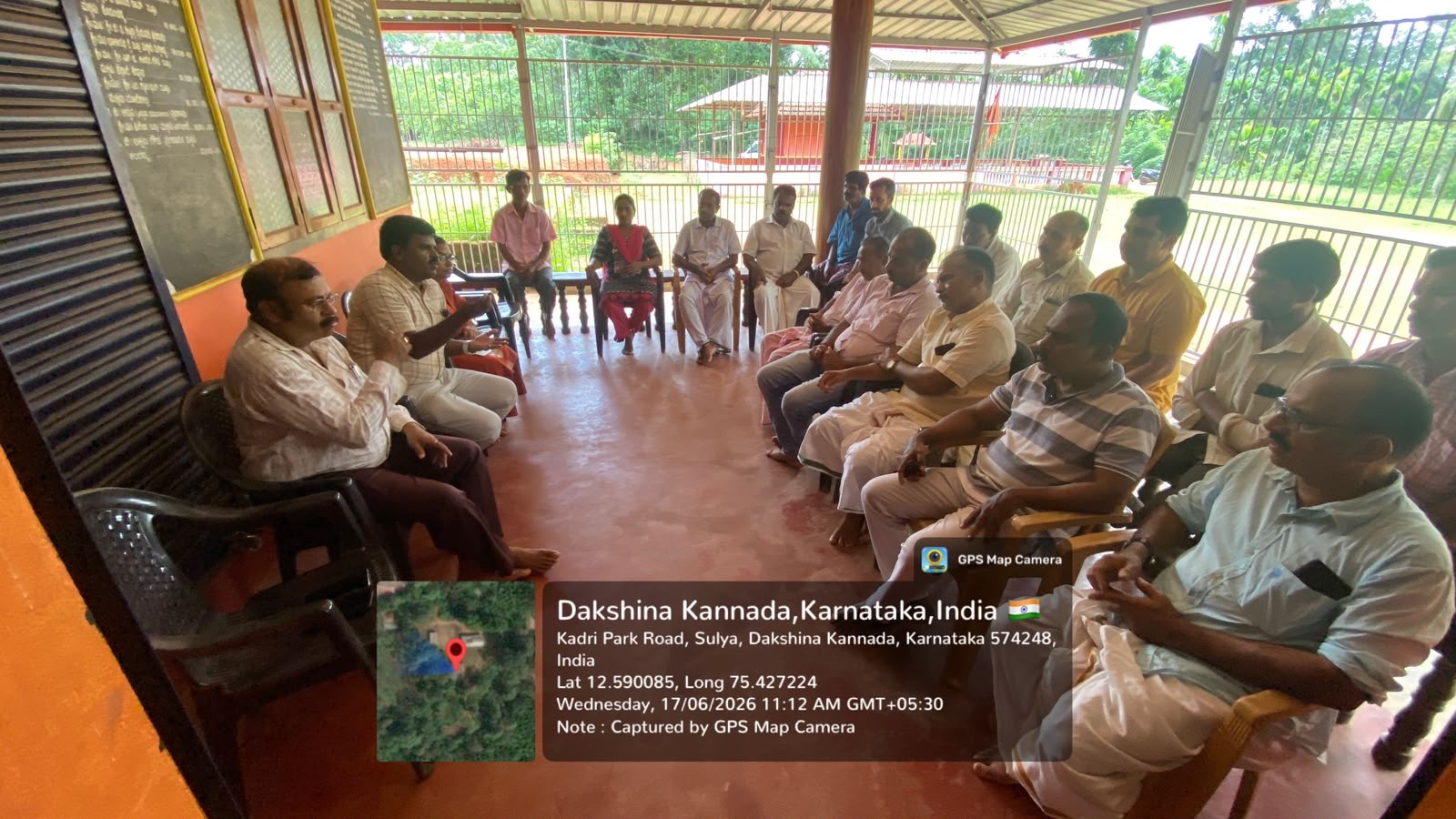
As part of the Khet Bachao Abhiyan, a farmer awareness programme was conducted at Duggaladka, Sullia, on 17 June 2026 with the objective of promoting sustainable nutrient management and responsible use of agricultural inputs in horticultural crops. The programme served as a platform to educate farmers on improving soil productivity through scientific approaches while reducing the adverse effects of indiscriminate input use.
The event started with introductory remarks by Dr. T. N. Raviprasad, who provided an overview of the campaign and its significance in addressing emerging challenges related to soil health and agricultural sustainability. He encouraged farmers to adopt evidence-based farming practices to enhance productivity and conserve natural resources.
During the subsequent sessions, Dr. Rajashekara H. and Dr. Jyoti Nishad discussed various aspects of nutrient stewardship in horticultural farming. The speakers highlighted the benefits of soil-test-guided fertilizer application, integrated nutrient management, and efficient utilization of farm inputs. They explained how these practices contribute to improved crop performance, reduced production costs, and long-term maintenance of soil fertility.
The programme also featured an interactive discussion where farmers actively participated by sharing their field experiences and raising concerns related to fertilizer selection and application schedules. The experts provided practical recommendations on balanced nutrient application and emphasized the importance of periodic soil analysis for informed decision-making. Special attention was given to the need for minimizing nutrient losses and avoiding excessive use of agrochemicals to safeguard soil and environmental health.
A total of 22 farmers, including 20 men and 2 women, attended the programme. The participants appreciated the practical insights shared during the sessions and expressed interest in adopting the recommended nutrient management practices. The programme concluded with a formal expression of thanks to the resource persons and participants for their valuable contributions and active engagement throughout the event.
[Organisers: Dr TN Raviprasad, Dr. Rajashekara H. and Dr Jyoti Nishad].
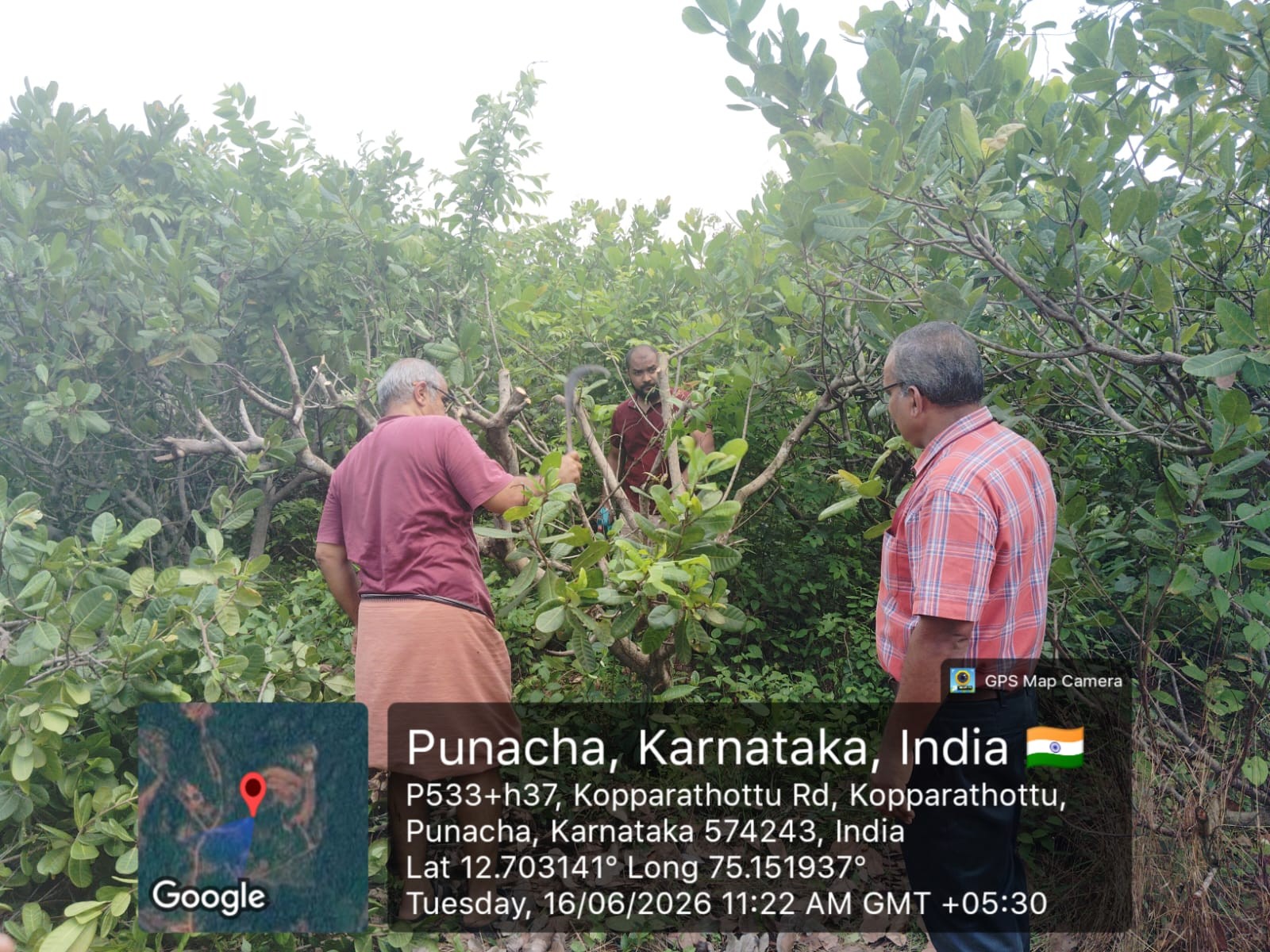
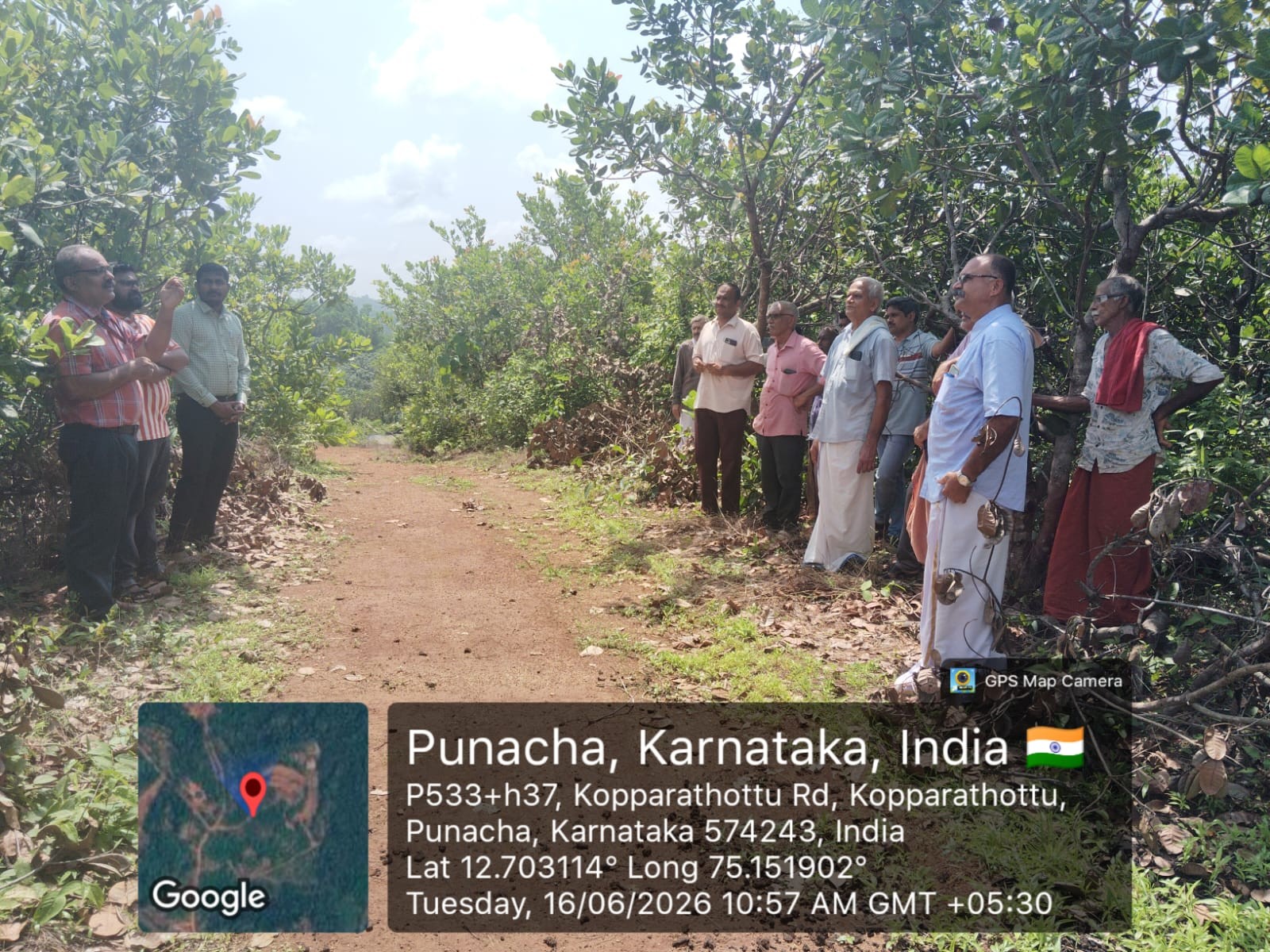
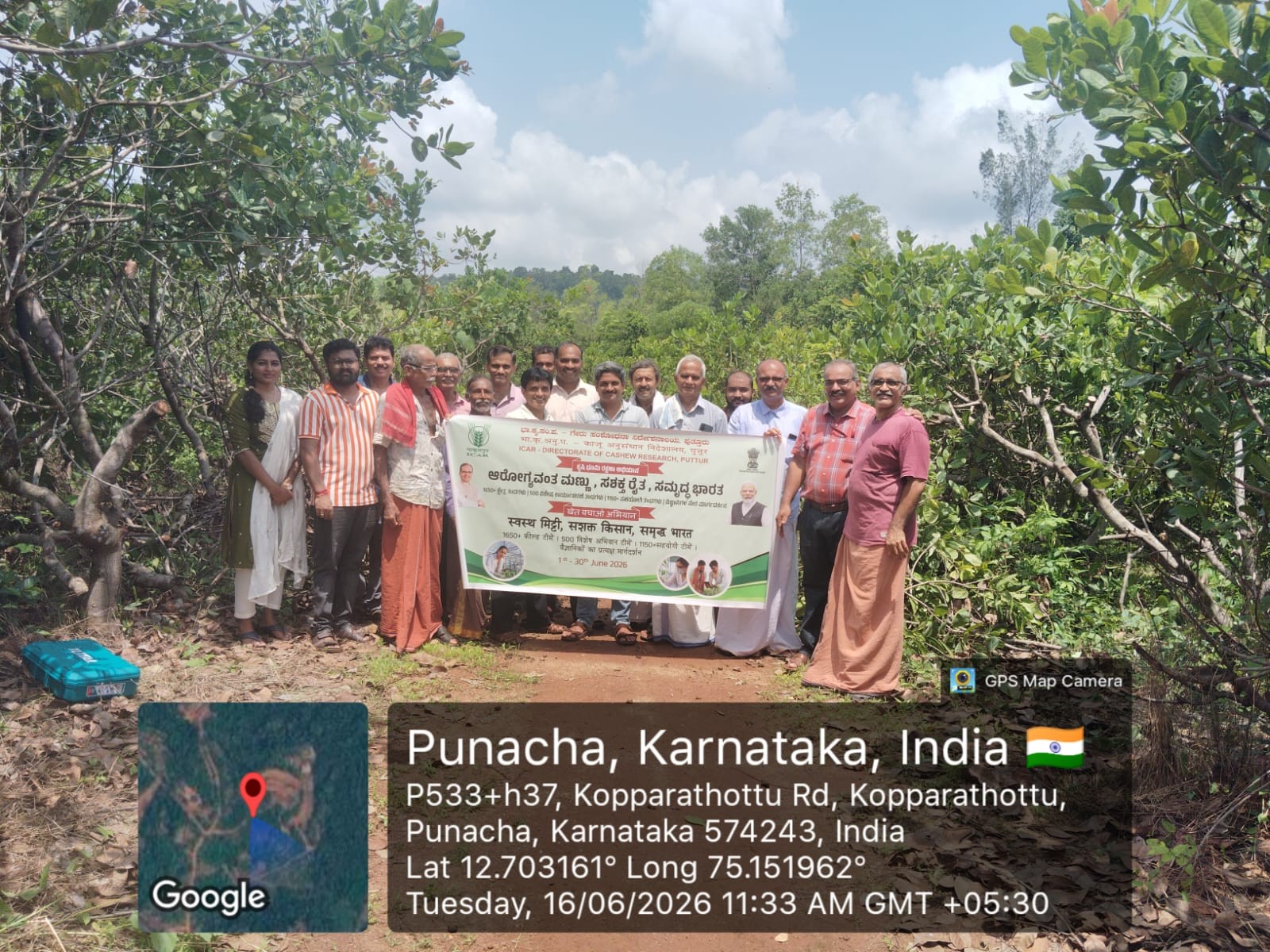
An awareness program on the above subject was conducted in Kopparathottu, Punacha Village, Bantwal Taluk, Dakshina Kannada district, Karnataka state, on 16-06-2026. The program was started with a welcome address by Dr Manjesh, G.N. and he briefed about the campaign to the gathering.
There was a brief lecture on importance of organic farming and nutrient management in cashew by Dr. Mohana, GS and farmers were interacted with the staff regarding pest and disease in cashew and wild boar control. The demonstration on soil sample collection for soil test was explained to the farmers. Pruning in high density planting of cashew is demonstrated in Mr. Krishna Prasad’s cashew farm (VRI-3 variety). Besides, cashew apple processing and its scope and importance were explained to the farmers.
The farmers are advised to soil test based nutrient management for all the crops.
A total of 20 participants were participated in the campaign. In the end,
Dr. V. Thondaiman proposed a vote of thanks.
[Organisers: Drs. Mohana, G.S., V. Thondaiman and Manjesh G.N].
Scientific Team:
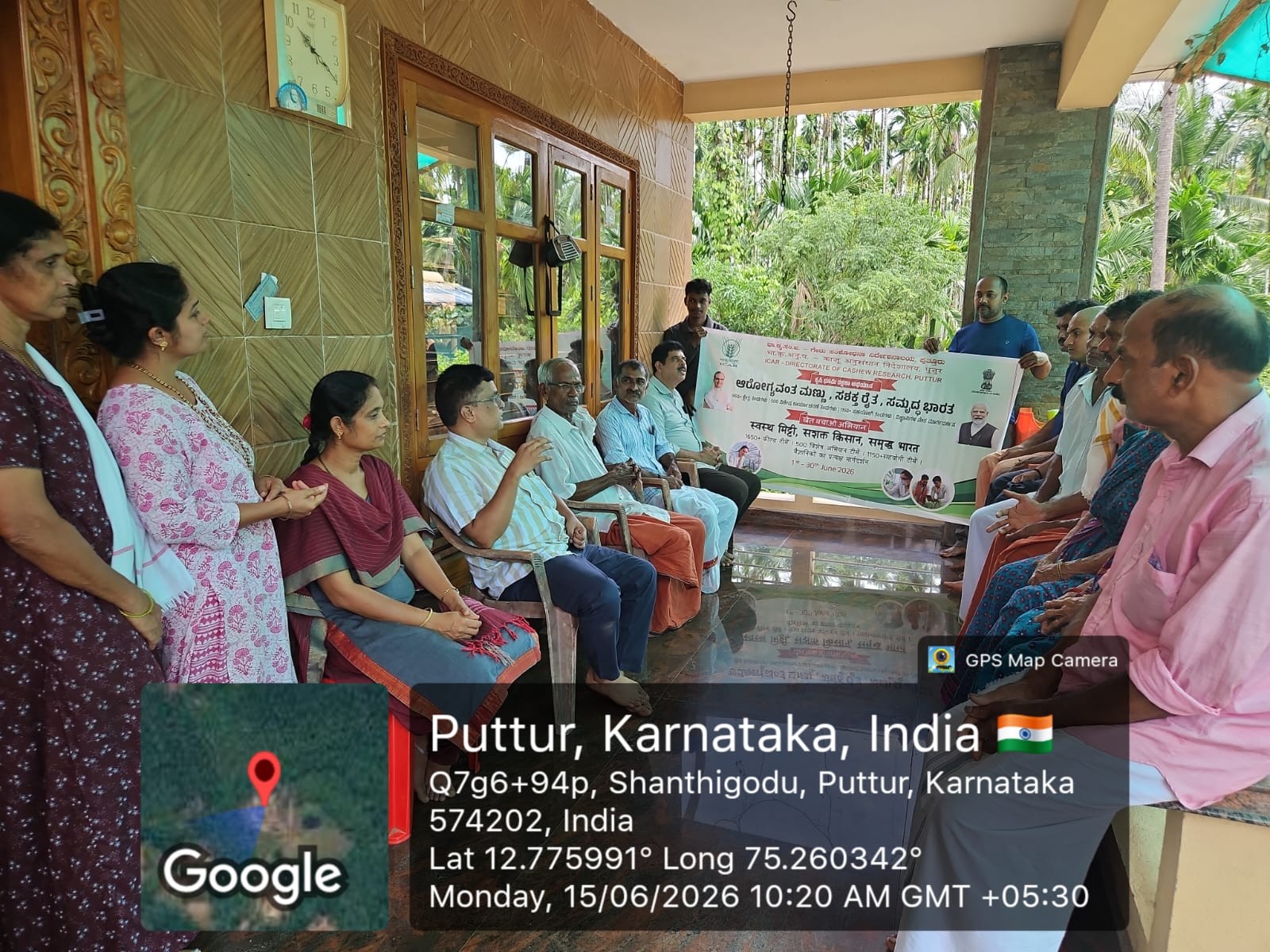
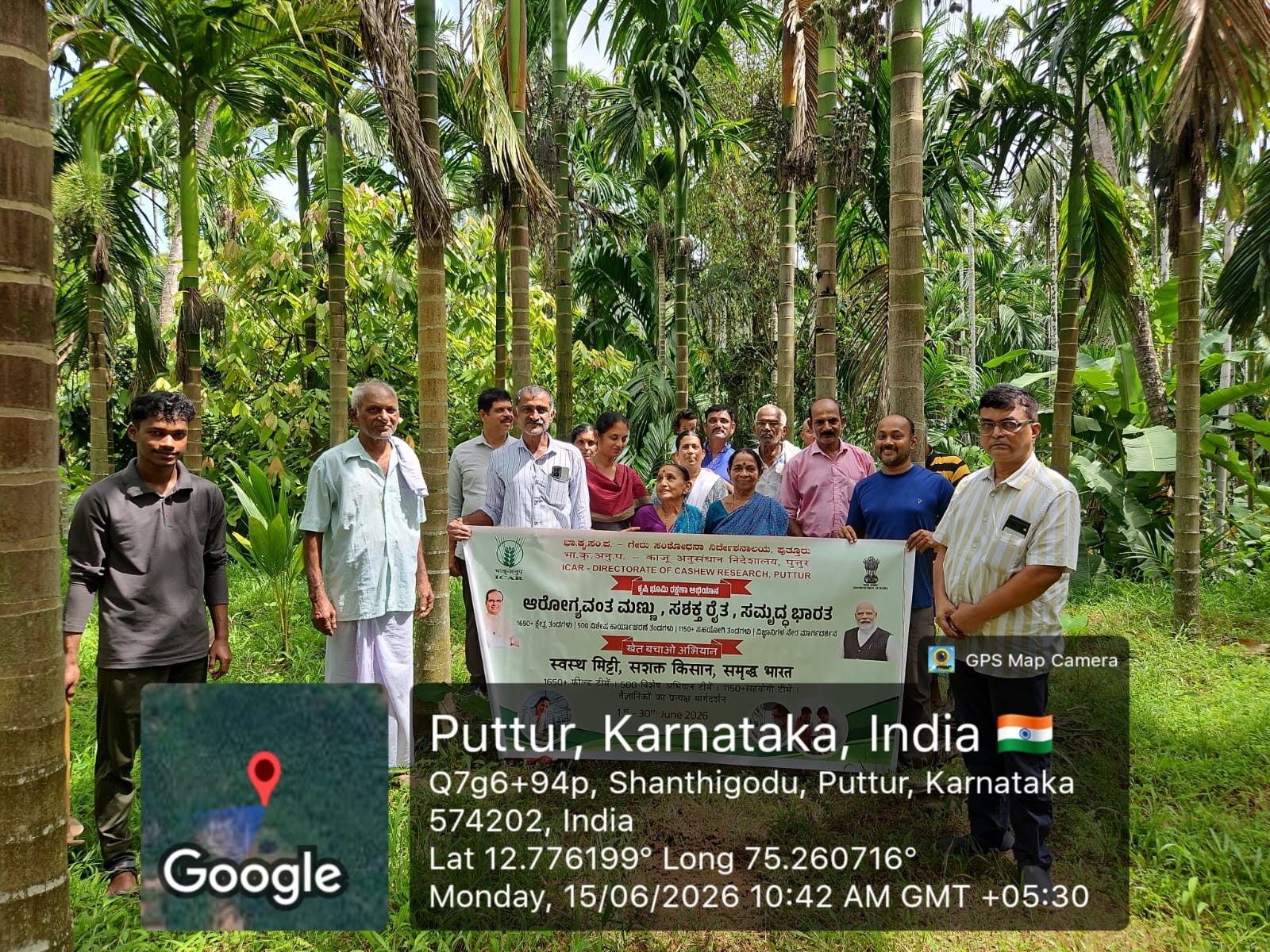
Dr. Venkatesh, M. Prin. Scientist (Soil Science), ICAR-DCR, Puttur, (Team Leader)
Dr. K. Vanitha, Senior Scientist, ICAR-DCR, Puttur, Team Member
Number of participants: 20 (Male -14, Femele-06)
In this campaign, importance of scientific and balanced nutrient management practices was explained to the farmers along with use of vermicompost, biofertilizers, compost and green manuring for the restoration of soil fertility.
Further, soil test-based fertilizer application was emphasized. A practical demonstration on soil sampling techniques was conducted during this campaign enabling farmers to gain hands-on experience in proper sample collection methods. Soil samples from farmer’s field were also collected for laboratory analysis and further recommendations. Farmers expressed their concern about availability of biofertilizers like oil cakes at subsidized rates. A total of 20 farmers participated in this programme.
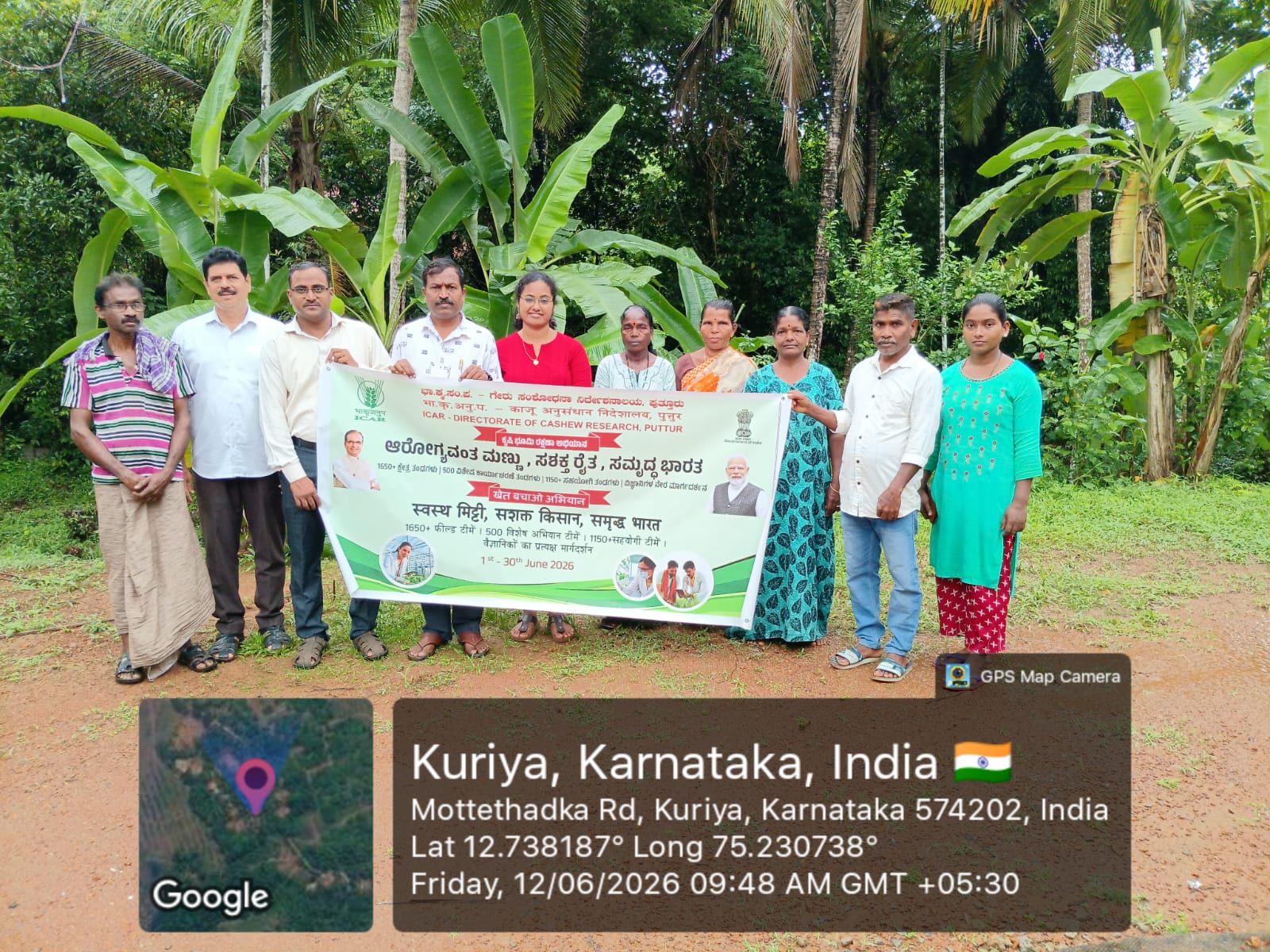
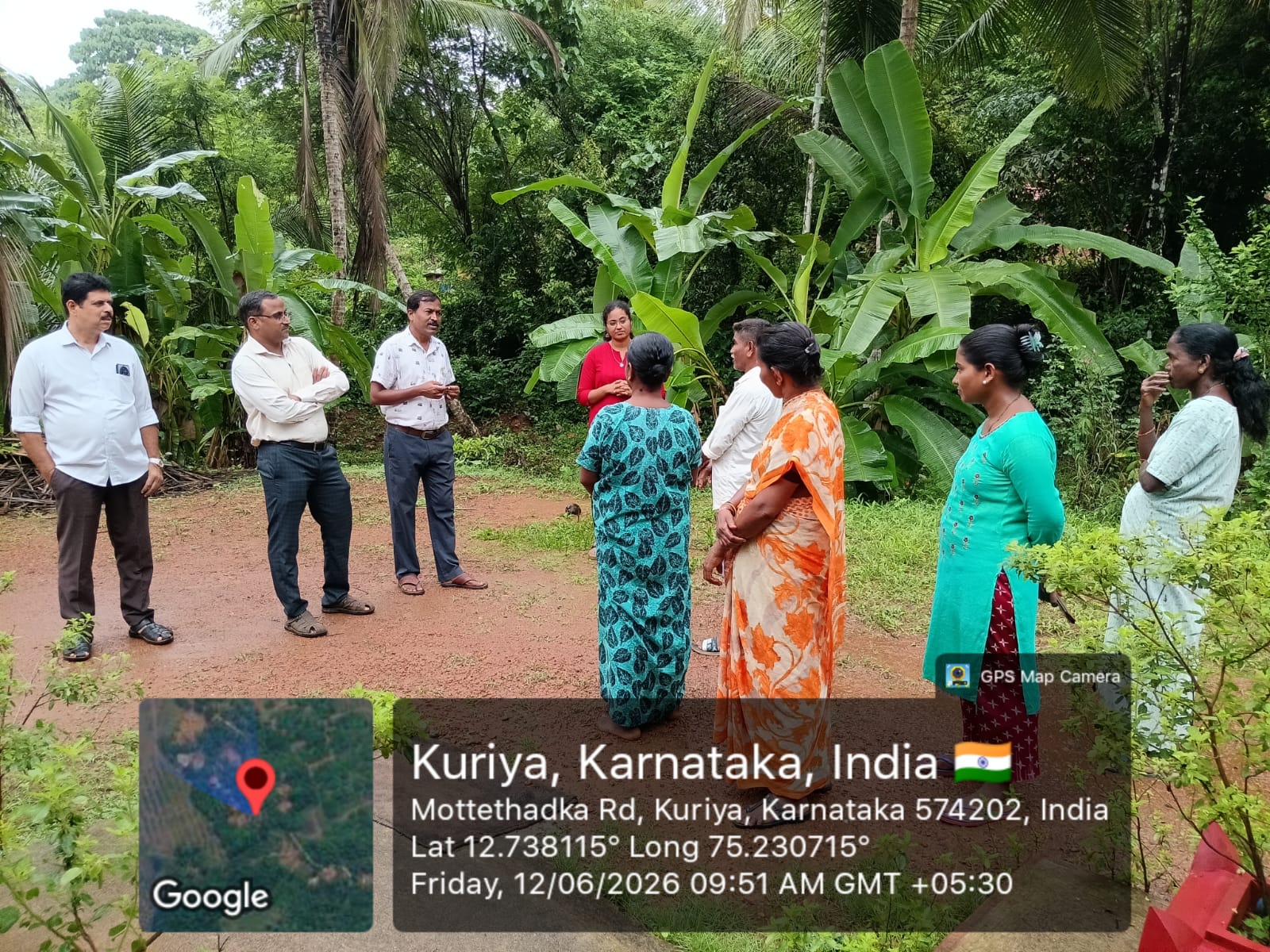
An awareness program on the above subject was conducted in Amoonja village, Kuriya of Puttur Taluk, Dakshina Kannada district, Karnataka state, on 12-06-2026. The program was started with a welcome by Dr Siddana Savadi. This was followed by a briefing about the program by Dr. Aswathy Chandrakumar.
There was a brief lecture on importance of organic farming and hazardous effect of using chemical fertilizer by Dr. Eradasappa E and farmers interacted with the staff regarding pest and disease management of black pepper and cashew. The farmers were advised to soil test based nutrient management for all the crops.
A total of 11 participants were present during the meeting.
An awareness program on the above subject was conducted in Amoonja village, Kuriya of Puttur Taluk, Dakshina Kannada district, Karnataka state, on 12-06-2026. The program was started with a welcome by Dr Siddana Savadi. This was followed by a briefing about the program by Dr. Aswathy Chandrakumar.
There was a brief lecture on importance of organic farming and hazardous effect of using chemical fertilizer by Dr. Eradasappa E and farmers interacted with the staff regarding pest and disease management of black pepper and cashew. The farmers were advised to soil test based nutrient management for all the crops.
A total of 11 participants were present during the meeting.
Scientific Team: Dr. Balasubramanian D, Principal Scientist, ICAR-DCR, Puttur, Karnataka
Dr. Babli Mog, Senior Scientist, ICAR-DCR, Puttur
Dr. Veena G L, Senior Scientist, ICAR-DCR, Puttur
Dr. Bhagya H P, Scientist, ICAR-DCR, Puttur
Number of participants:21 (Male -12, Femele-9)
Interaction with Input dealer: No
Interaction with Panch/Sarpanch: No
Awareness programmes undertaken during visit:
- Awareness on balanced fertilizer use
- Organic farming for horticultural crops
- Special attention on green manuring and other organic substitutes
In this awareness programme, we have emphasized on soil test-based fertilizer application and soil sampling methodology and importance of soil testing in perennial crops. Demonstrated soil sampling in cashew plantation. Usage of organic inputs like compost, biofertilizer, green leaf manuring, and recycling of farm waste as insitu decomposition.
Any demonstration of green manuring: No
Biofertilizers: No
Any Local Learning/Observation Recorded: Growing flowers in the home garden is of interest to farm women.
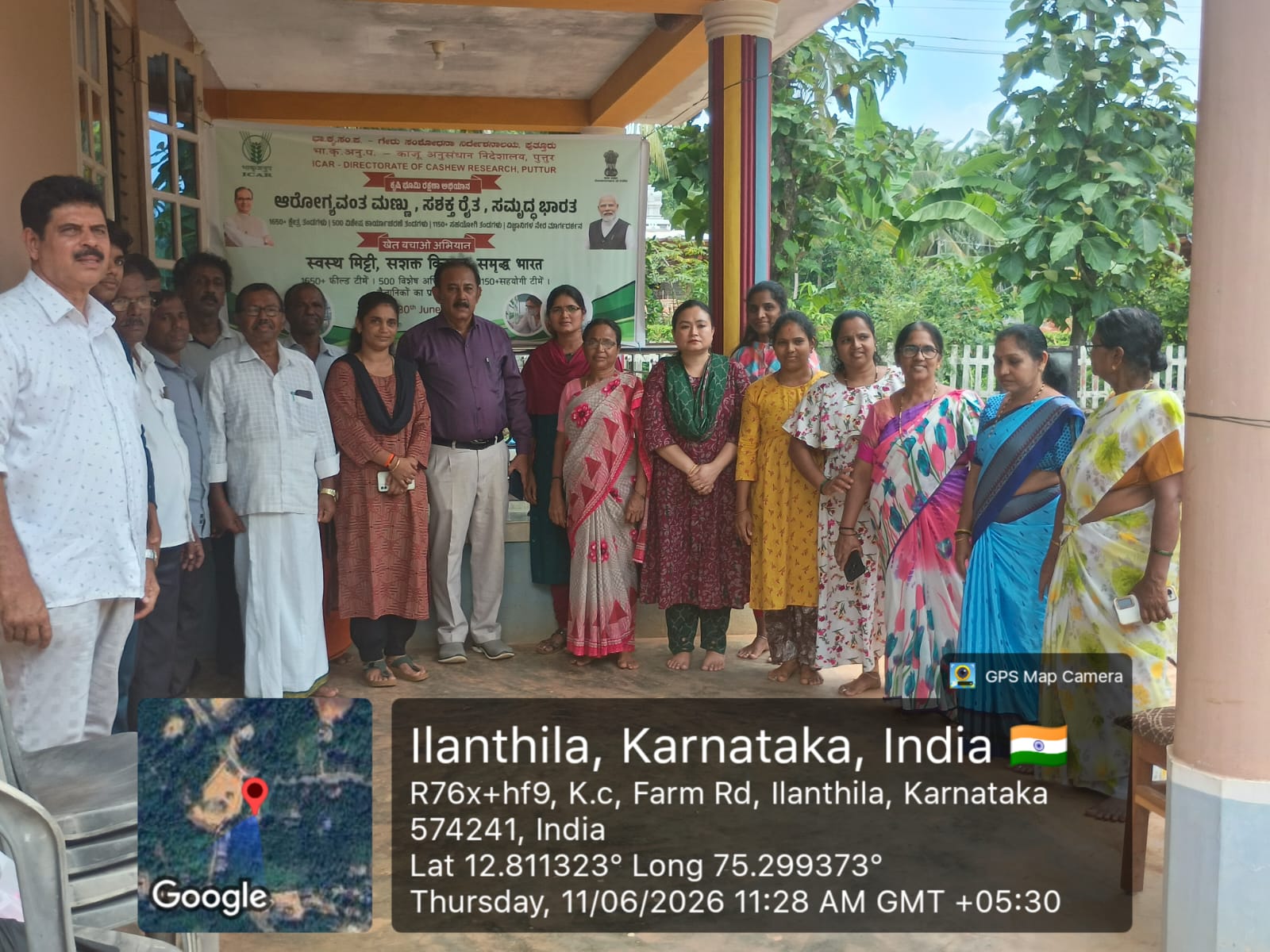
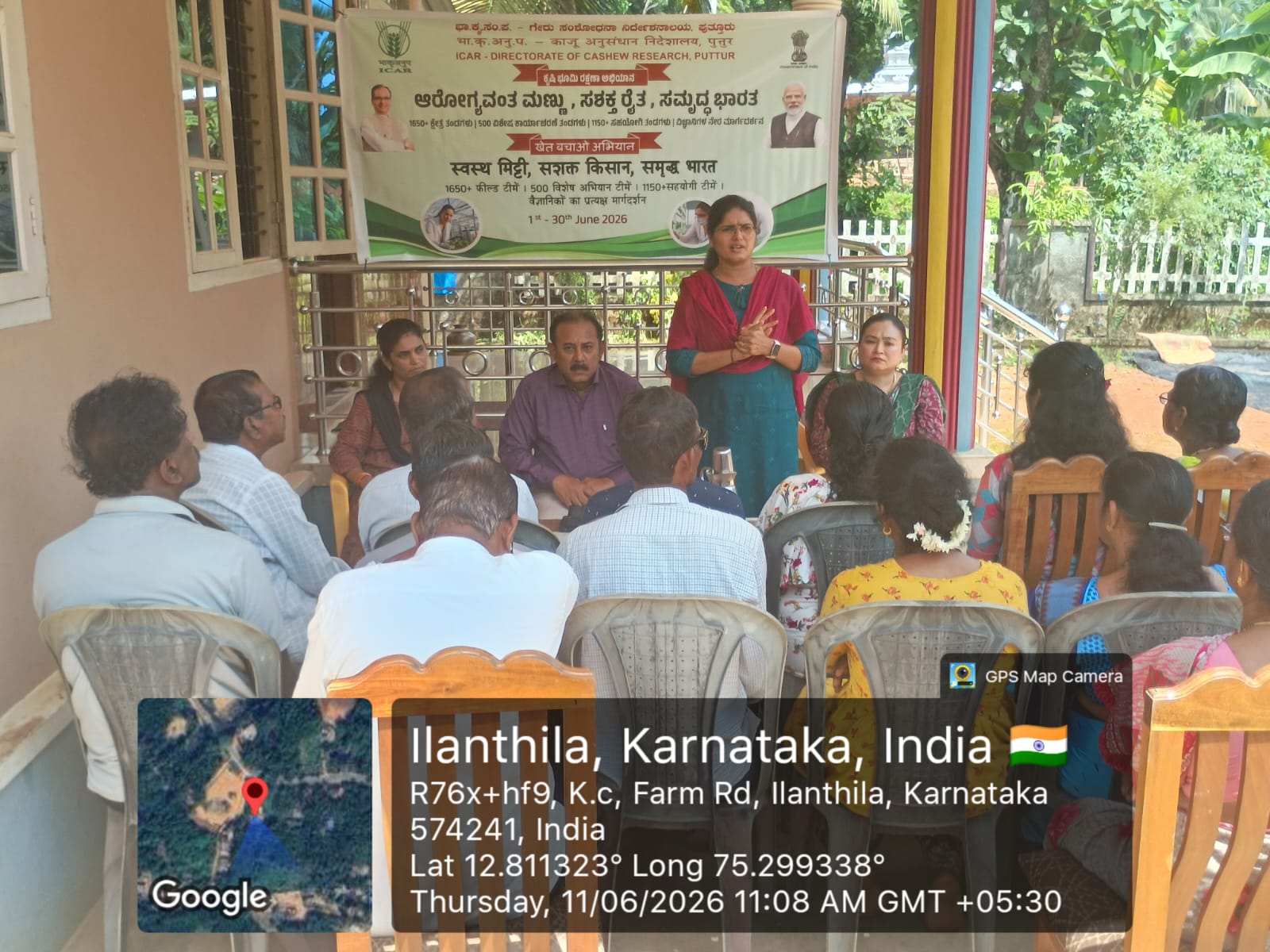
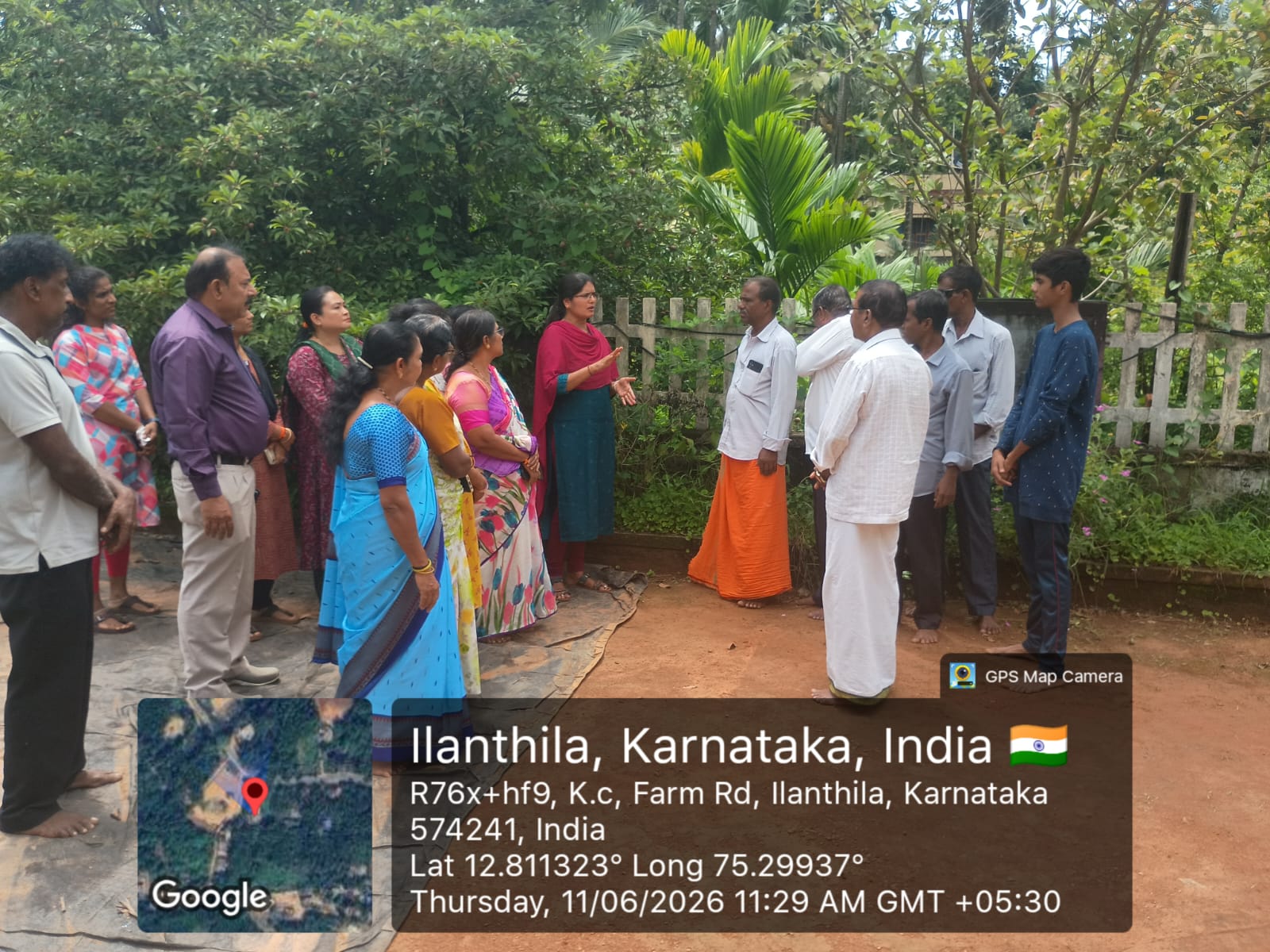
Number of participants: 27 (M:23, F: 04)
Interaction with the input dealer: No
Interaction with Panch / Sarpanch: No
Awareness programmes undertaken during visit: Khet Bachao Abhiyan
Any demonstration of green manuring: No
Biofertilizers: No
Any Local Learning/Observation Recorded: Few farmers practice vermicomposting and were earlier adopting gobar gas sludge application
An awareness programme under the Khet Bachao Abhiyan was organized at Kukkedi on 10 June 2026 to create awareness among farmers on the adoption of science-based nutrient management, judicious use of agricultural inputs, and sustainable farming practices in horticultural crops. The programme aimed to promote soil health conservation, improve input-use efficiency, and encourage environmentally sustainable agriculture.
The programme commenced with a welcome address by Dr. T. N. Raviprasad, who welcomed the participants and highlighted the objectives of the Khet Bachao Abhiyan. He emphasized the importance of protecting agricultural lands through scientific farming practices, balanced nutrient application, and responsible use of agricultural inputs.
Thereafter, Dr. Rajashekara H. and Dr. Jyoti Nishad addressed the gathering and explained the importance of science-based nutrient and input management for enhancing crop productivity, maintaining soil fertility, and ensuring long-term sustainability of farming systems. They stressed the role of soil-test-based nutrient recommendations, integrated nutrient management, and efficient input utilisation in reducing cultivation costs and preventing soil degradation.
An interactive session with farmers was conducted, during which participants shared their existing fertiliser and input management practices in horticultural crops. Farmers sought guidance regarding the appropriate selection, dosage, and timing of fertiliser application. The experts addressed their queries and highlighted the need for soil testing, balanced fertilisation, and the judicious use of agrochemicals to prevent nutrient imbalances, enhance productivity, and conserve soil health. A total of 27 farmers participated in the programme (Male: 23; Female: 04). The programme concluded with a vote of thanks by one of the participants, who expressed gratitude to the resource persons and participants for their active involvement in making the programme successful.
[Organisers: Dr TN Raviprasad, Dr. Rajashekara H. and Dr Jyoti Nishad].
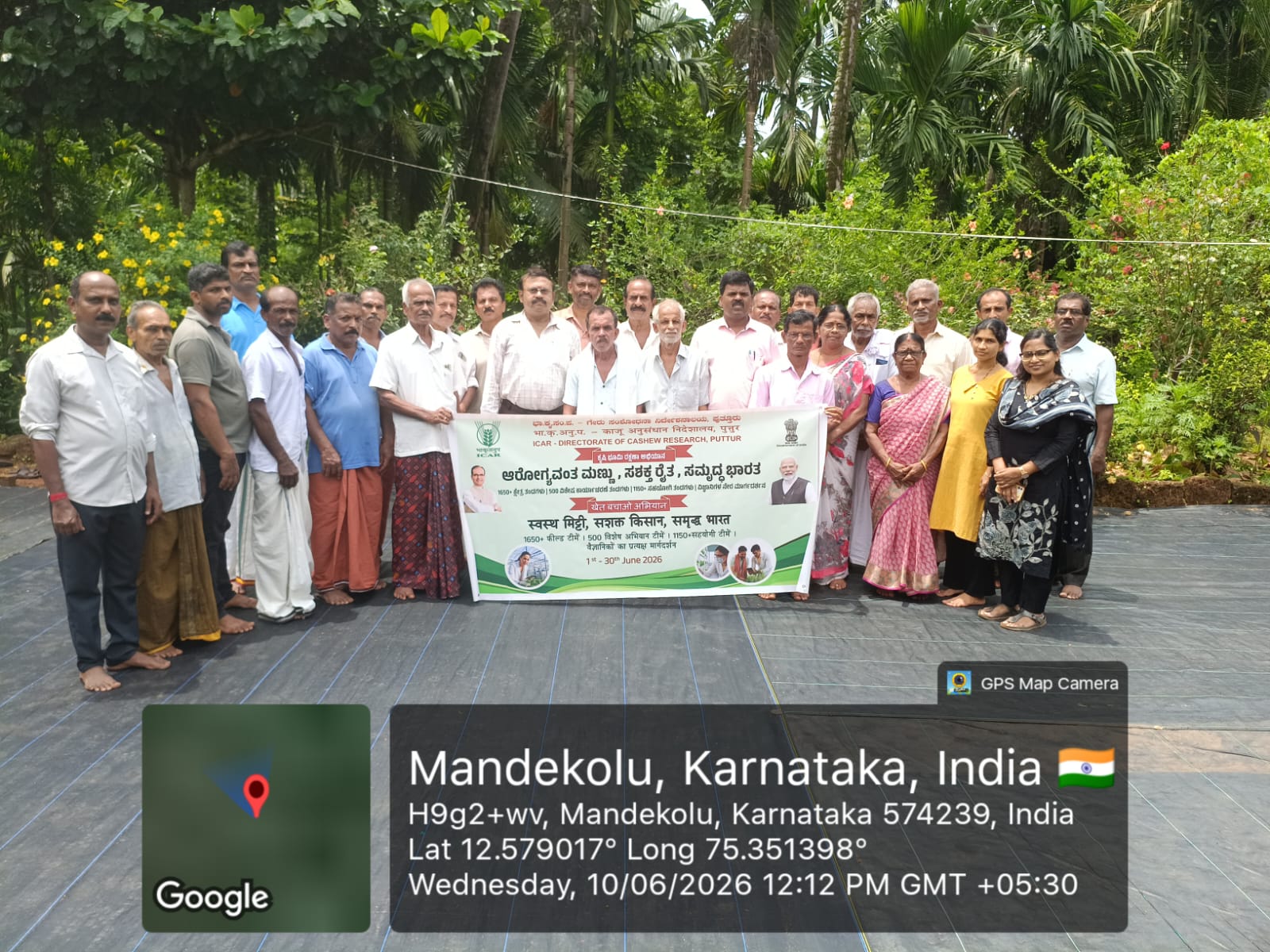
An awareness program on the above subject was conducted in Anaje village, Narimogaru of Puttur Taluk, Dakshina Kannada district, Karnataka state, on 09-06-2026. The program was started with a welcome by Dr V. Thondaiman. This was followed by a briefing about the program by Dr. Manjesh, G.N.
There was a brief lecture on importance of organic farming and hazardous effect of using chemical fertilizer by Dr. Manjesh, GN and farmers were interacted with the staff regarding pest and disease management of black pepper and cashew. The demonstration on soil sample collection for soil test was done in the farm.
The farmers are advised to soil test based nutrient management for all the crops.
A total of 21 participants were present during the meeting. In the end, Dr. V. Thondaiman proposed a vote of thanks.
[Organisers: Drs. Mohana, G.S., V. Thondaiman and Manjesh G.N].
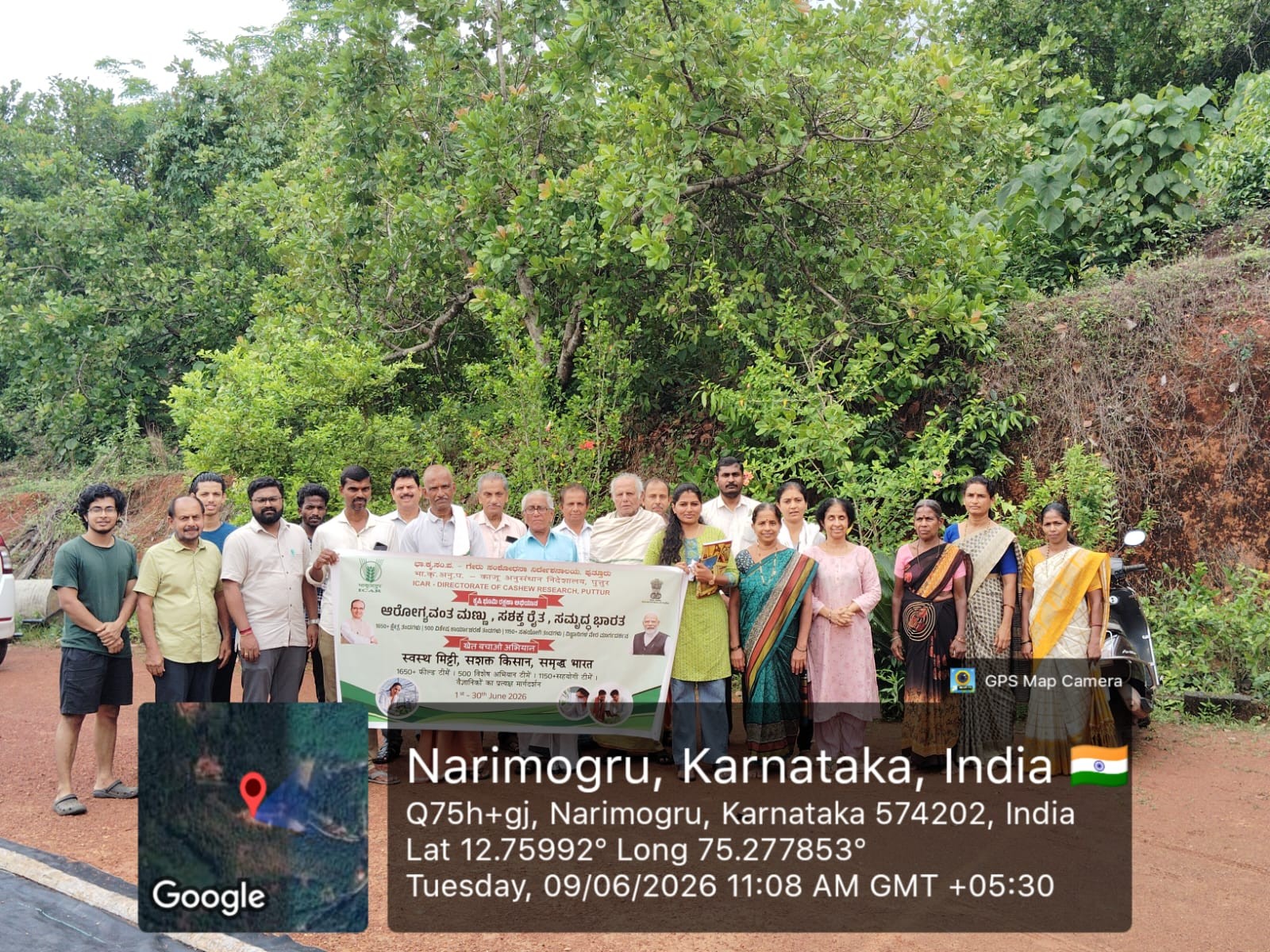
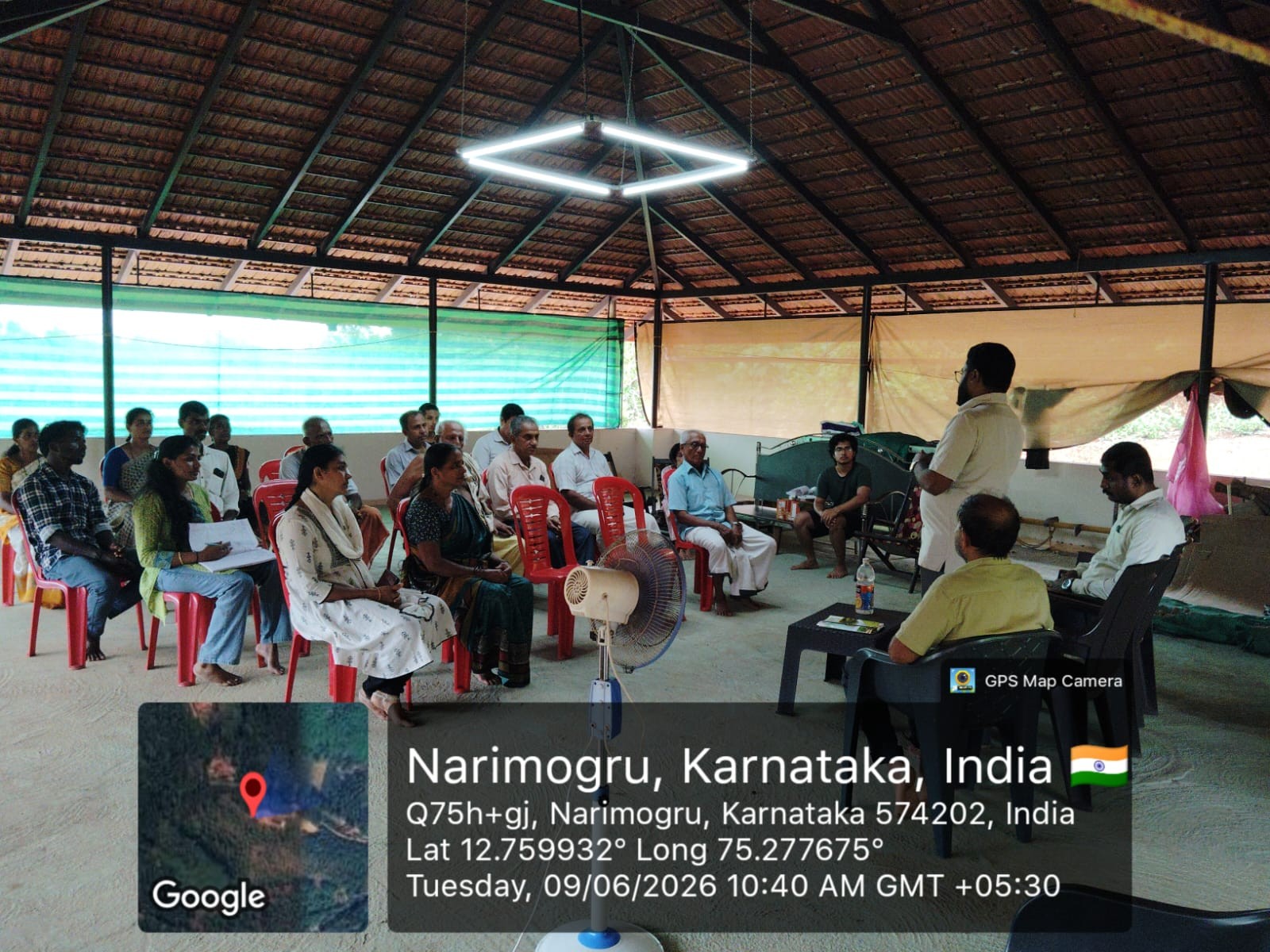
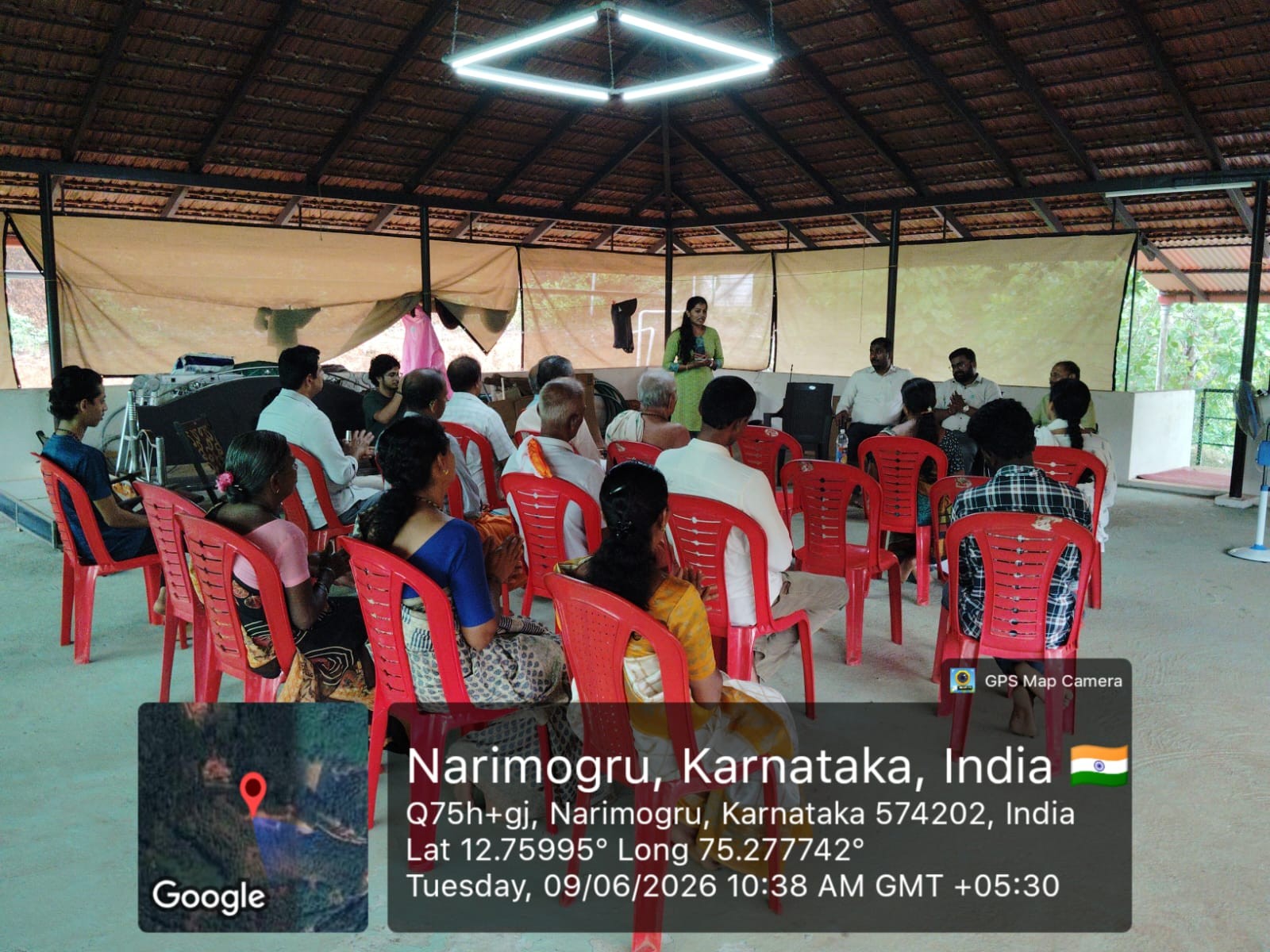
As part of the National Campaign on Khet Bachao Abhiyan, a field-level awareness programme was organized at the farm of Mr. Chandrashekhar in Uppinangadi, Puttur, Dakshina Kannada, Karnataka, with the objective of promoting scientific and balanced nutrient management practices and encouraging the use of vermicompost, biofertilizers, and green manuring for the restoration and preservation of soil fertility.
The programme was organized by a team of scientists comprising Dr. Venkatesh M.S., Principal Scientist (Team Leader), Dr. Vanitha K., Senior Scientist (Team Member), and Dr. Manjunatha K., Scientist (Team Member), in collaboration with officials from the Department of Agriculture and the Black Pepper Growers’ Association, Vitla, Puttur. The officials who participated in the programme included Dr. Shiva Shankar, Deputy Director of Agriculture (DDA) and Mr. Cheluvarangappa, Assistant Director of Agriculture (ADA), along with several progressive farmers associated with the Black Pepper Growers’ Association. The programme commenced with an introductory address by Dr. Shiva Shankar, who outlined the objectives of the campaign and emphasized the importance of balanced fertilizer application for sustainable crop production. This was followed by a field visit to the farm of Mr. Chandrashekhar, where participants observed integrated farming practices involving crops such as arecanut, black pepper, jackfruit, coffee and rubber. The farmer had successfully adopted green manure composting practices, and the farm was equipped with a sensor-based irrigation system. Farmers witnessed live demonstrations of composting techniques and engaged in discussions on various aspects of pest and disease management, soil health, and the balanced use of fertilizers.
In the afternoon session, following the field visit, Dr. Venkatesh M.S. delivered a lecture on the Importance of Soil Testing and Balanced Use of Fertilizers. Subsequently, Dr. Vanitha K. presented on various aspects of pest and disease management in plantation crops. Dr. Manjunatha K. delivered a presentation on the Need for Farm Mechanization and Its Role in Improving Agricultural Productivity. The technical sessions were followed by an interactive scientist–farmer discussion, during which participants shared their experiences and clarified their queries related to crop production and farm management. The programme concluded with a vote of thanks at 5:30 PM. A total of 66 participants attended the programme, including 60 male farmers and 6 female farmers.
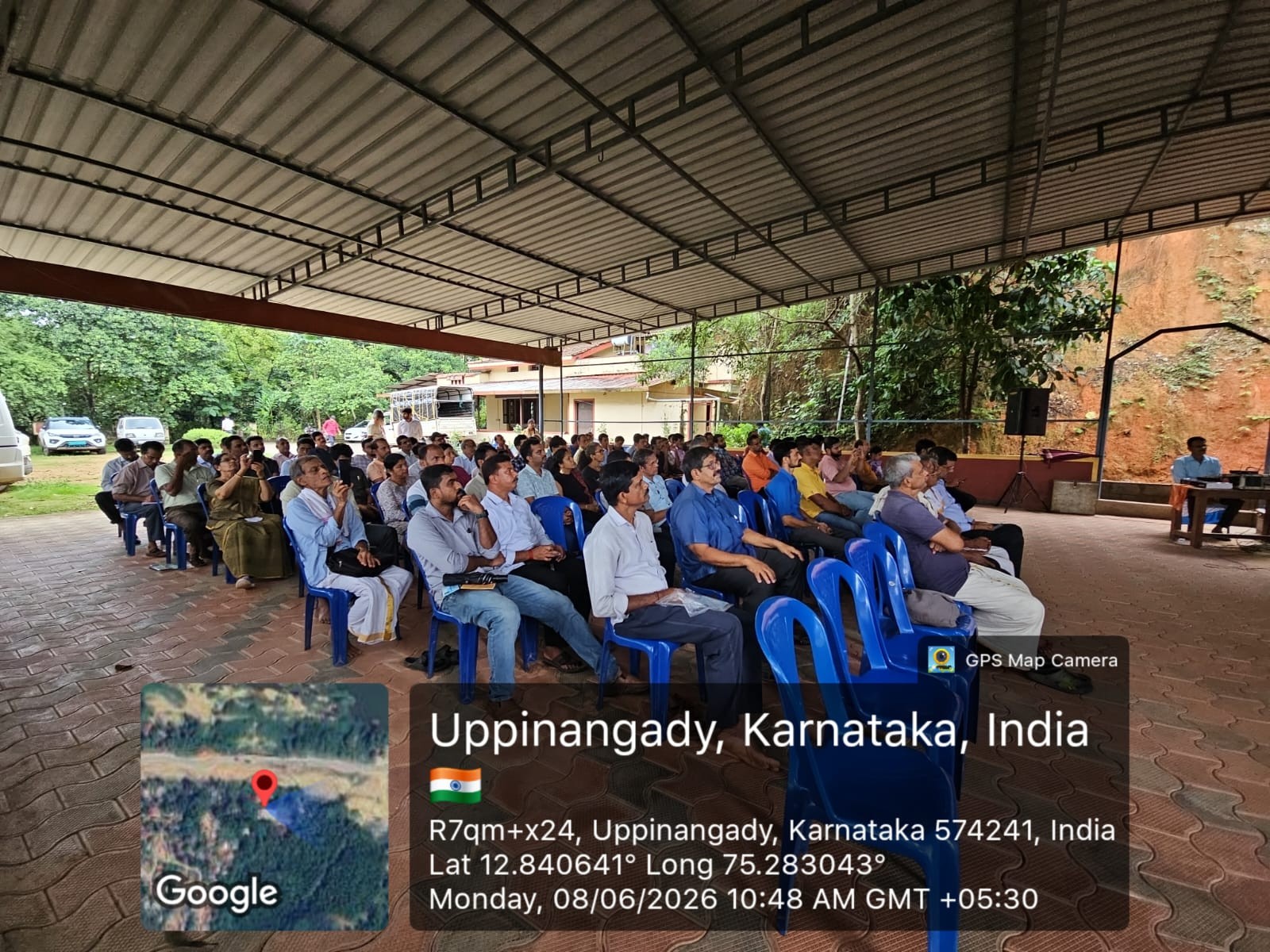
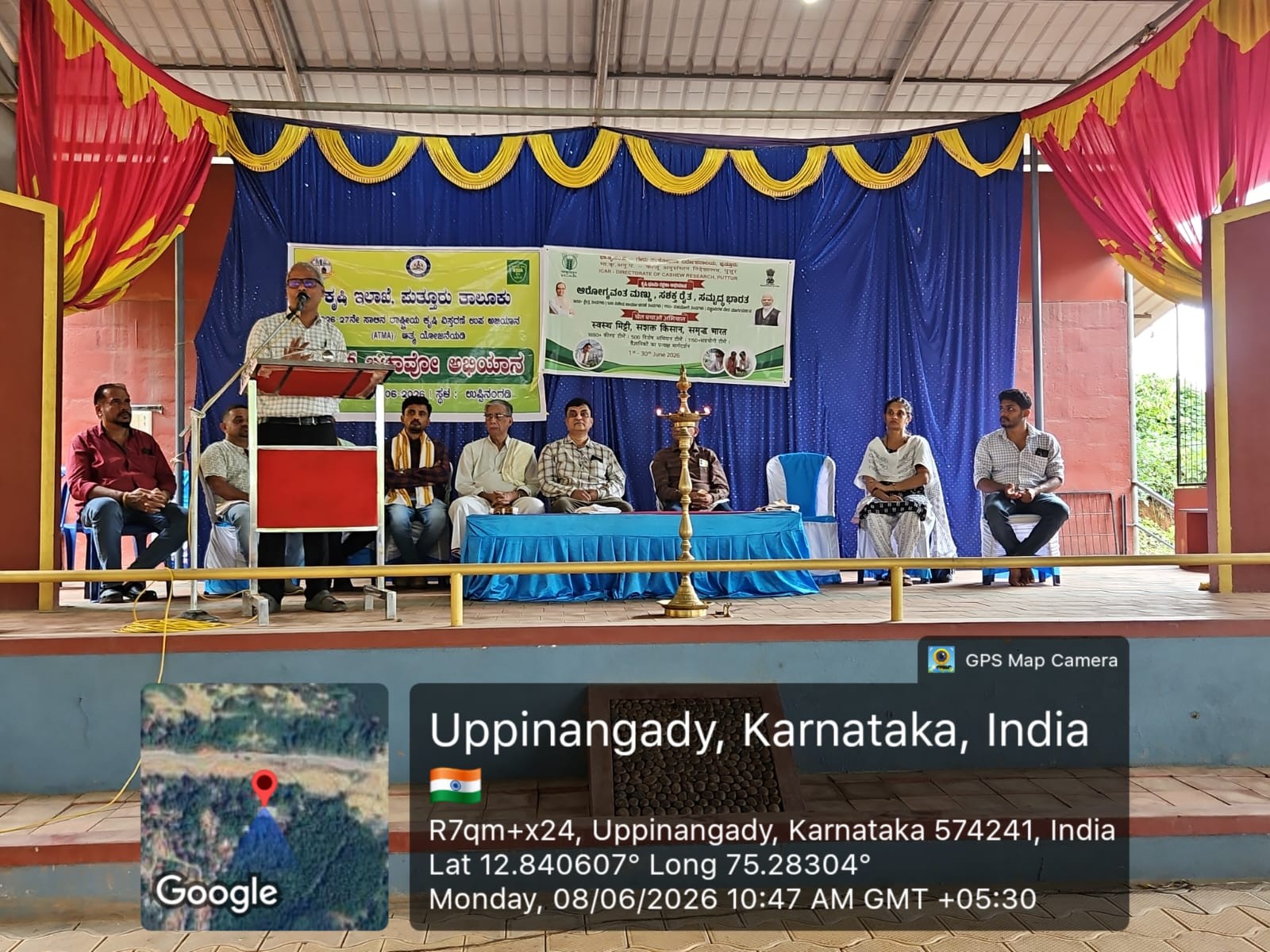
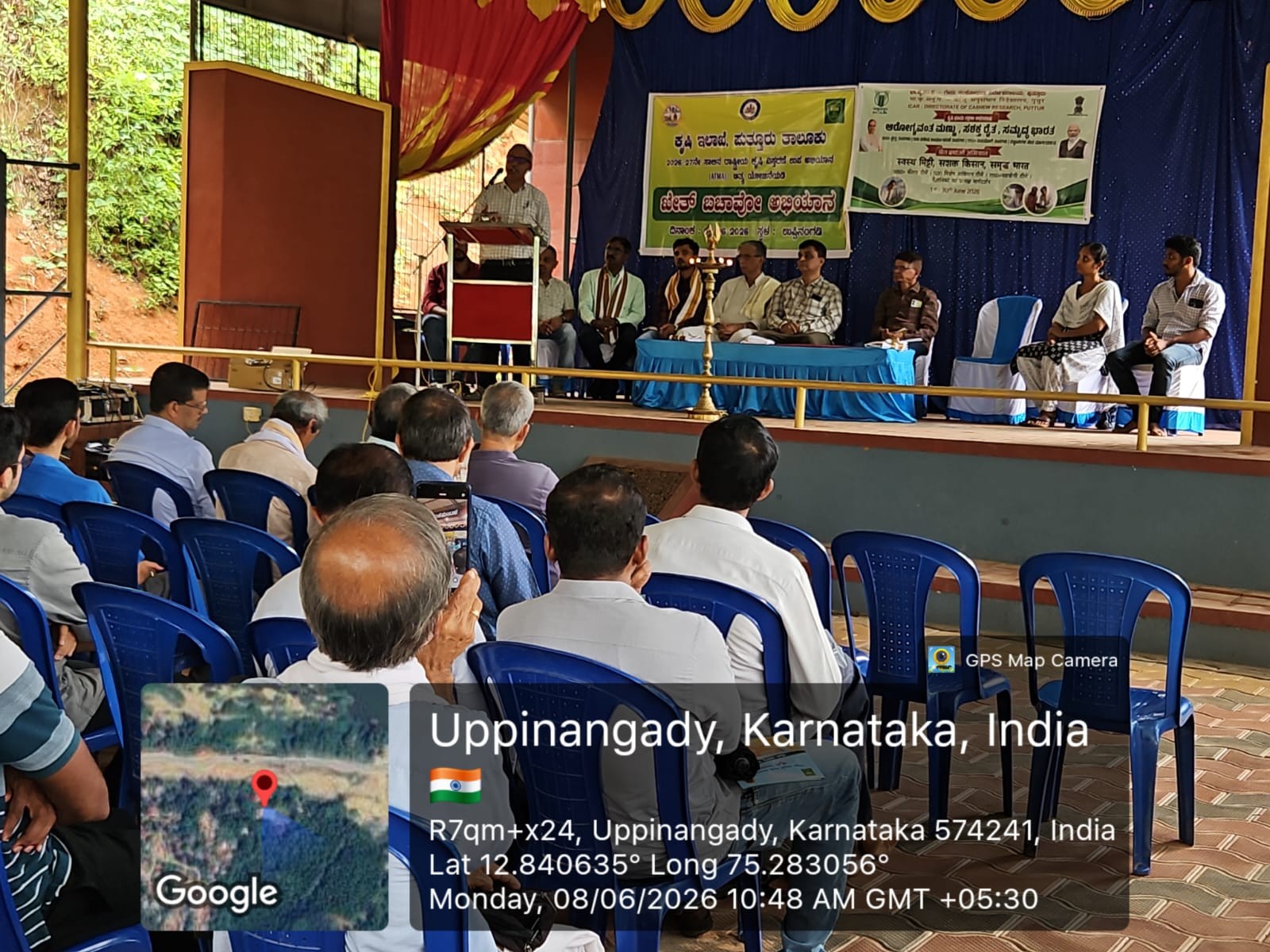
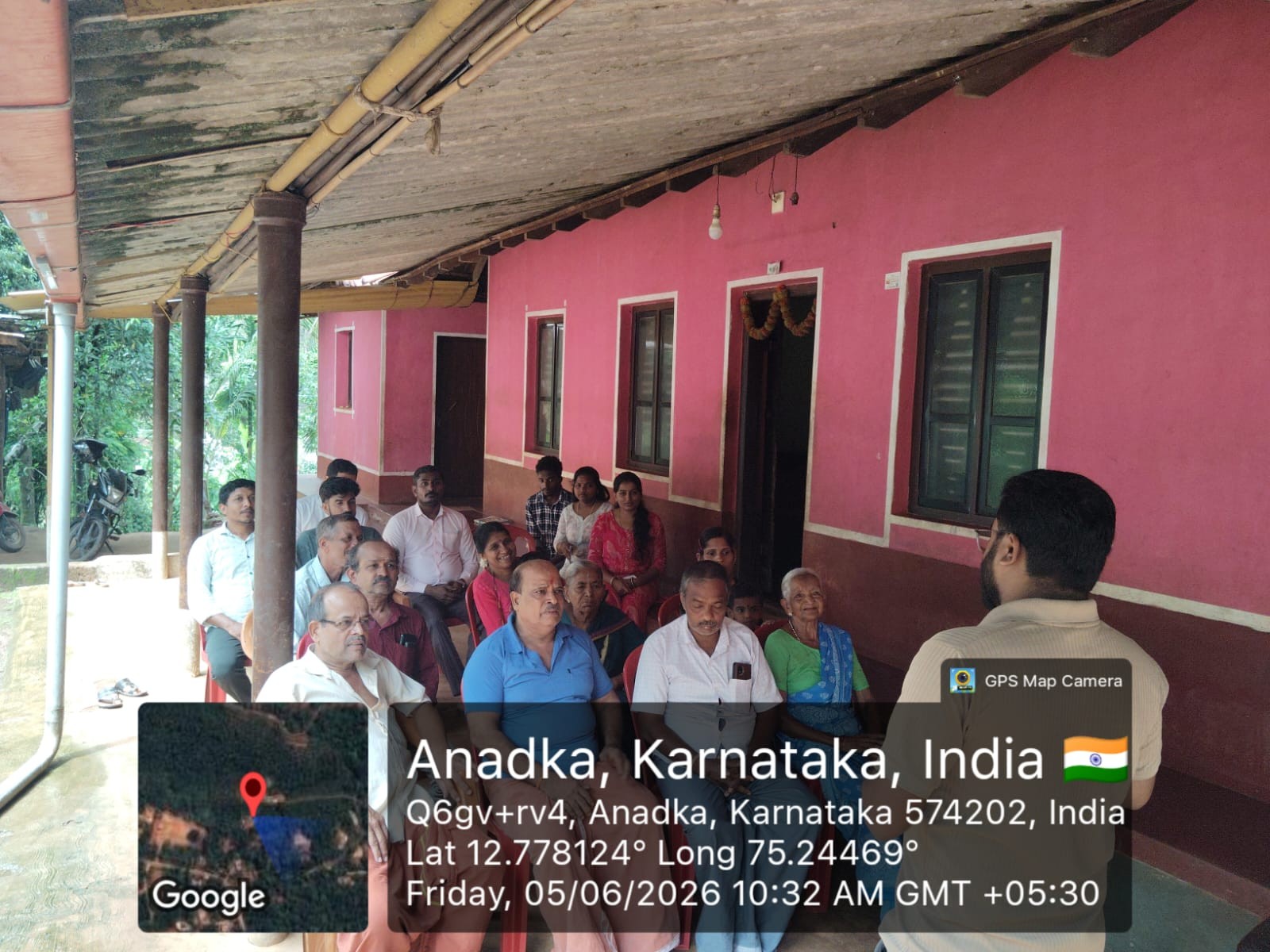
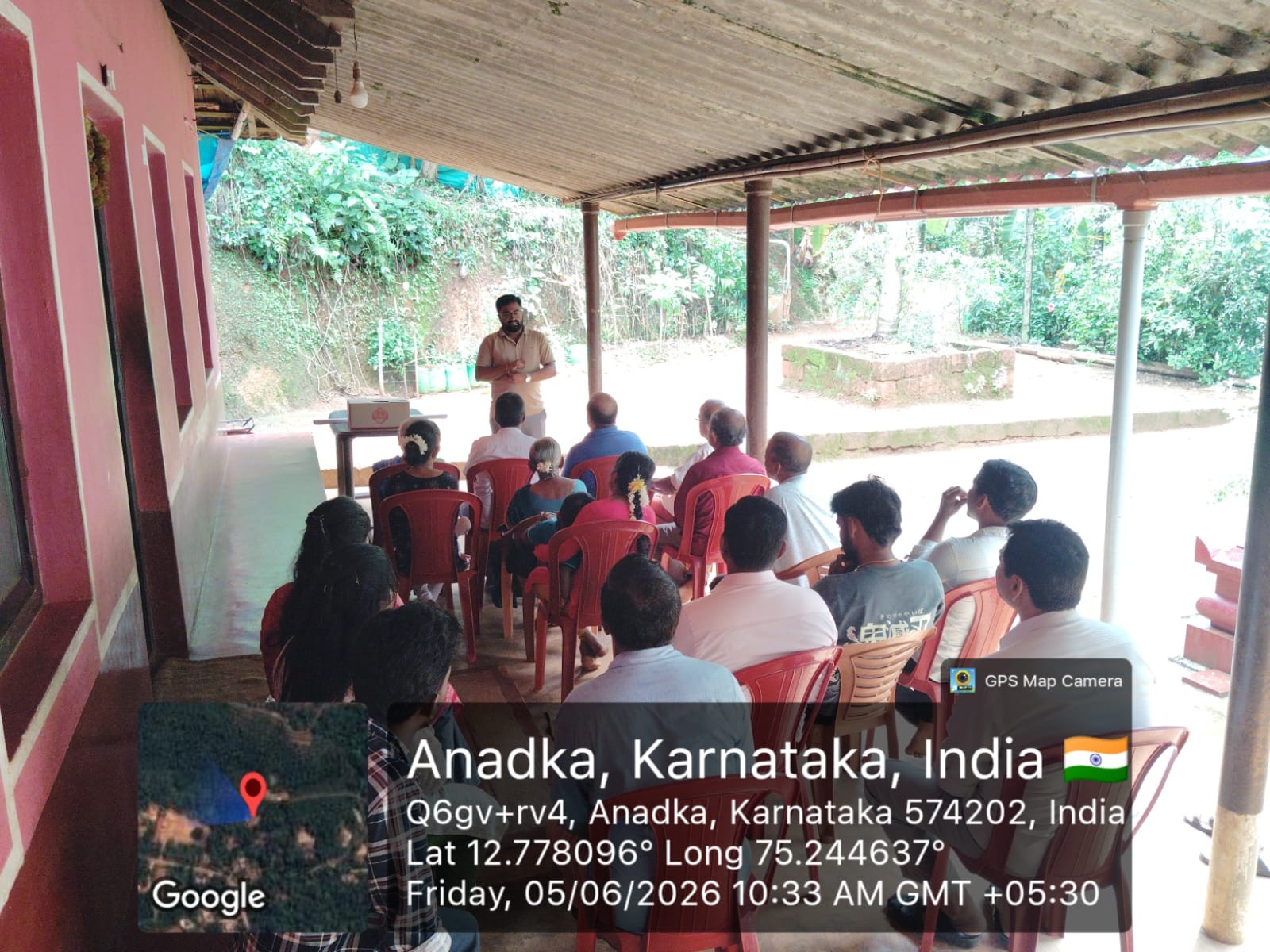
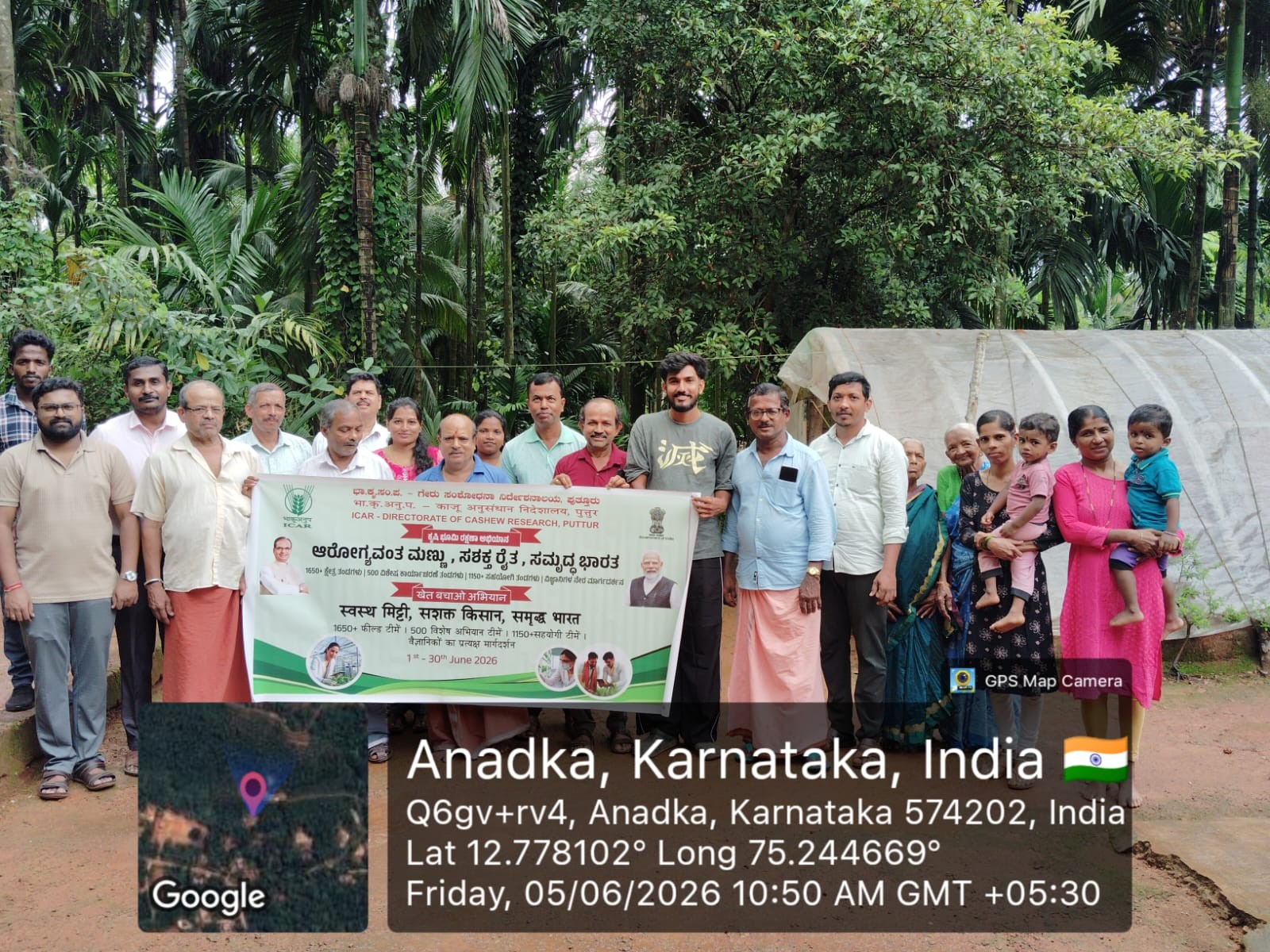
An awareness program on the above subject was conducted in Anadka village of Puttur Taluk, Dakshina Kannada district, Karnataka state, on 05-06-2026. The program was started with a welcome by Dr V. Thondaiman. This was followed by a briefing about the program by Dr. Manjesh, G.N.
There was a brief lecture on importance of organic farming and hazardous effect of using chemical fertilizer by Dr. Manjesh, GN and farmers were interacted with the staff regarding pest and disease management of arecanut, cashew and coconut. The demonstration on soil sample collection for soil test was done in the farm.
The farmers are advised to soil test based nutrient management for all the crops.
A total of 20 participants were present during the meeting. In the end, Dr. V. Thondaiman proposed a vote of thanks.
[Organisers: Drs. Mohana, G.S., V. Thondaiman and Manjesh G.N].
Number of participants: 18 (M:9, F: 9)
Interaction with the input dealer: No
Interaction with Panch / Sarpanch: Yes
Awareness programmes undertaken during visit: For Khet Bachao Abhiyan for creating awareness on balanced application of nutrition and awareness on composting and vermicomposting
Any demonstration of green manuring: No
Biofertilizers: No
Any Local Learning/Observation Recorded: Few farmers practicing composting and having an idea of soil test-based fertilizer application and use of amendments for problematic soils
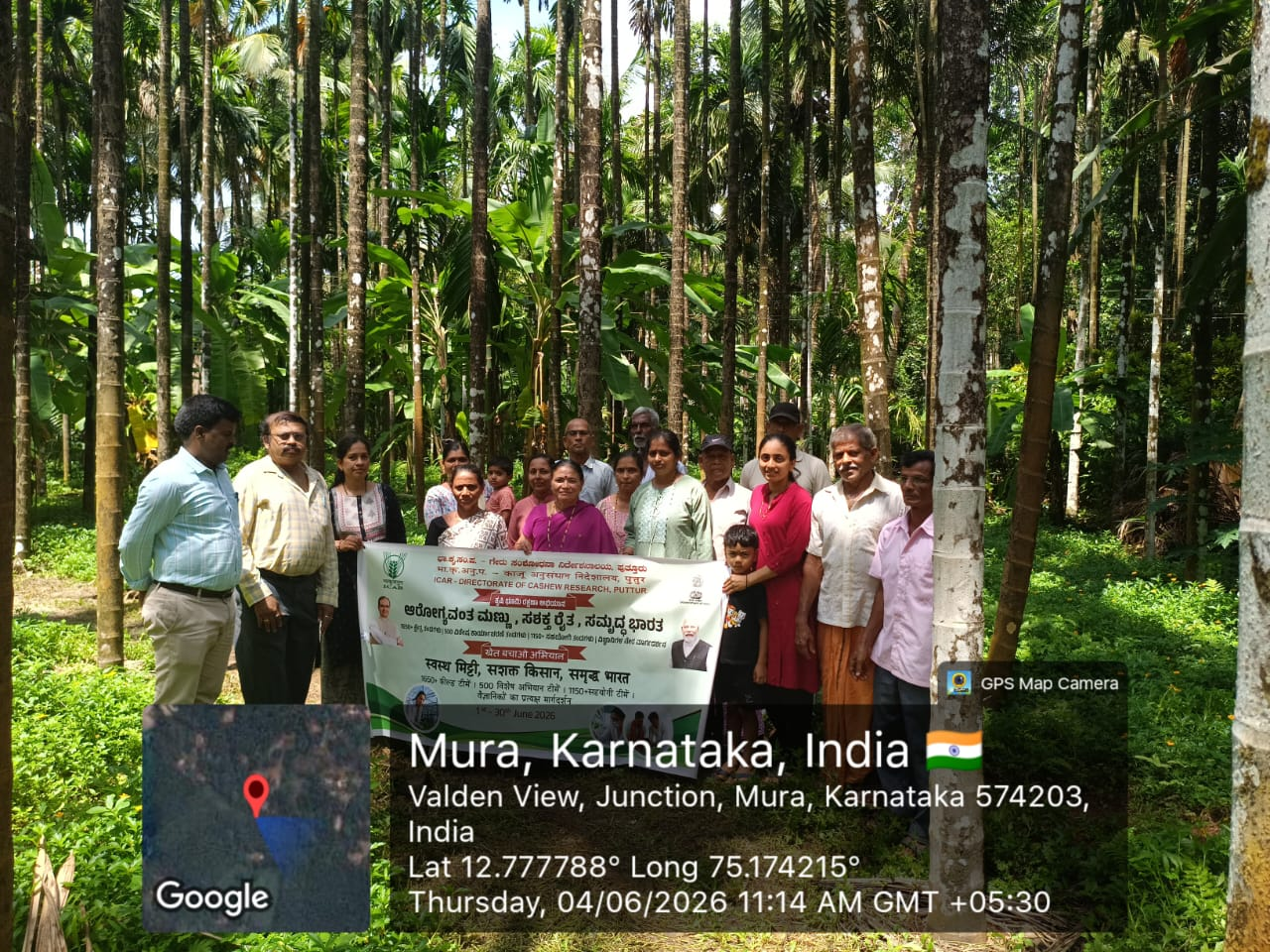
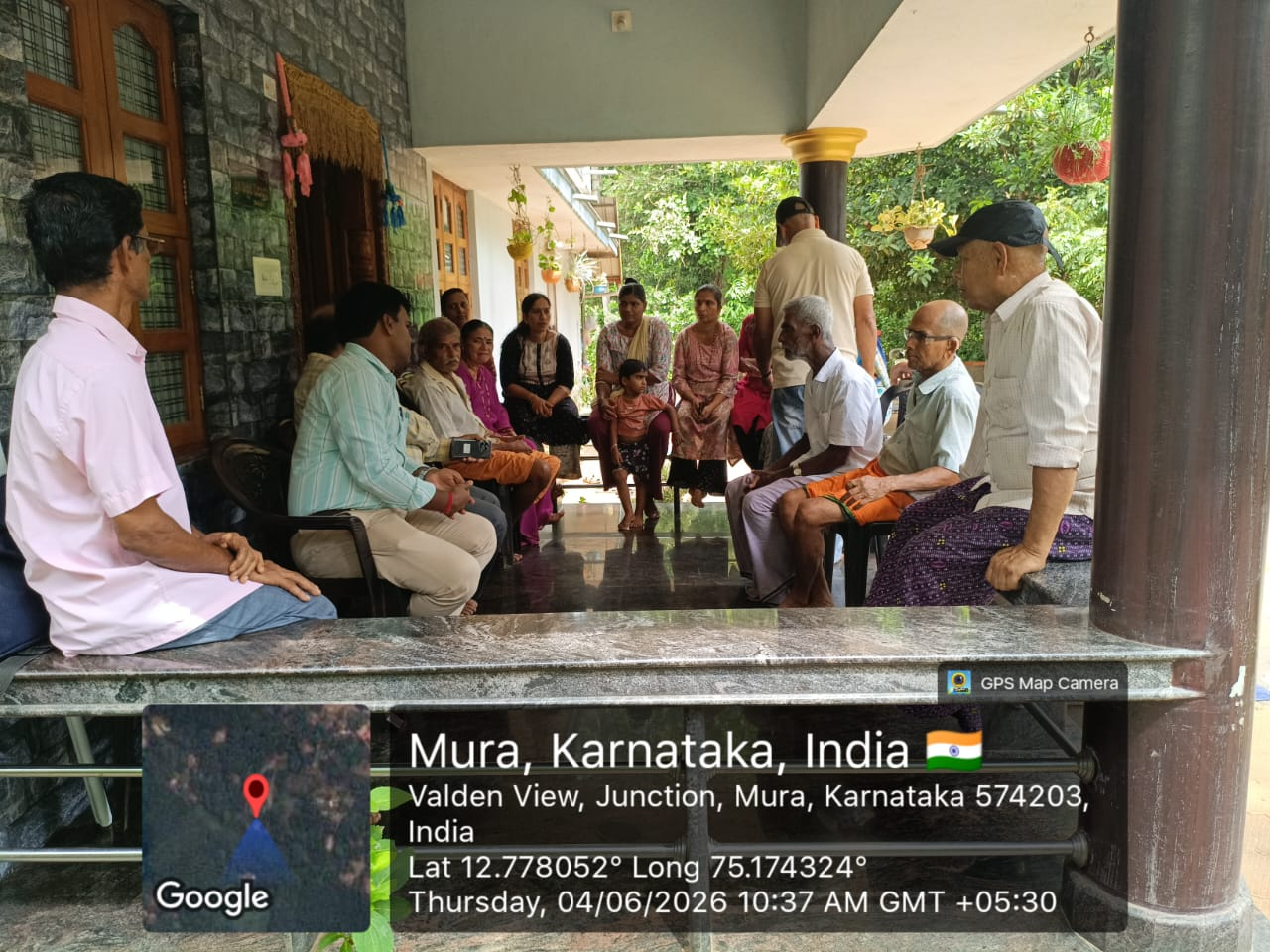
An awareness programme on “Khet Bachao Abhiyan” with major emphasis on adoption of Science-Based Nutrient and Other Input Management” was organised at Mura on 04.06.2026 to create awareness among farmers about balanced nutrient management, scientific use of agricultural inputs, and sustainable practices in horticultural crops.
The programme began with a welcome address by Sri. Sheshappa Gowda, Progressive farmer and Dr. T. N. Raviprasad, who greeted the participants and emphasized the importance and objectives of the campaign and also briefed the gathering on the significance of adopting science-based nutrient and input management practices for enhancing crop productivity and maintaining soil health. Subsequently, Dr. Rajashekara H. emphasized about biocontrol agents and their multiplication and application in the field. The participants from Mura village were attended programme, who actively participated in the discussions.
An interactive session with the farmers formed an important part of the programme. Farmers shared their prevailing fertiliser management practices in horticultural crops and sought clarification on the appropriate methods, dosage, and timing of fertiliser application. The experts addressed the queries and highlighted the importance of soil test-based nutrient management to prevent nutrient imbalance and improve productivity sustainably. A total of 18 participants (Male: 09; Female: 09) attended the programme.
[Organisers: Dr TN Raviprasad and Dr. Rajashekara H.].
Organizing Institute: ICAR-Directorate of Cashew Research, Puttur, Karnataka
Scientific Team: Dr. Balasubramanian D, Principal Scientist, ICAR-DCR, Puttur, Karnataka
Dr. Babli Mog, Senior Scientist, ICAR-DCR, Puttur
Dr. Veena G L., Senior Scientist, ICAR-DCR, Puttur
Dr. Bhagya H P, Scientist, ICAR-DCR, Puttur
Number of participants:19 (Male -7, Femele-12)
Interaction with Input dealer: No
Interaction with Panch/Sarpanch: No
Awareness programmes undertaken during visit:
- Awareness on balanced fertilizer use
- Organic farming for horticultural crops
- Special attention on green manuring and other organic substitutes
In this awareness programme, we have emphasized on soil test-based fertilizer application and importance of soil testing in perennial crops. Usage of organic inputs like compost, biofertilizer, green leaf manuring, panchagavya and recycling of farm waste as insitu decomposition.etc.
Any demonstration of green manuring: No
Biofertilizers: No
Any Local Learning/Observation Recorded:Nil
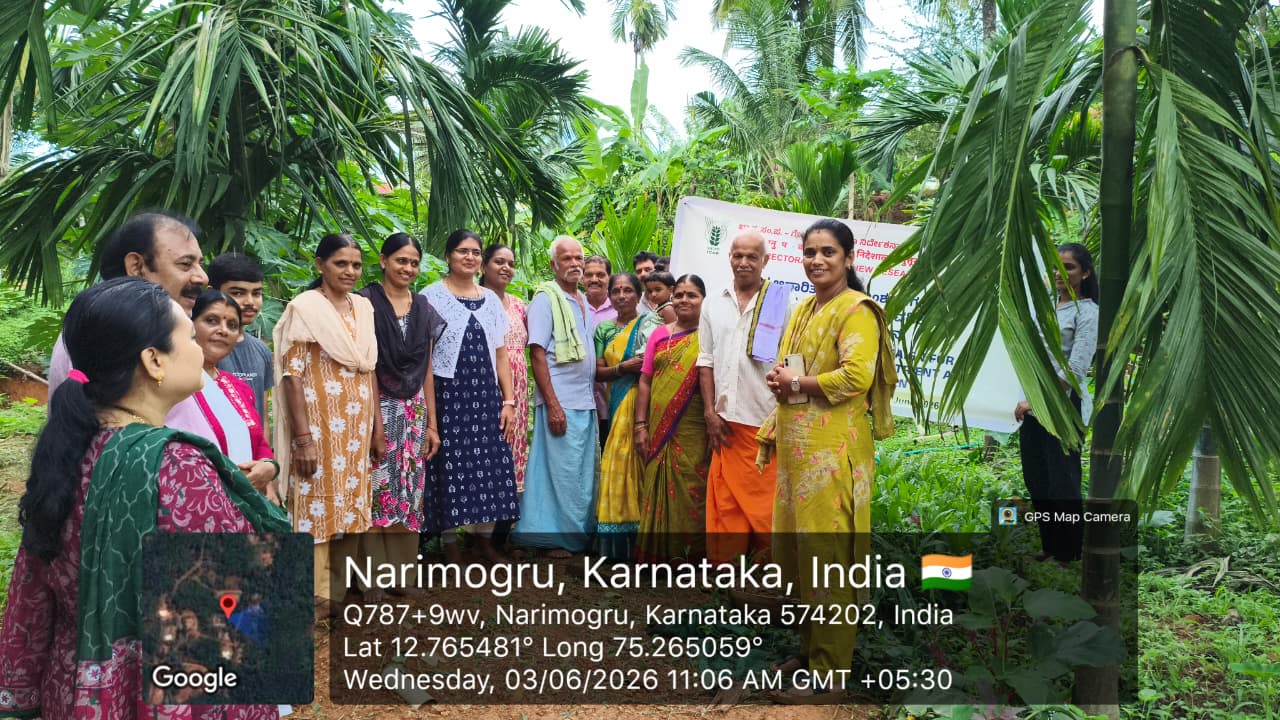
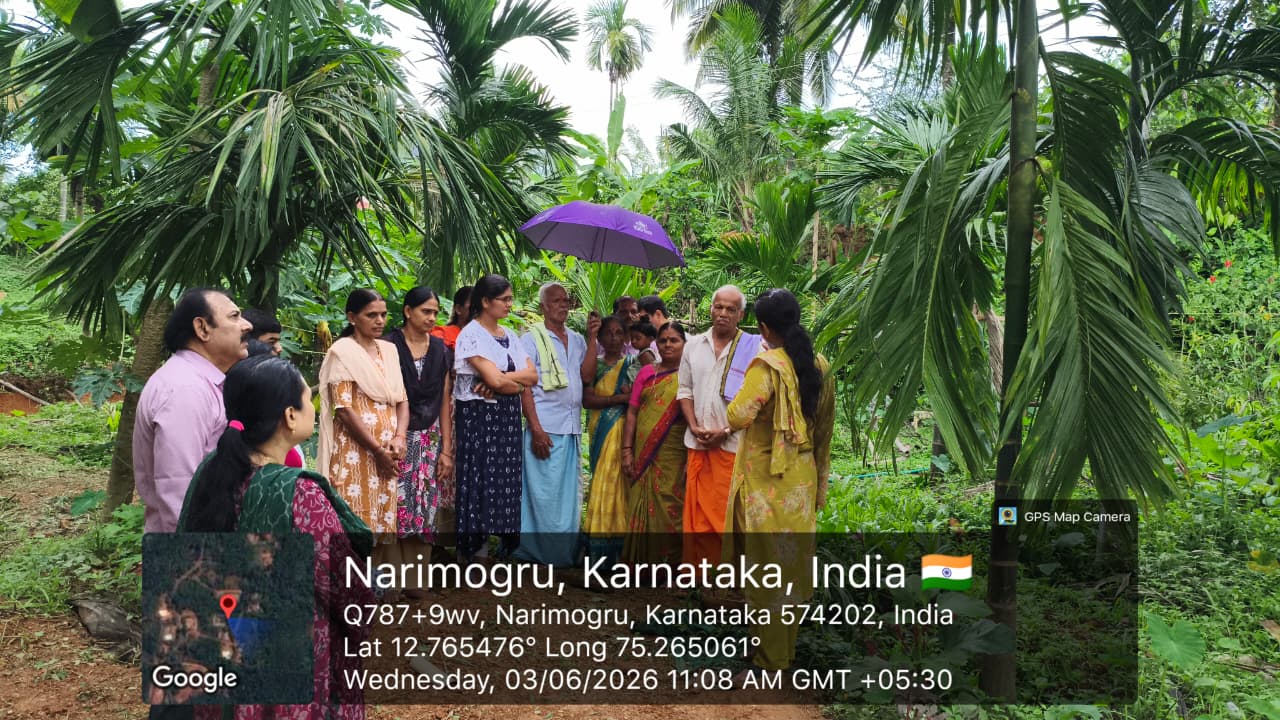
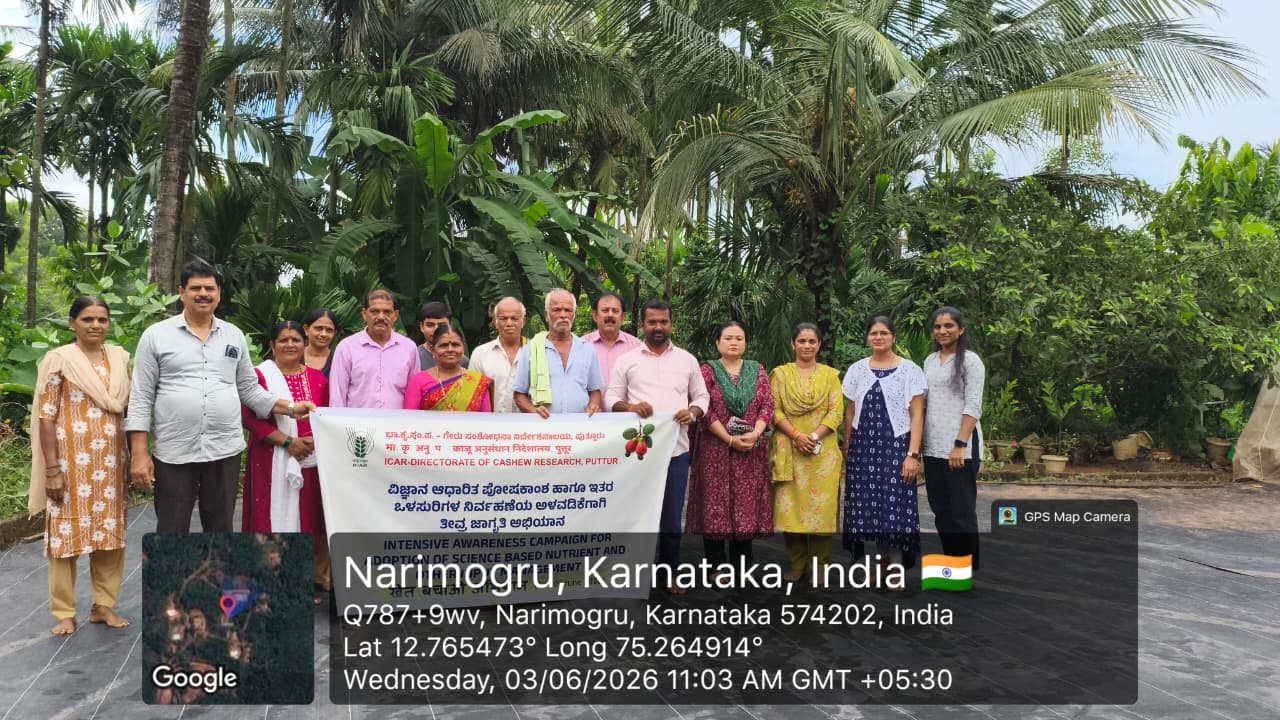
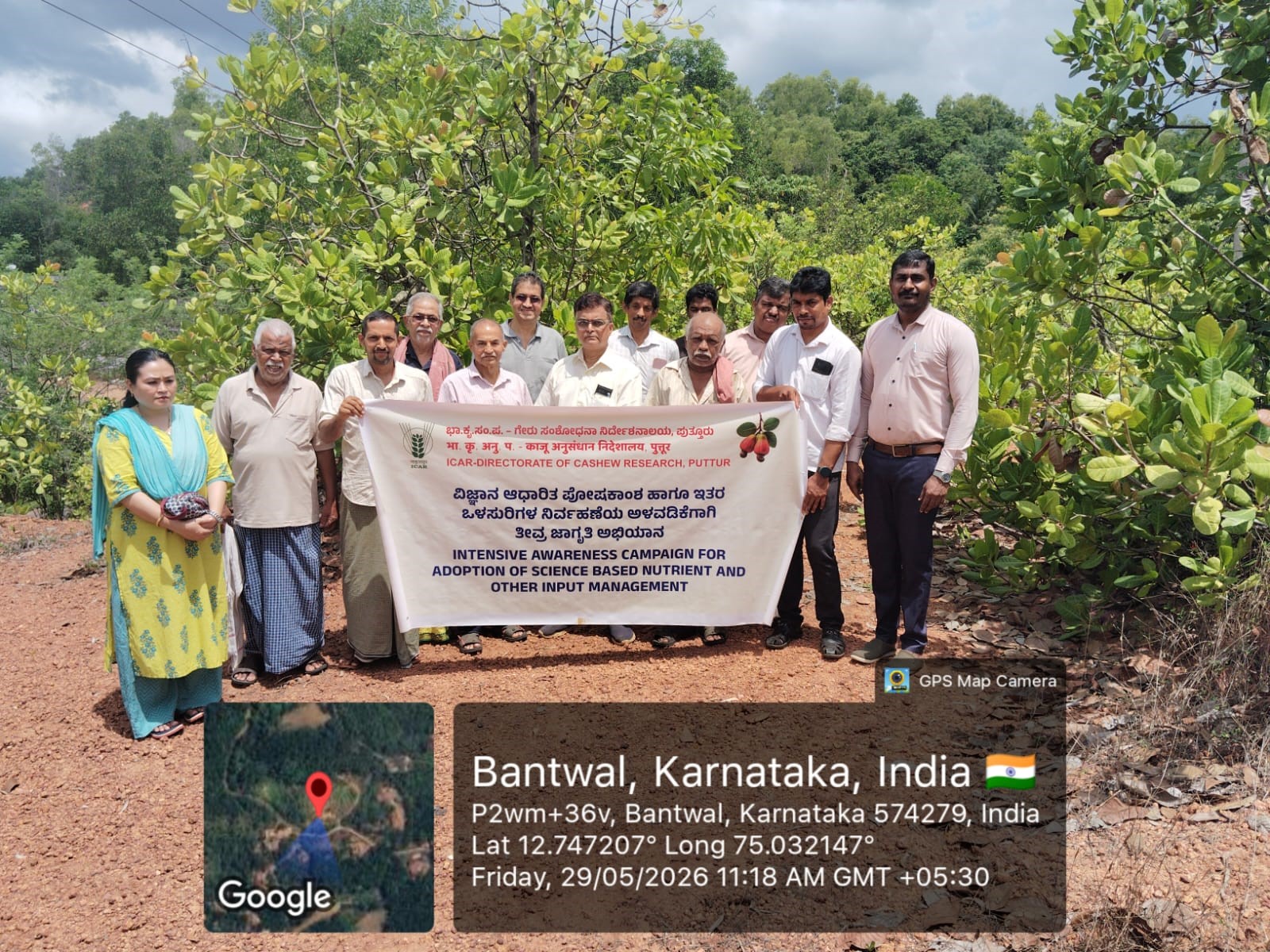
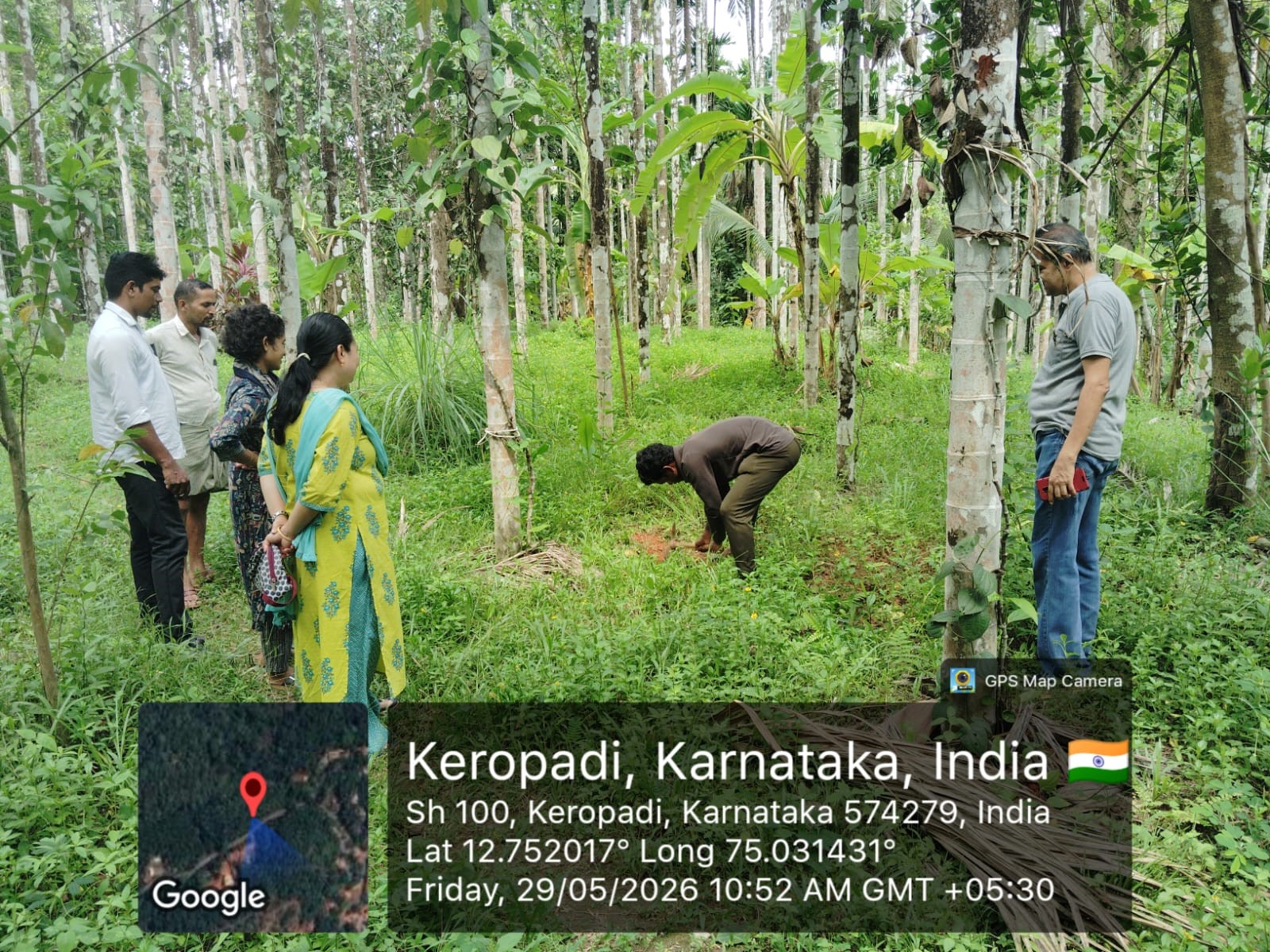
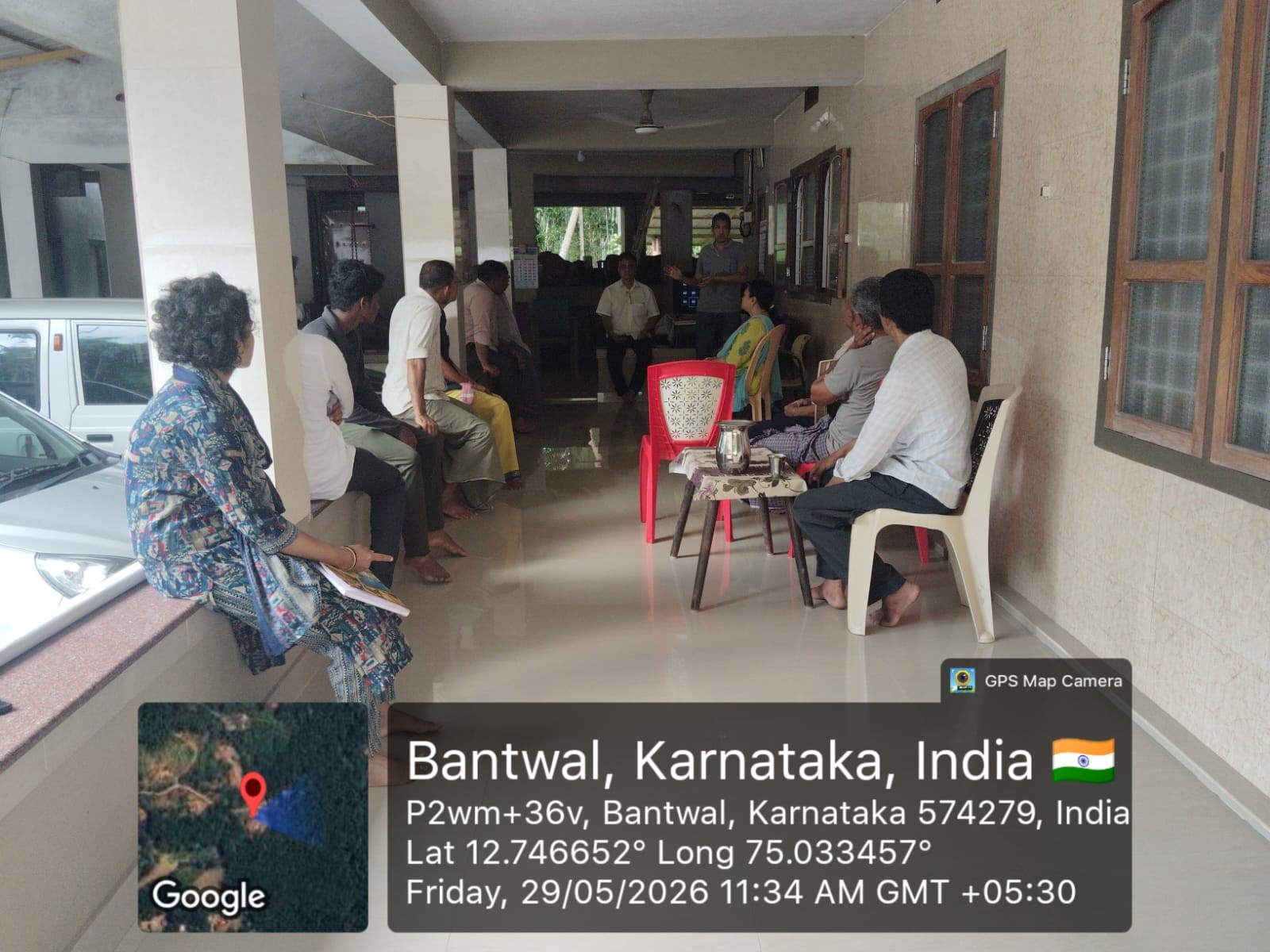
An awareness program on the above subject was conducted in Keropadi, Kanyana village of Bantwal Taluk, Dakshina Kannada district, Karnataka state, on 29-05-2026. The program was started with a welcome by Dr Babli Mog. This was followed by a briefing about the program by Dr. Venaktesh MS.
There was an interesting interaction among the farmers regarding the usage of fertilisers in Mr. Krishnaprsad’s cashew farm, who has hosted this meeting. The cashew farm has the Bhaskara variety in 1.5 acres. Dr. Venkatesh, Principal Scientist (Soil Science) has explained about soil and nutrient management practices of cashew. The demonstration on soil sample collection for soil test was done in the farm and the soil samples from the farmers field was also collected for soil testing. The farmer uses poultry manure along with chemical fertilisers for cashew. The farmers gathered om this event were advised to apply farmyard manure along with the vermicompost. The booklet on good agricultural practices in cashew was distributed to the farmers.
In addition, the farmers were sensitised to the utilisation of cashew apples, which are largely wasted.
A total of 20 participants were present during the meeting. In the end, Dr. V. Thondaiman proposed a vote of thanks.
Scientific Team: Dr. Bhagya H P, Scientist, ICAR-DCR, Puttur
Dr. Vanitha, K., Senior Scientist, ICAR-DCR, Puttur
Number of participants:38 (Male -17, Femele-21)
Interaction with Input dealer: No
Interaction with Panch/Sarpanch: No
Awareness programmes undertaken during visit:
- Awareness on balanced fertilizer use
- Organic farming for horticultural crops
- Special attention on green manuring and other organic substitutes
In this awareness programme, we have emphasized on soil test-based fertilizer application and soil sampling methodology and importance of soil testing in perennial crops. Demonstrated soil sampling in cashew plantation. Usage of organic inputs like compost, biofertilizer, green leaf manuring, and recycling of farm waste as insitu decomposition.
Any demonstration of green manuring: No
Biofertilizers: No
Any Local Learning/Observation Recorded: Nil
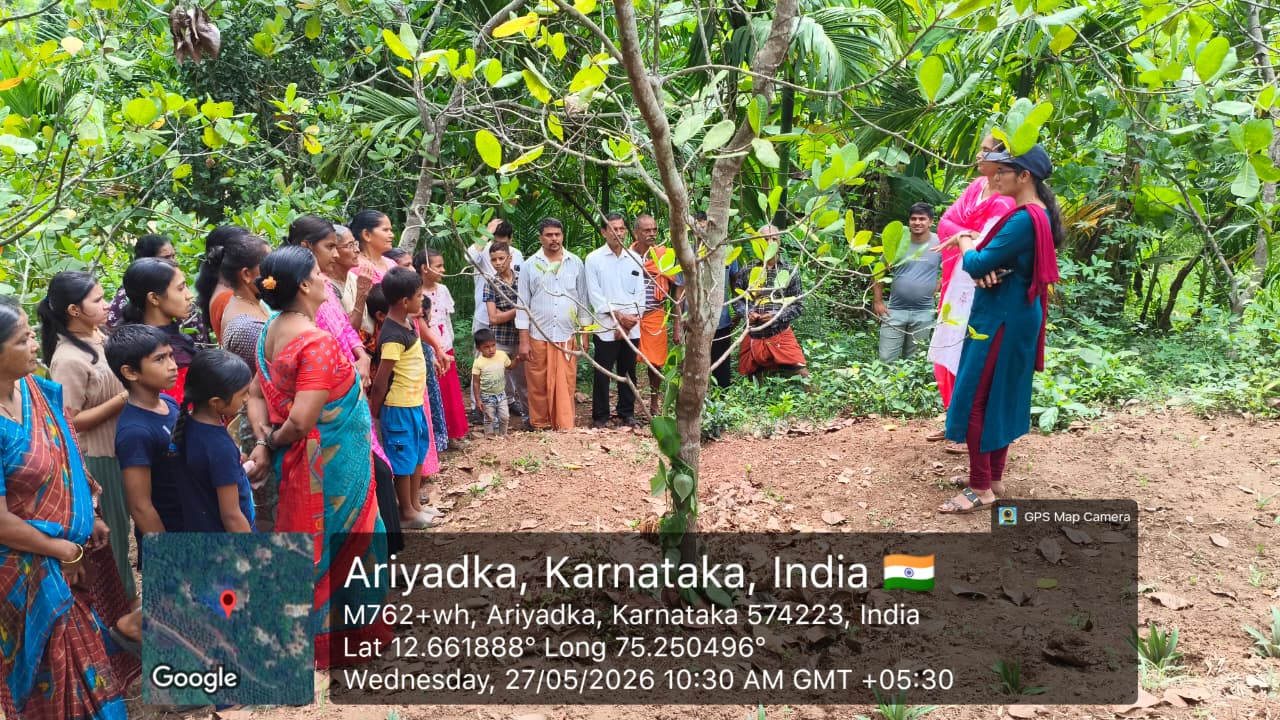
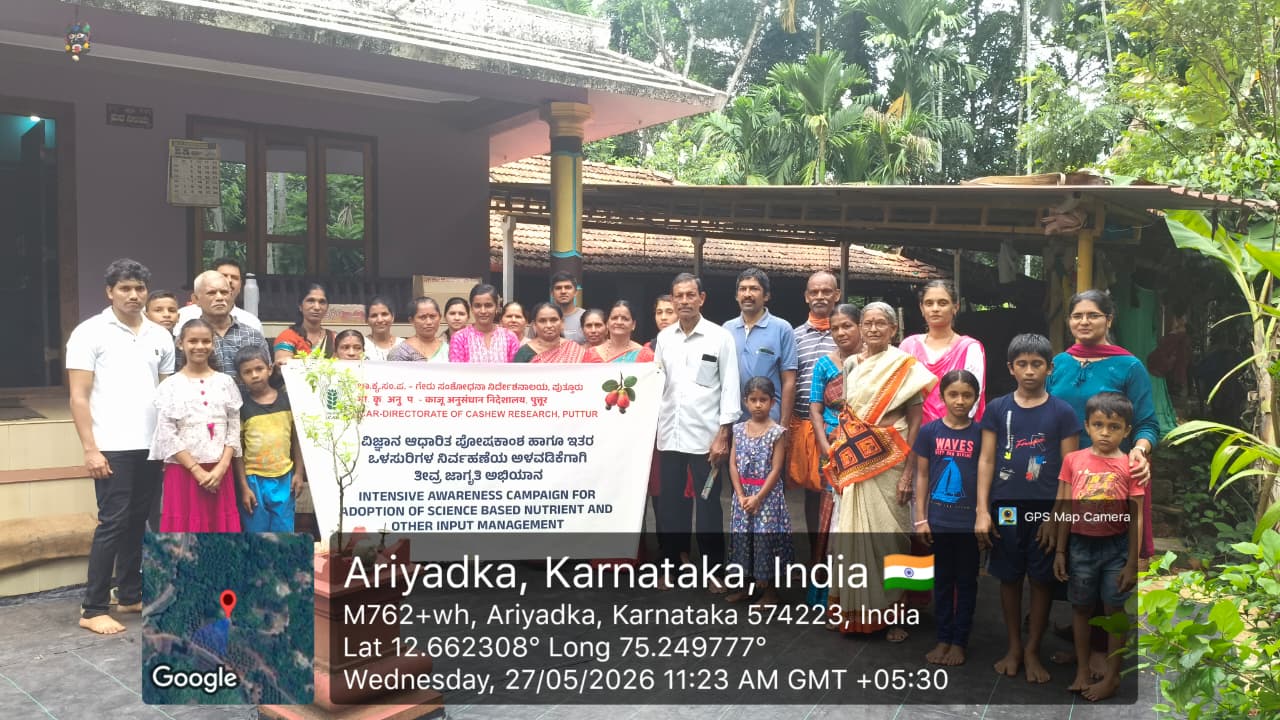
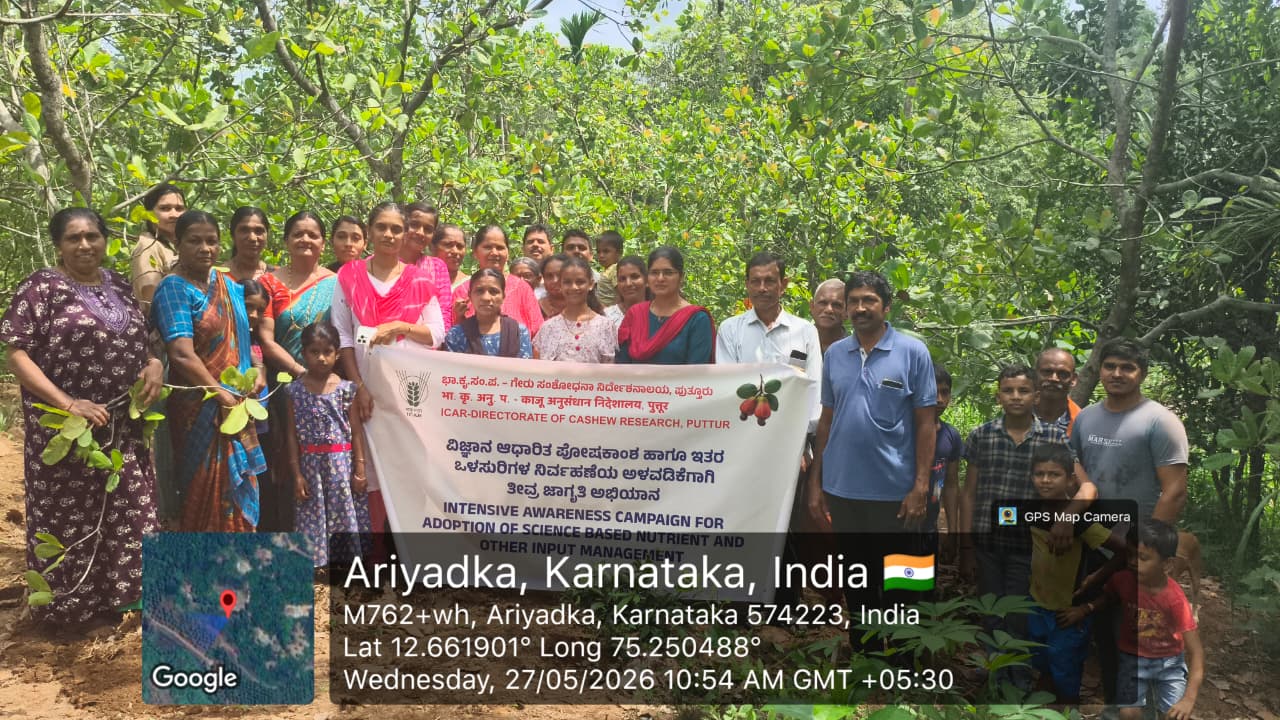
As part of the National Campaign on Balanced Use of Fertilizers, a field-level awareness programme was organized at Shantigodu, Puttur, Dakshina Kannada, Karnataka, to promote scientific and balanced nutrient management practices involving NPK fertilizers, micronutrients, and organic manures for sustaining soil fertility and enhancing crop productivity. The programme was conducted by a team of scientists comprising
Dr. Mohan G.S., Principal Scientist; Dr. Manjesh G.N., Scientist; and Dr. Manjunatha K., Scientist. The programme commenced with a welcome and introductory address by
Dr. Manjesh G.N., who emphasized the importance of balanced fertilizer application and outlined the objectives of the national campaign. Dr. Mohan G.S. delivered a session on organic farming, soil health management, different cashew varieties, and value addition of cashew apple for generating additional farm income. Dr. Manjunatha K. highlighted the importance of soil testing and scientific methods of soil sample collection for efficient orchard management. A total of 27 participants attended the programme, comprising 21 male farmers and 6 female farmers.
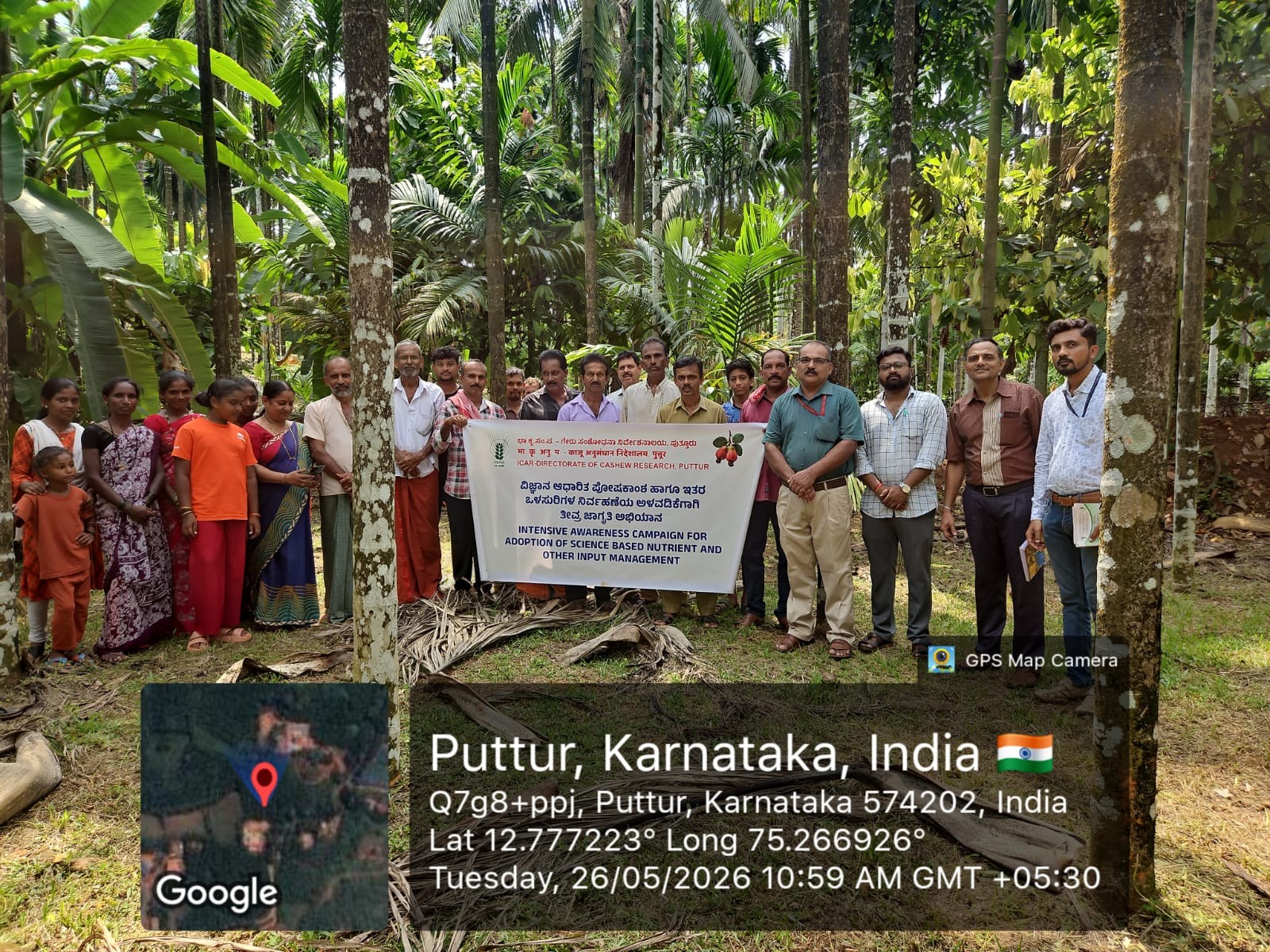
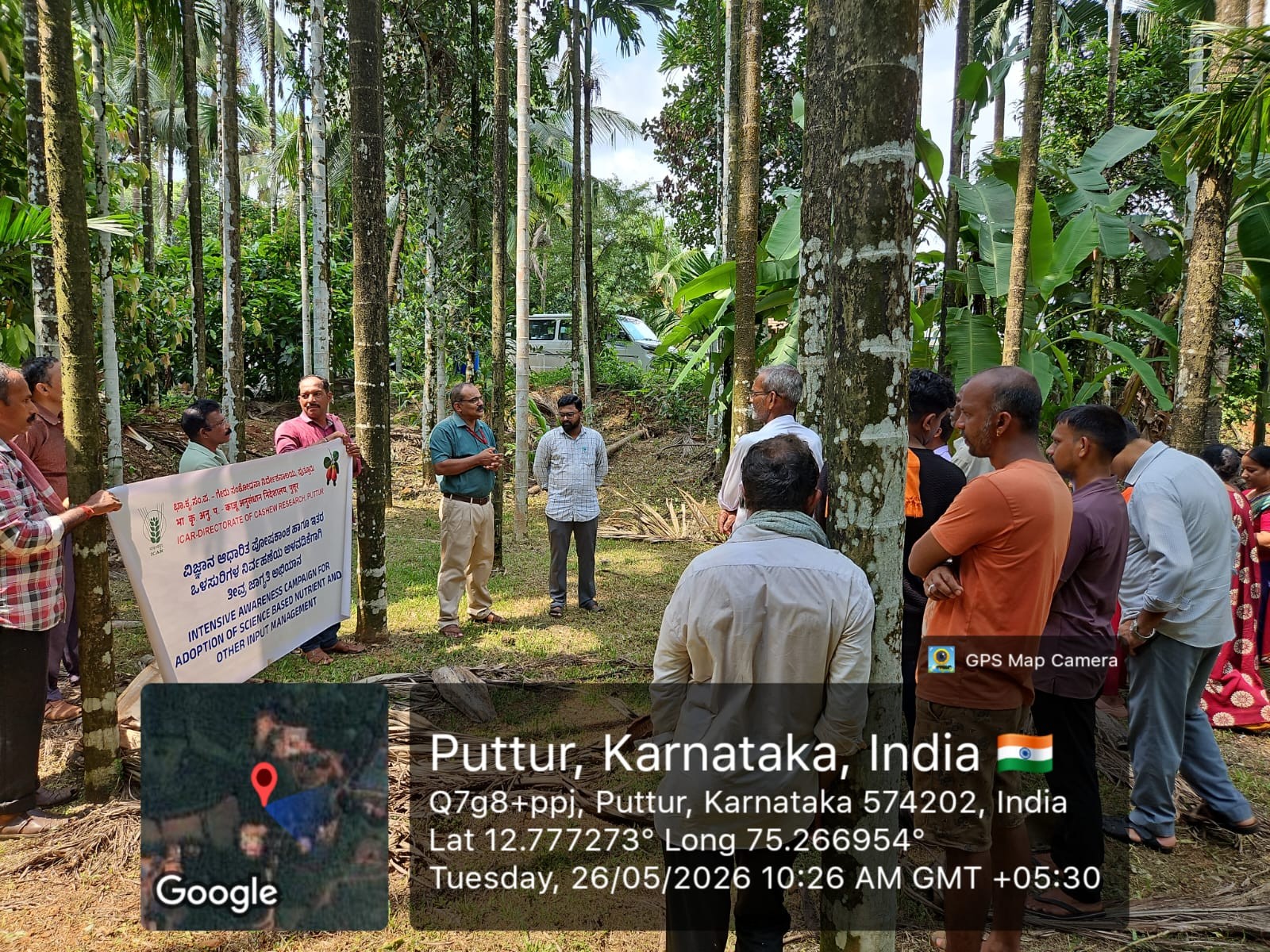
Number of participants: 22 (M:22, F: 0)
Interaction with the input dealer: No
Interaction with Panch / Sarpanch: Yes
Awareness programmes undertaken during visit: Balanced application of nutrition and awareness on composting and vermicomposting
Any demonstration of green manuring: No
Biofertilizers: No
Any Local Learning/Observation Recorded: Few farmers practicing composting and having an idea of soil test-based fertilizer application and use of amendments for problematic soils
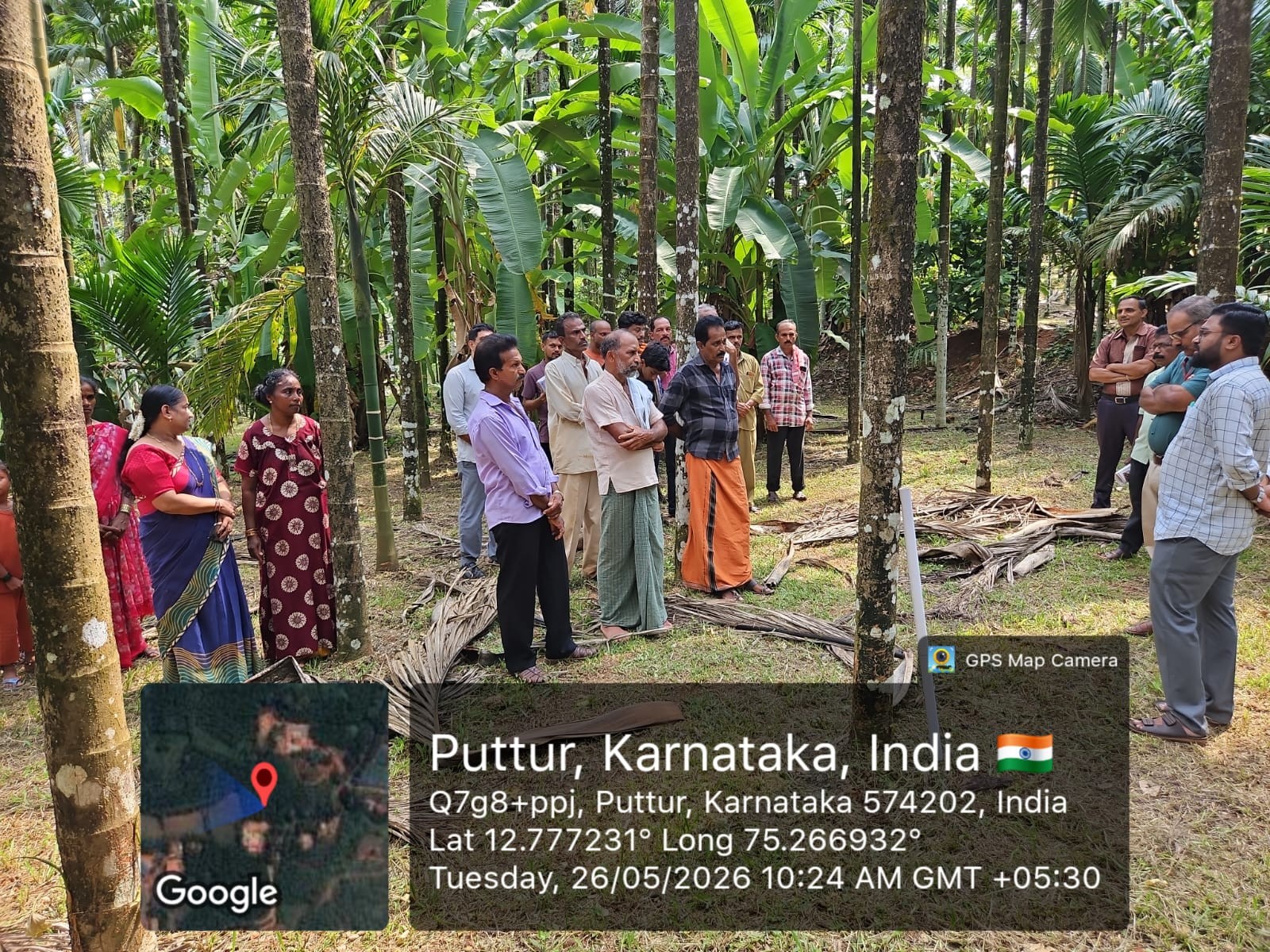
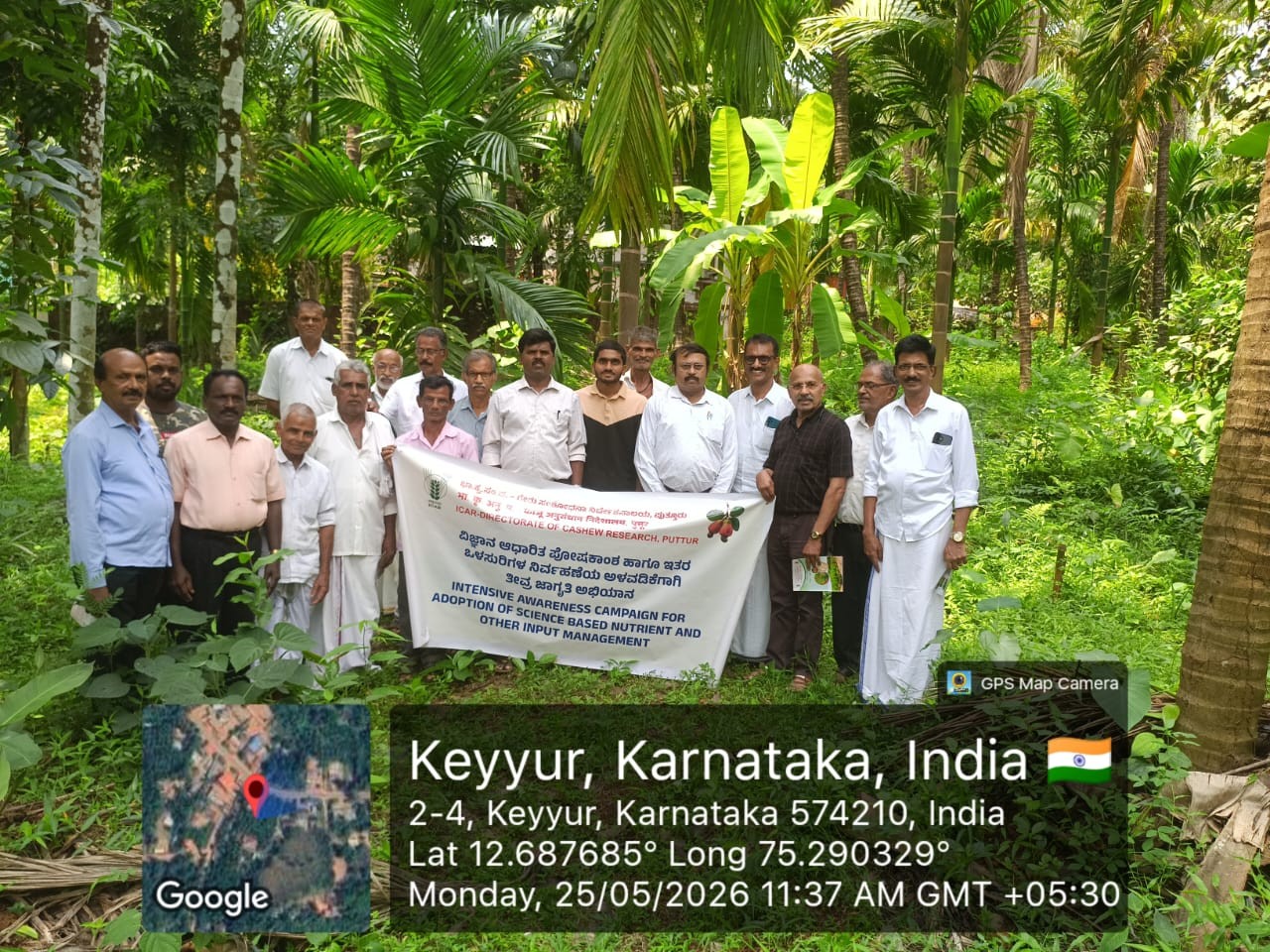
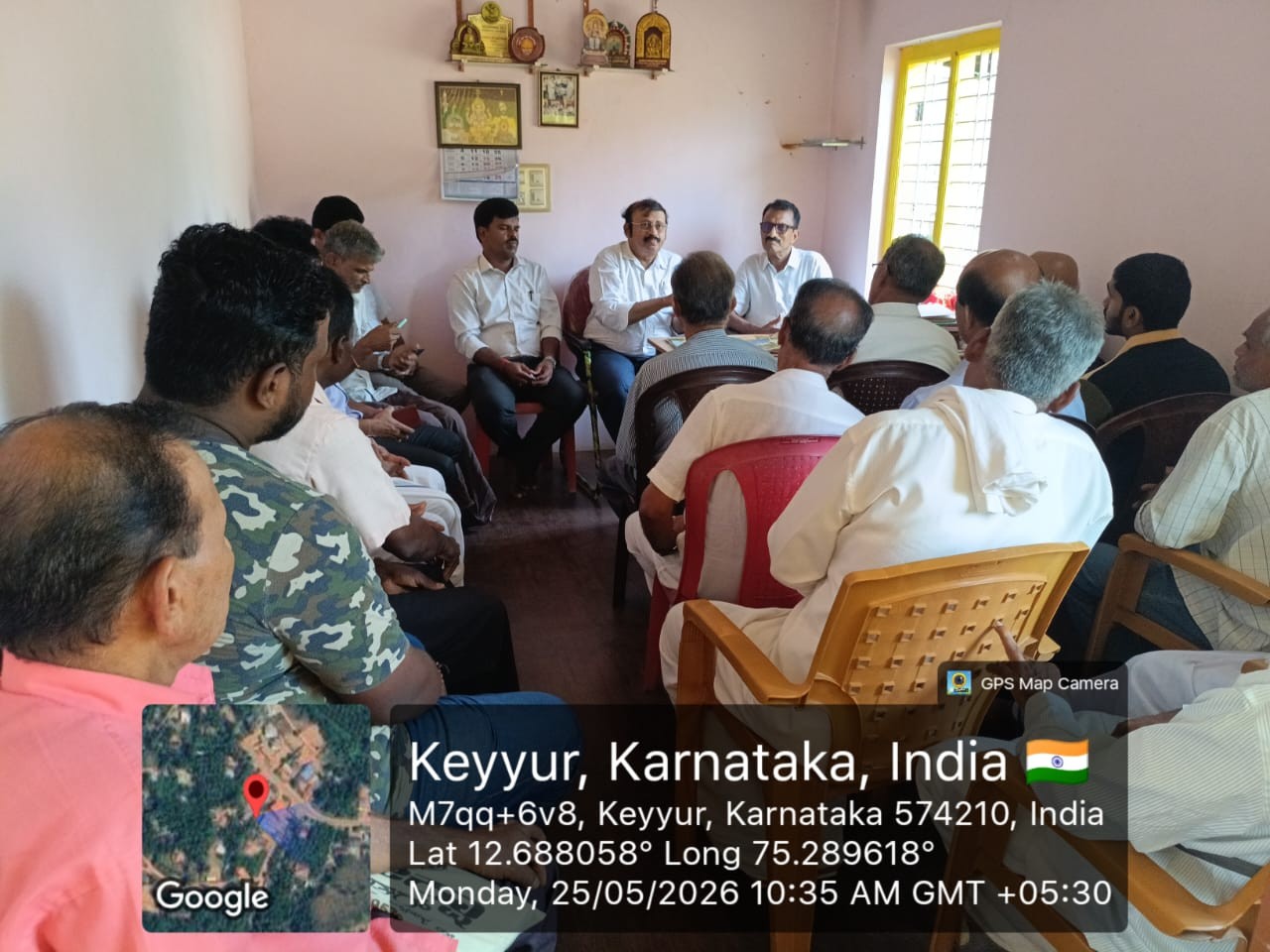
An awareness programme on “Adoption of Science-Based Nutrient and Other Input Management” was organised at Keyyur on 25 May 2026 to create awareness among farmers about balanced nutrient management, scientific use of agricultural inputs, and sustainable practices in horticultural crops.
The programme began with a welcome address by Sri. Jayaram, Progressive farmer and Dr. T. N. Raviprasad, who greeted the participants and emphasized the importance and objectives of the campaign and also briefed the gathering on the significance of adopting science-based nutrient and input management practices for enhancing crop productivity and maintaining soil health. Subsequently, Dr. Rajashekara H. emphasized about biocontrol agents and their multiplication and application in the field. The participants from Madavu, Airkilla and Keyyur were attended programme, who actively participated in the discussions.
An interactive session with the farmers formed an important part of the programme. Farmers shared their prevailing fertiliser management practices in horticultural crops and sought clarification on the appropriate methods, dosage, and timing of fertiliser application. The experts addressed the queries and highlighted the importance of soil test-based nutrient management to prevent nutrient imbalance and improve productivity sustainably. A total of 22 participants (Male: 22; Female: 00) attended the programme.
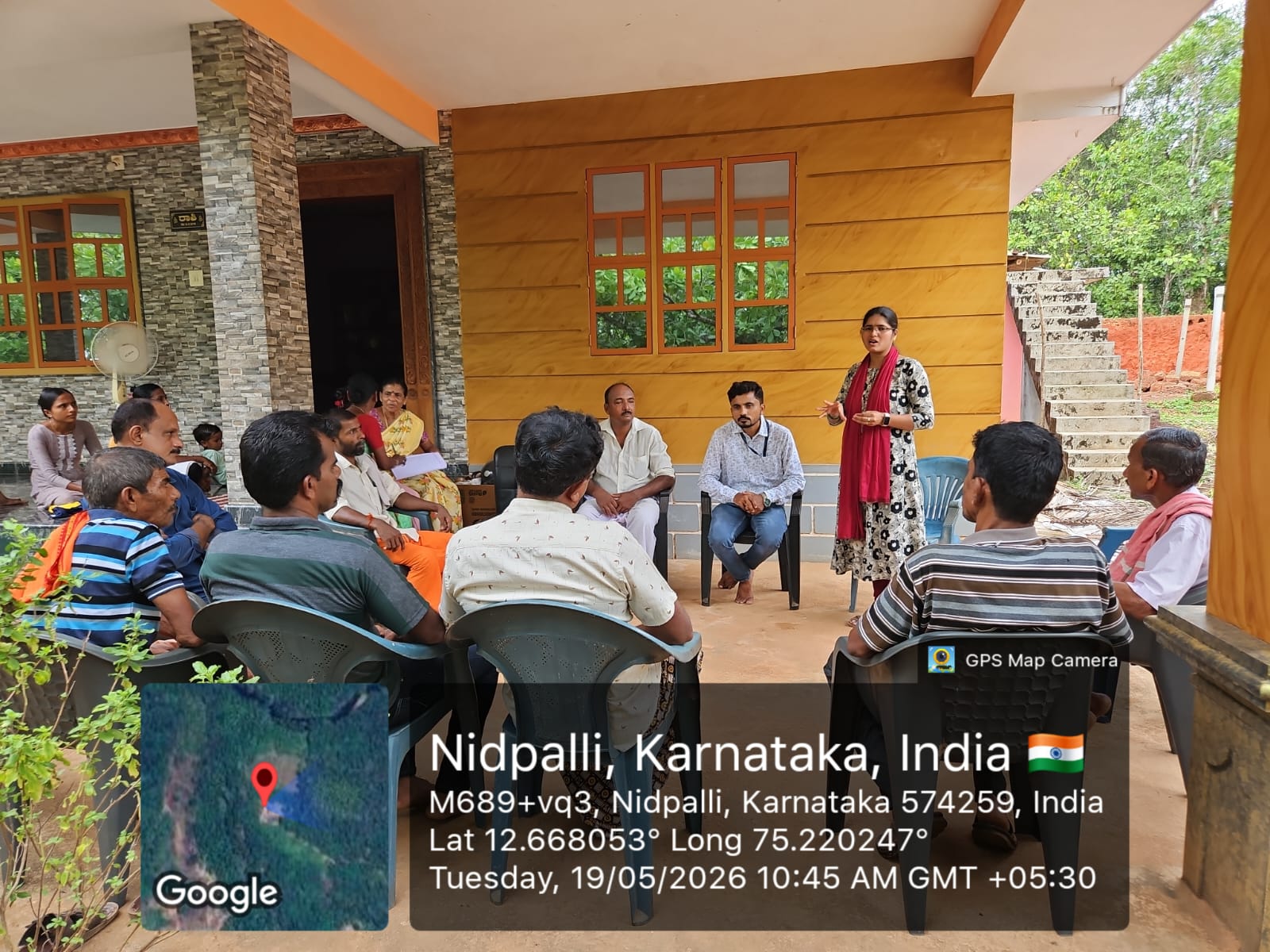
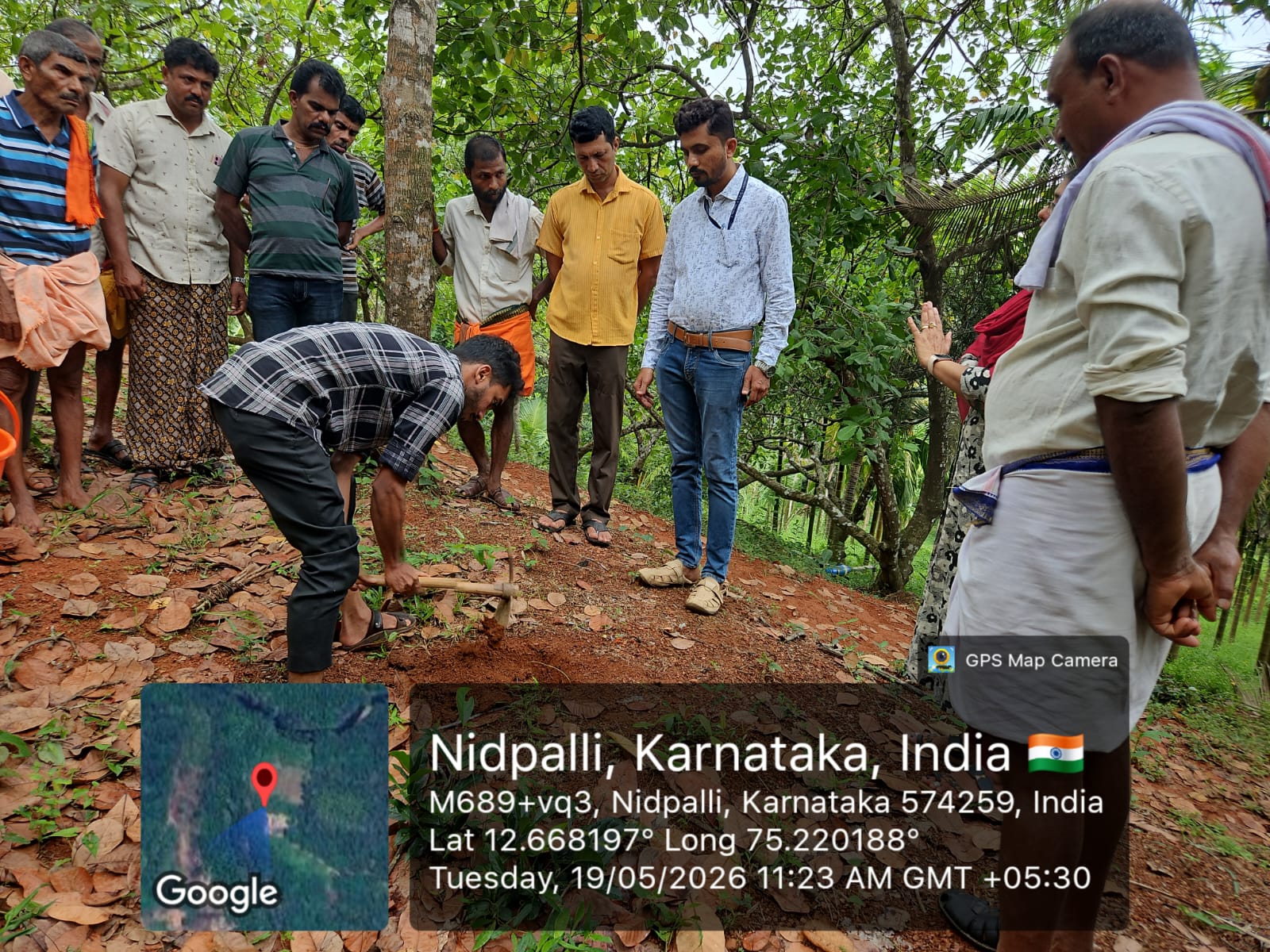
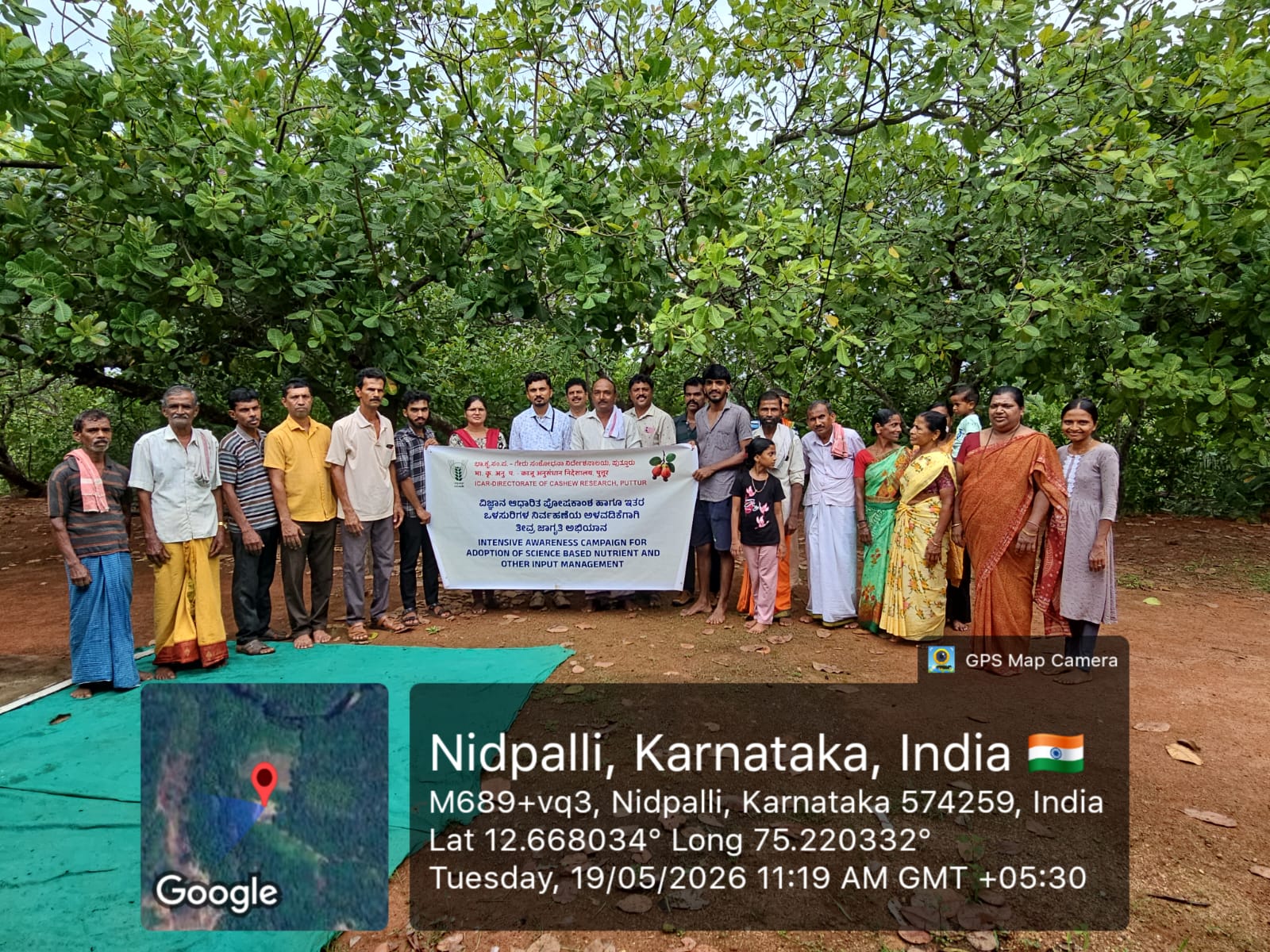
As part of the National Campaign on Balanced Use of Fertilizers, a field-level awareness programme was organized at Nidpalli, Dakshina Kannada, Karnataka, with the objective of promoting scientific and balanced nutrient management practices involving NPK fertilizers, micronutrients, and organic manures to sustain soil fertility and enhance crop productivity. The programme was conducted by a team of scientists comprising Dr. Bhagya H.P., Scientist; Dr. Manjunatha K., Scientist; and Ms. Vijetha, YP-II. The programme commenced with a welcome and introductory address by Dr. Bhagya H.P., who highlighted the importance of balanced fertilizer application, the objectives of the national campaign, suitable cashew varieties, high-density planting systems, and canopy management practices in cashew cultivation. Dr. Manjunatha K. briefed the importance of soil testing, scientific methods of soil sample collection, fertilizer recommendations, and nutrient dosage schedules for efficient orchard management. He also elaborated on the major pests and diseases affecting cashew plantations and the recommended management practices for their effective control. A practical demonstration on scientific soil sampling techniques was conducted by Ms. Vijetha, YP-II (Soil Science), providing farmers with hands-on training in proper soil sample collection methods. Soil samples from farmers’ fields were also collected for laboratory analysis and for providing location-specific nutrient management recommendations. A total of 23 participants attended the programme, including 17 male farmers and 6 female farmers.
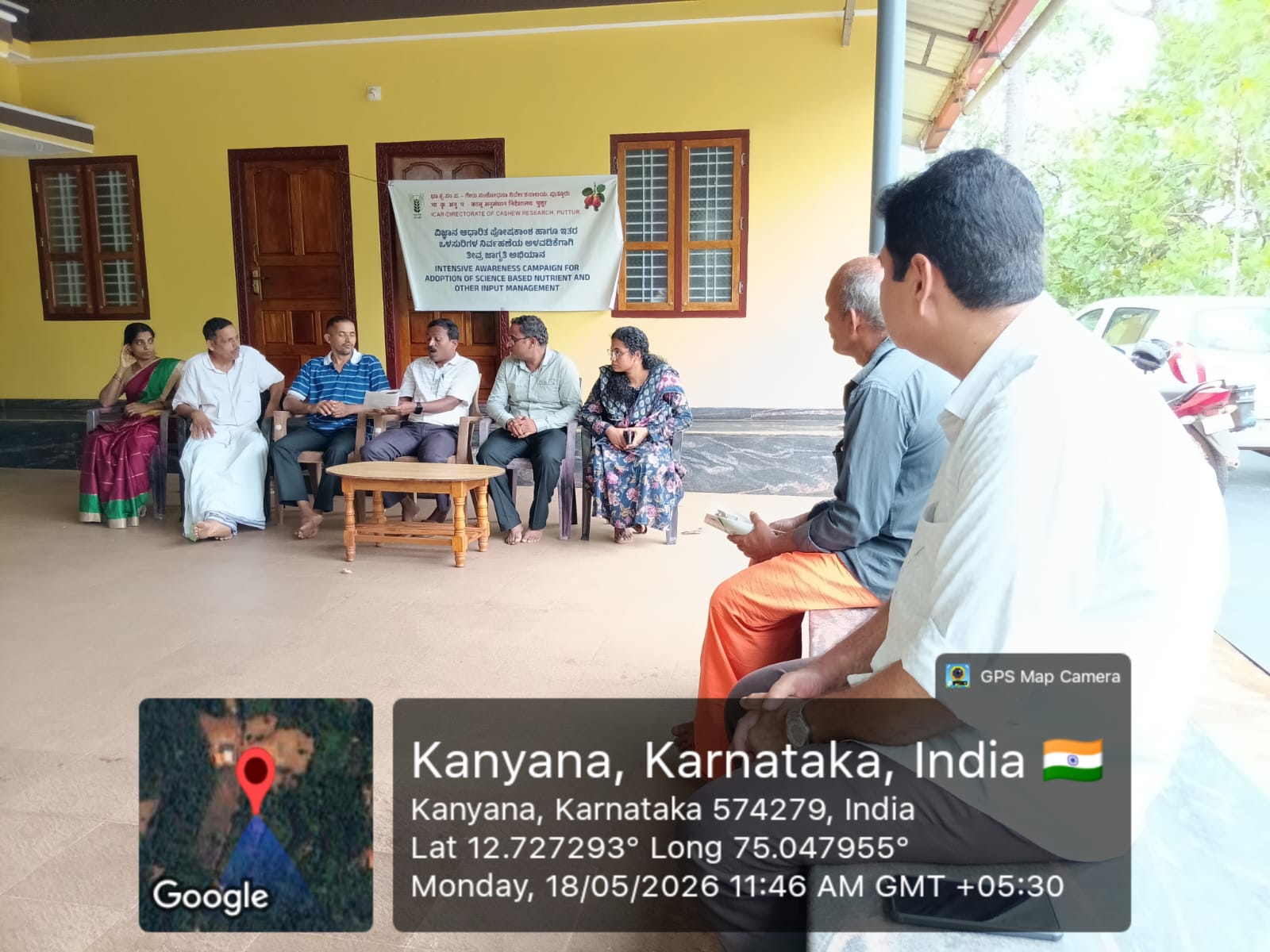
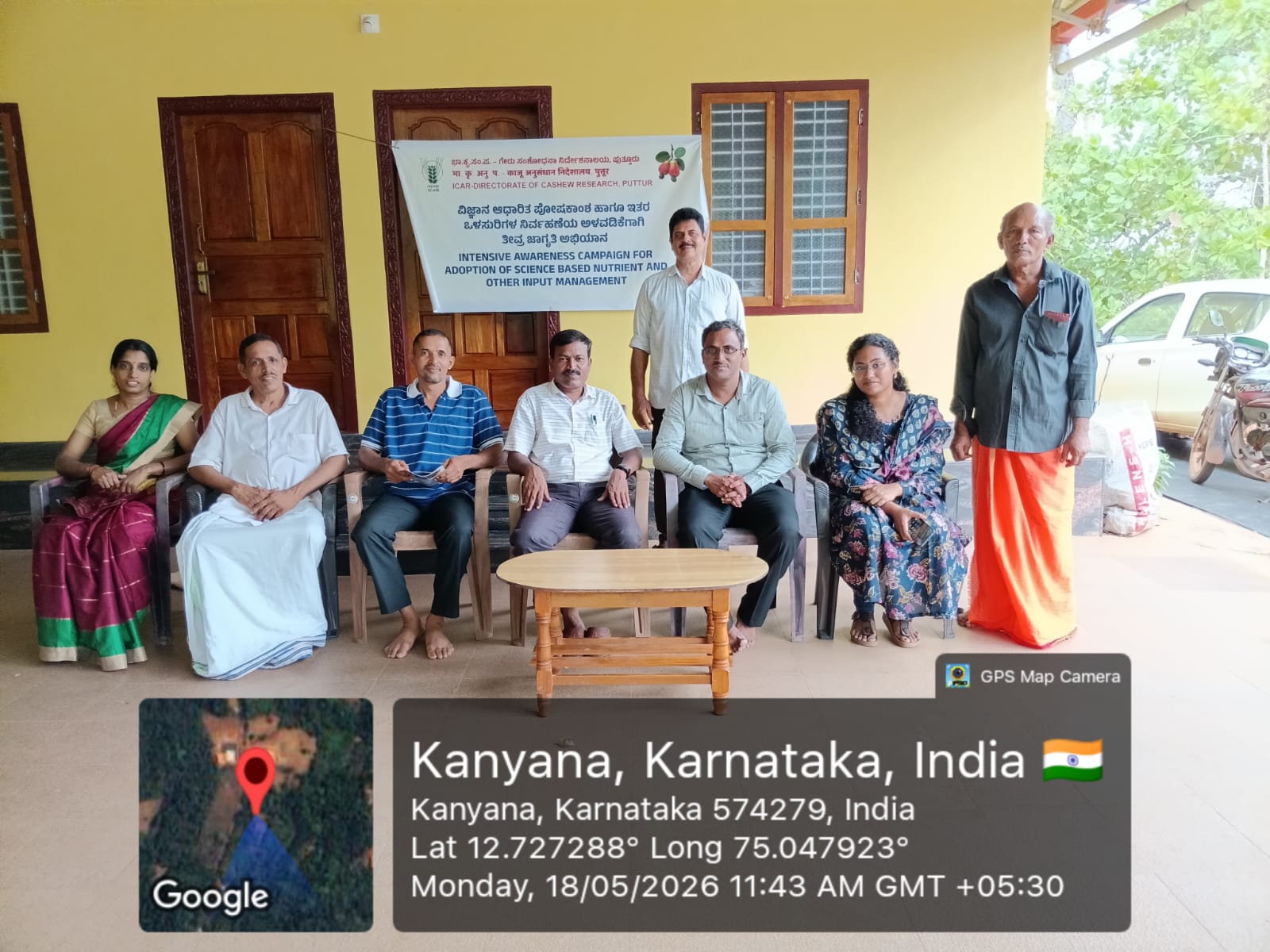
As part of the nationwide Campaign on the Balanced Use of Fertilizers, scientists from ICAR-Directorate of Cashew Research, Dr. Eradasappa E., Dr. Siddanna Savadi, and Dr. Aswathy C., visited Nirpaje village, Kanyani, in Bantwal Taluk of Dakshina Kannada district, Karnataka.
During the programme, the scientists interacted with farmers and explained the importance of scientific nutrient management for sustainable crop production. Farmers were encouraged to reduce the excessive use of conventional chemical fertilizers and to increase the use of alternatives such as organic compost, vermicompost and microbial biofertilizers. The team also advised farmers to apply fertilizers based on soil test recommendations, particularly in cashew cultivation, to improve nutrient use efficiency and maintain soil health.
A total of ten farmers participated in the programme, including two women farmers.
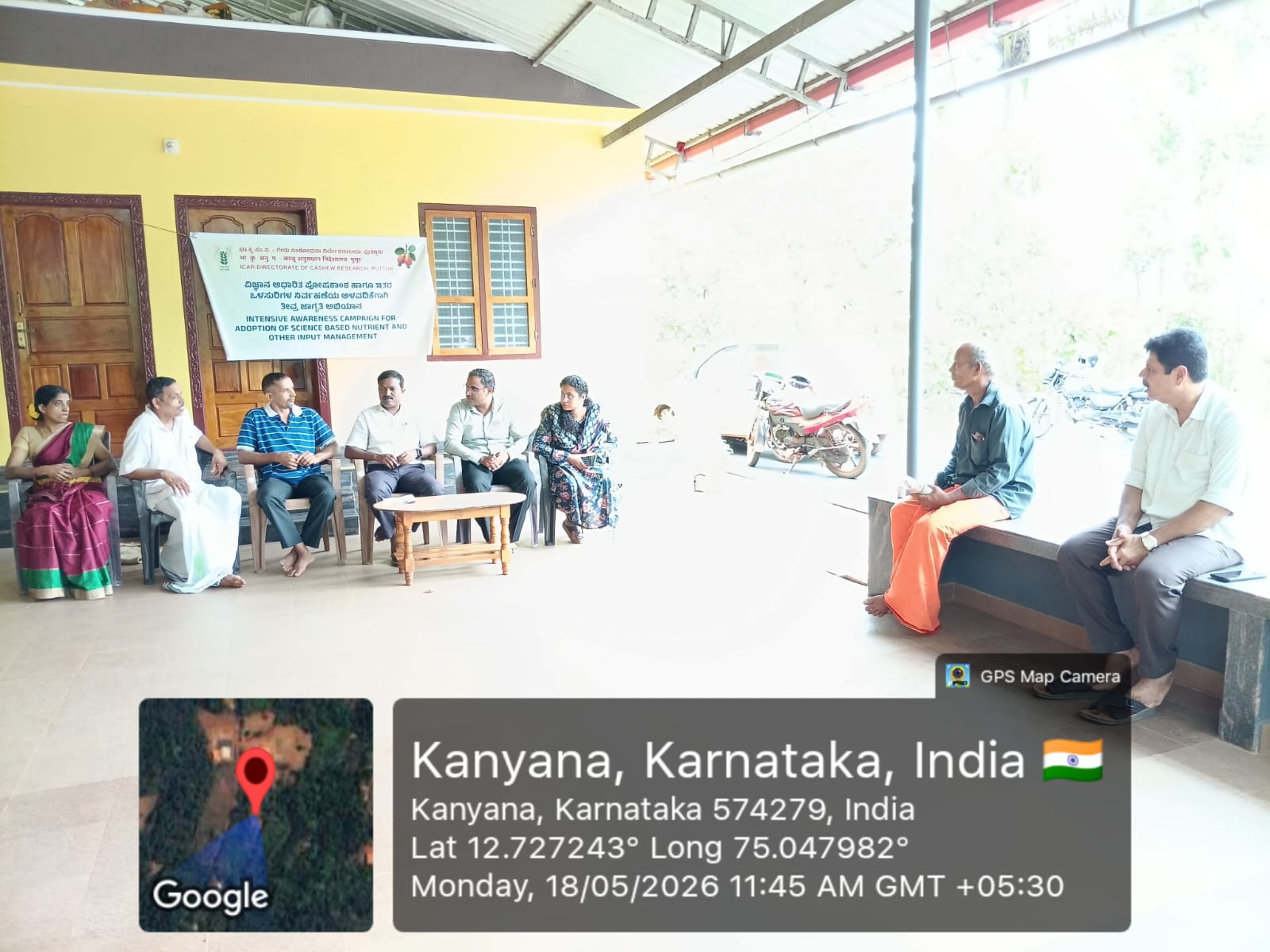
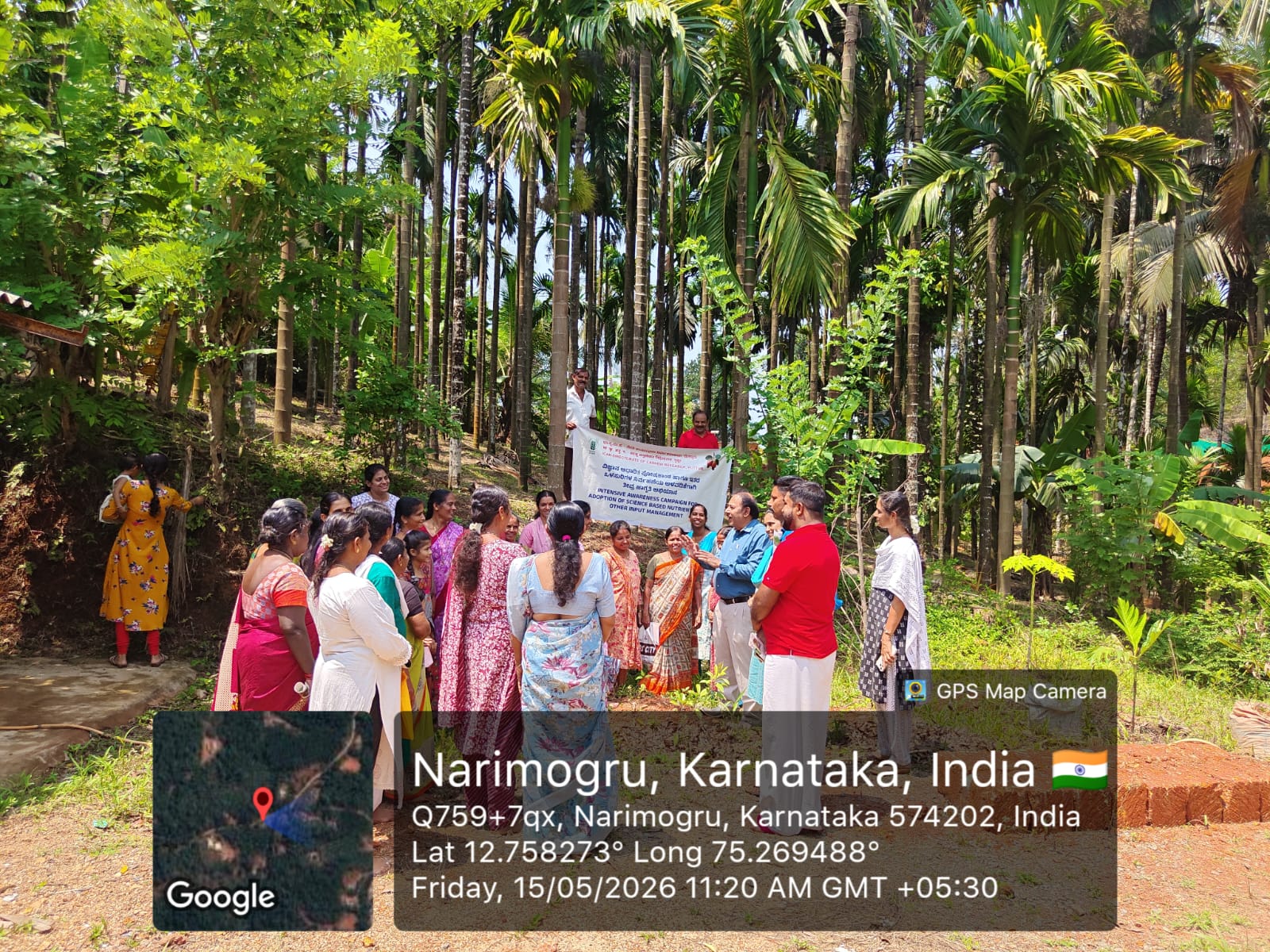
Organizing Institute: ICAR-Directorate of Cashew Research, Puttur, Karnataka
Scientific Team: Dr. Balasubramanian, D. Principal Scientist, ICAR-DCR, Puttur
Dr. Veena G L., Senior Scientist, ICAR-DCR, Puttur
Dr. Vanitha, K. Senior Scientist, ICAR-DCR, Puttur
Date of programme: 15.05.2026
State: Karnataka
District: Dakshina Kannada
Village name: Narimogaru
Number of participants:36 (Male -7, Femele-29)
Interaction with Input dealer: No
Interaction with Panch/Sarpanch/SHG: yes (Shree shakthi Mahila Swasahaya Sangha)
Awareness programmes undertaken during the visit:
- Awareness on balanced fertilizer use
- Organic farming for horticultural crops
- Special attention on green manuring and other organic substitutes
In this awareness program, we emphasized the importance of soil test-based fertilizer application along with the correct soil sampling methodology, particularly for perennial crops. We also promoted the use of organic inputs such as compost, biofertilizers, green leaf manuring, and the recycling of farm waste through in-situ decomposition.
Any demonstration of green manuring: No
Biofertilizers: No
Any Local Learning/Observation Recorded: NO
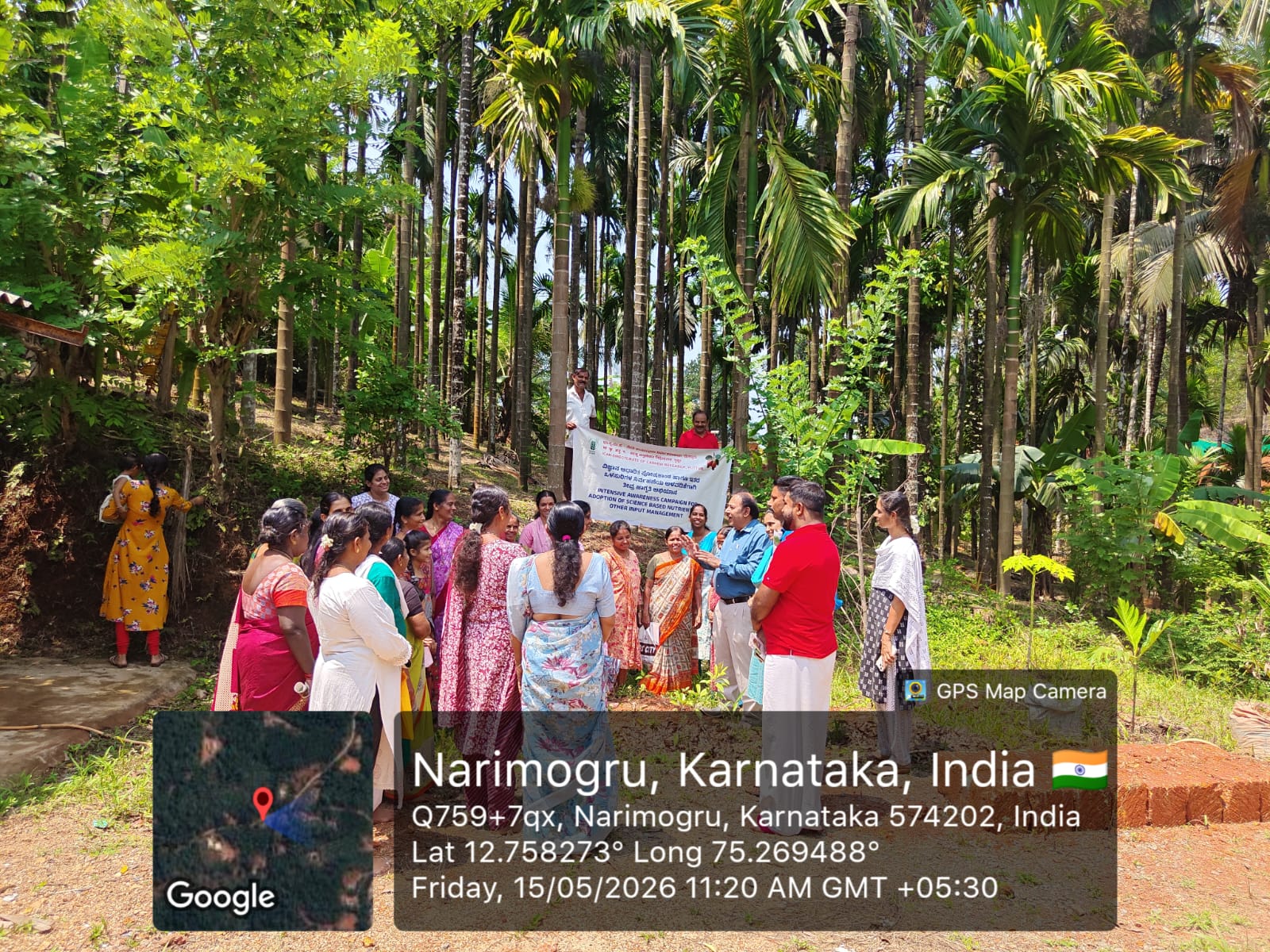
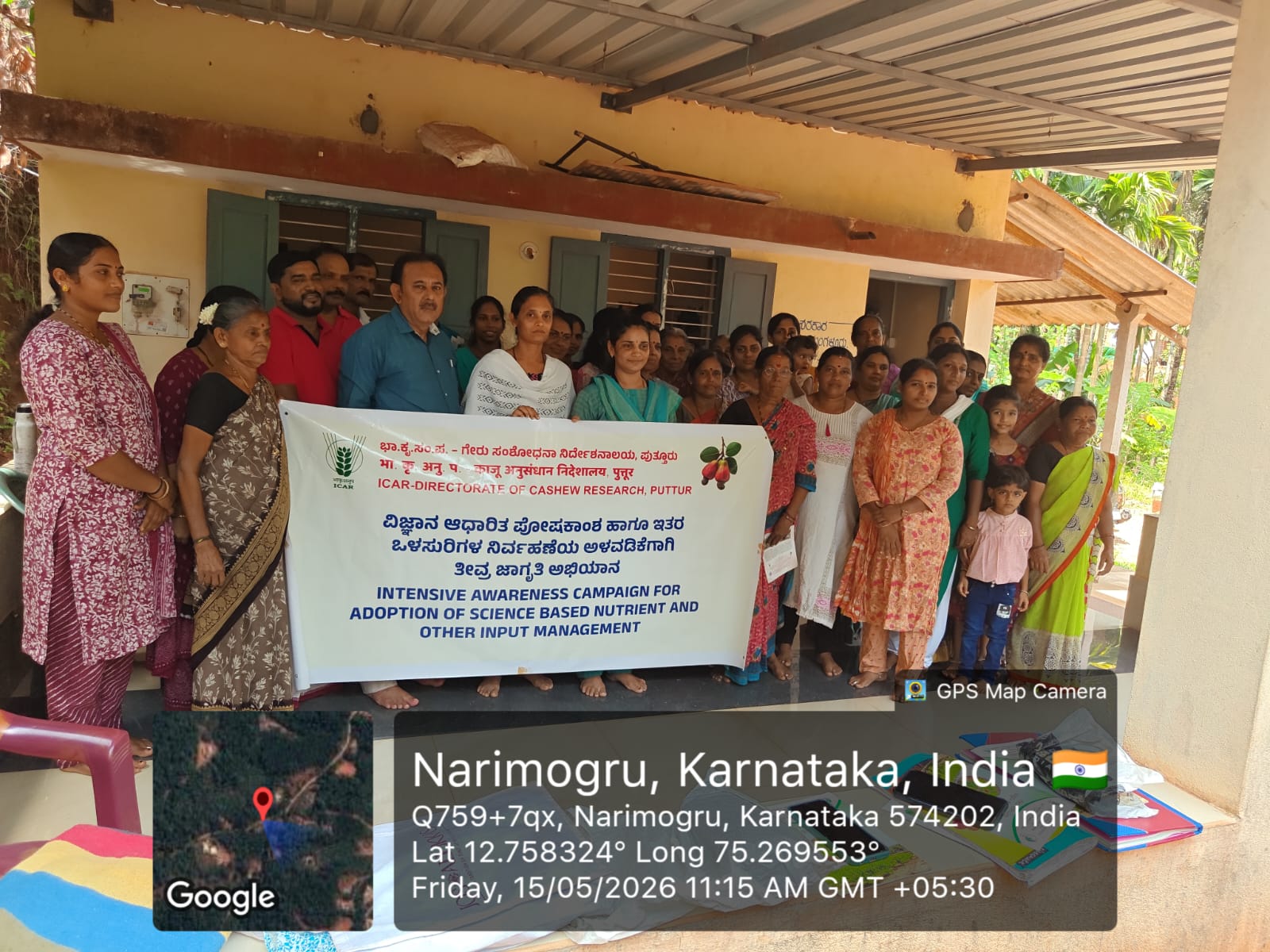
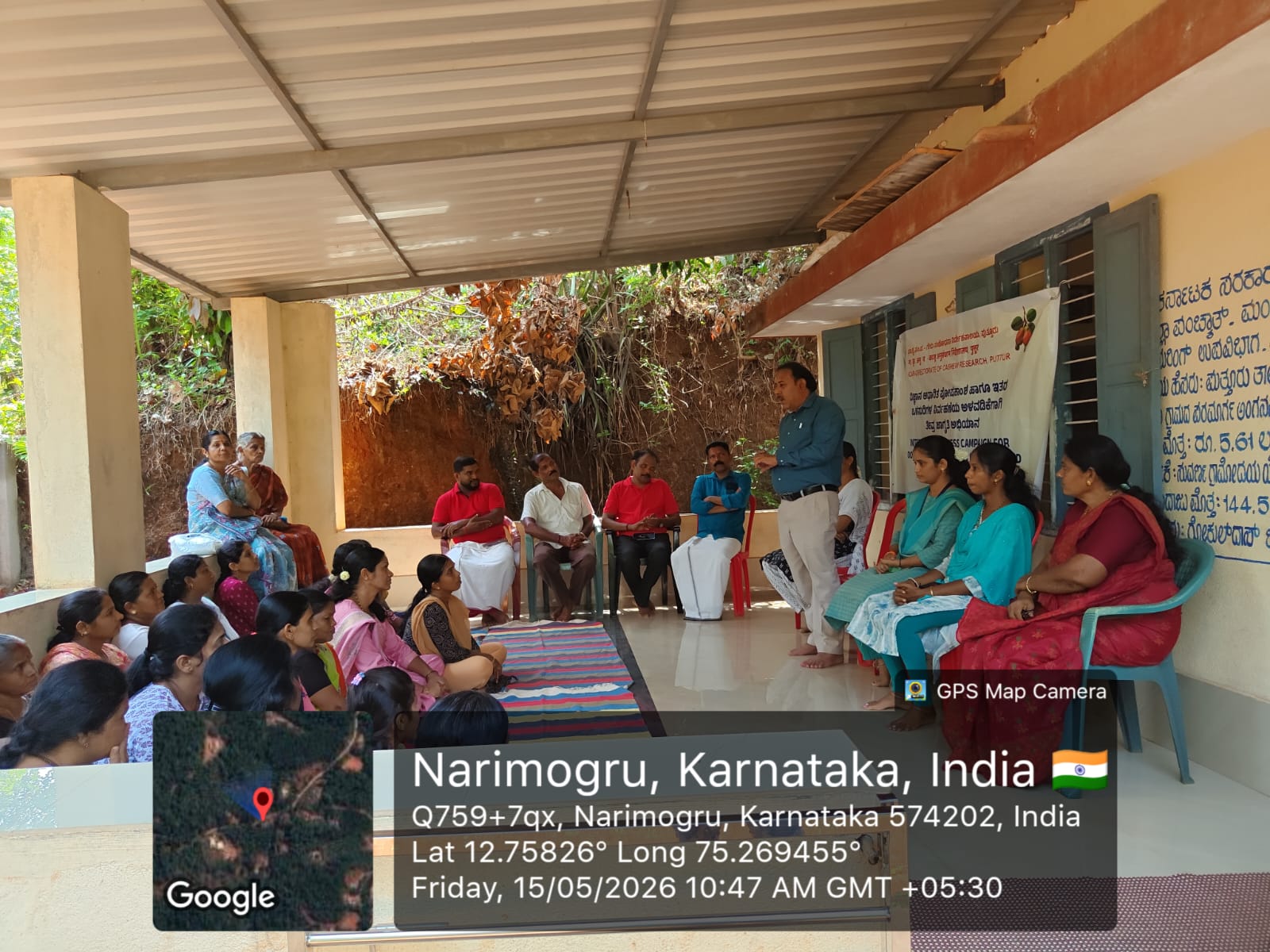
Number of participants: 19 (M:14, F: 05)
Interaction with the input dealer: No
Interaction with Panch / Sarpanch: Yes
Awareness programmes undertaken during visit: Balanced application of nutrition and awareness on composting and vermicomposting
Any demonstration of green manuring: No
Biofertilizers: No
Any Local Learning/Observation Recorded: Few farmers practice vermicomposting and were earlier adopting gobar gas sludge application
An awareness programme on “Adoption of Science-Based Nutrient and Other Input Management” was organised at Kanakamajalu on 14 May 2026 to create awareness among farmers about balanced nutrient management, scientific use of agricultural inputs, and sustainable practices in horticultural crops.
The programme began with a welcome address by Dr. T. N. Raviprasad, who greeted the participants and emphasised the importance and objectives of the campaign. Subsequently, Dr. Rajashekara H. and Dr. Jyoti Nishad briefed the gathering on the significance of adopting science-based nutrient and input management practices for enhancing crop productivity and maintaining soil health. The programme was also attended by the president of the village Yuvak Sangha, who actively participated in the discussions.
An interactive session with the farmers formed an important part of the programme. Farmers shared their prevailing fertiliser management practices in horticultural crops and sought clarification on the appropriate methods, dosage, and timing of fertiliser application. The experts addressed the queries and highlighted the importance of soil test-based nutrient management to prevent nutrient imbalance and improve productivity sustainably.A total of 19 participants (Male: 14; Female: 05) attended the programme. The event concluded with a vote of thanks by the President of Yuvak Sangha.
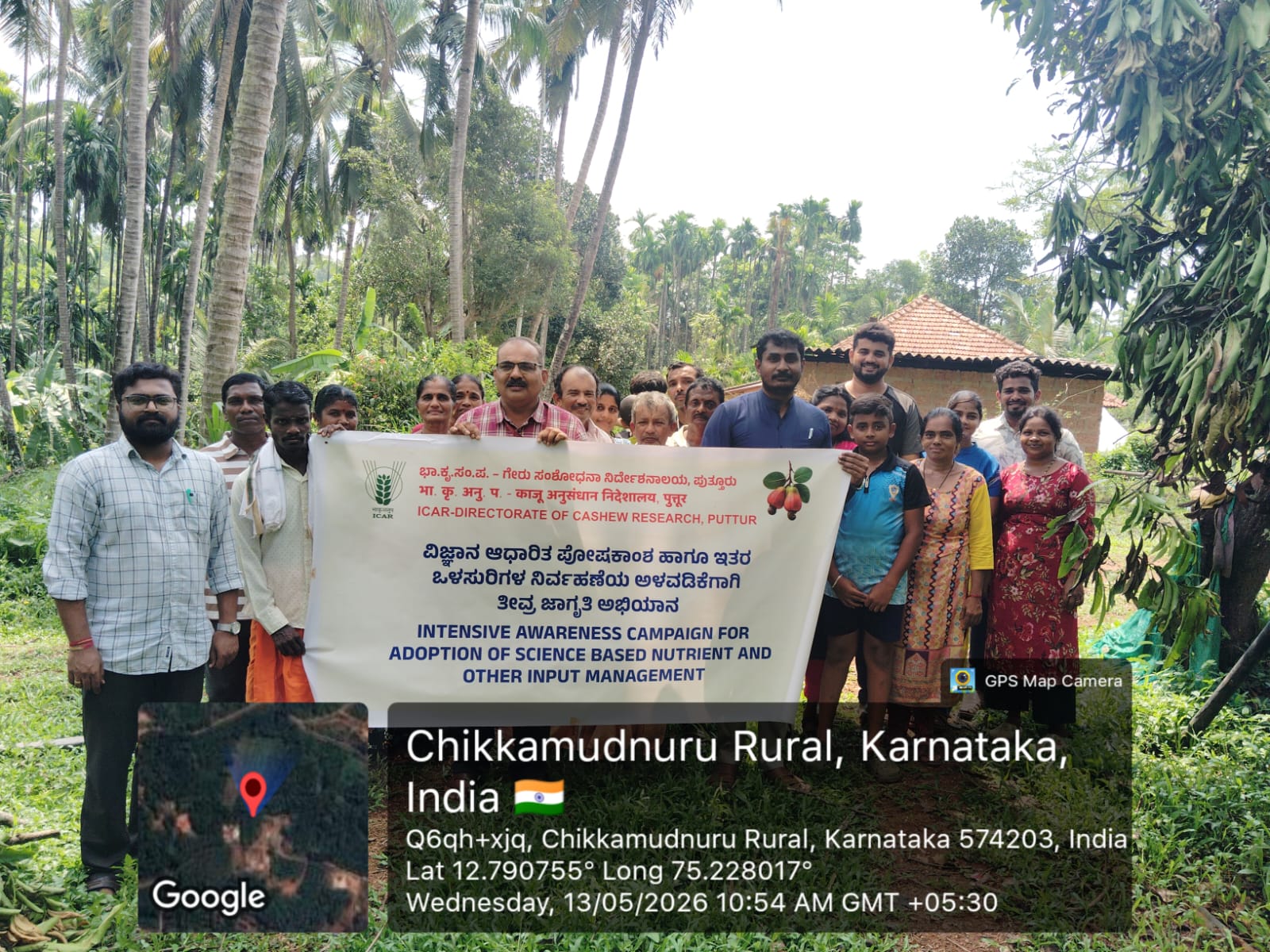
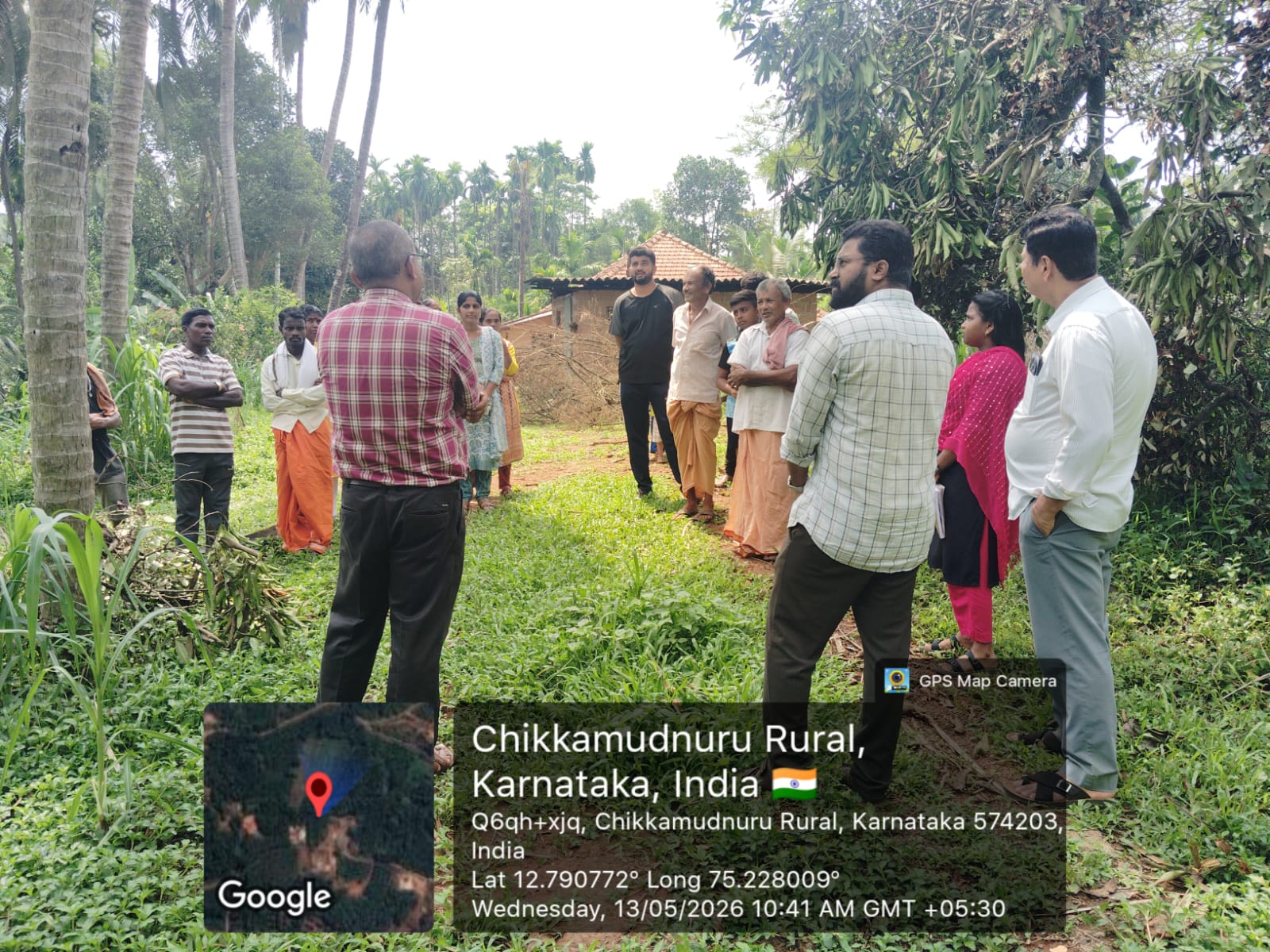
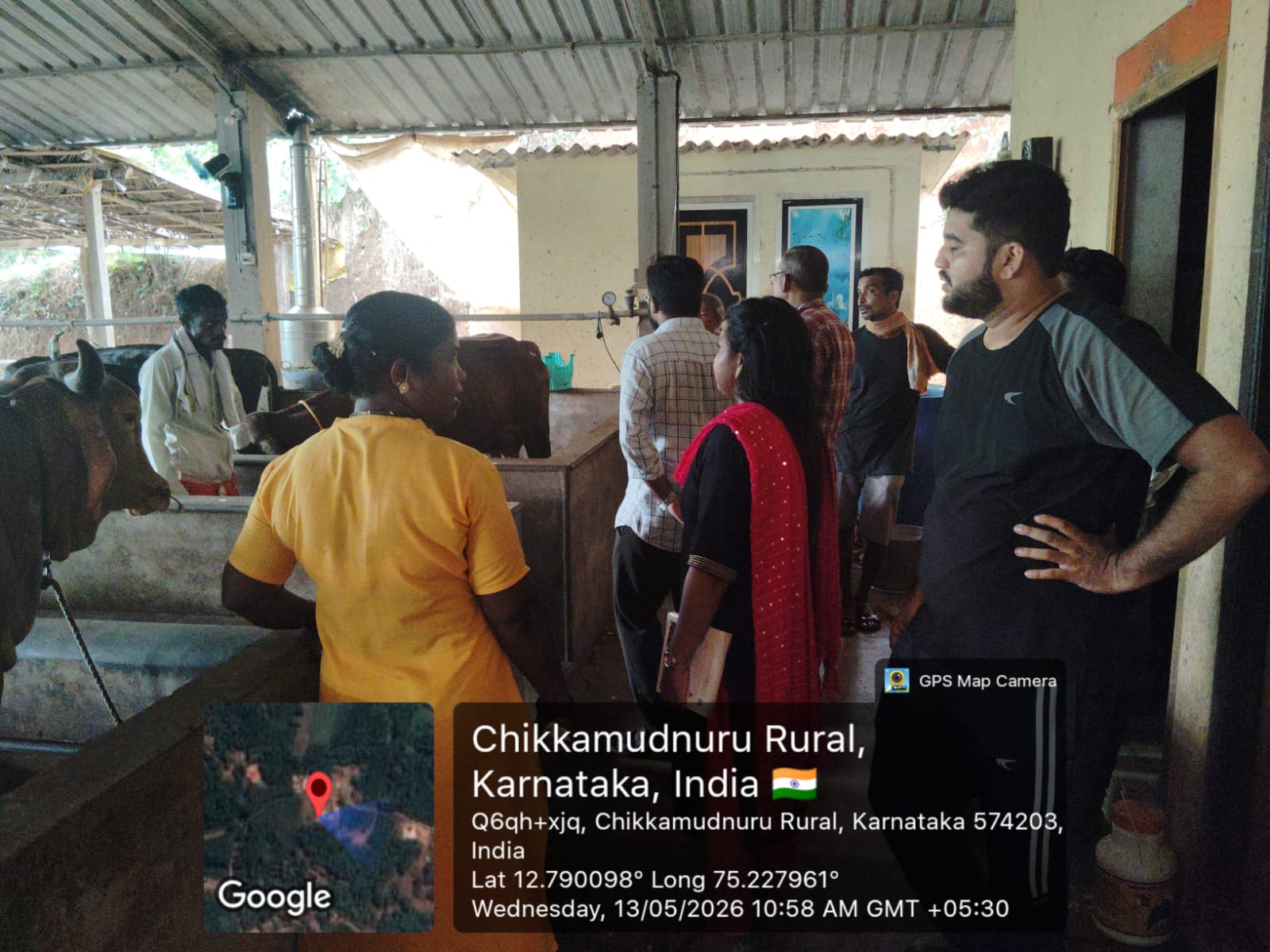
An awareness program on the above subject was conducted in Beeriga village, Chikkamudnur panchayat of Puttur Taluk, Dakshina Kannada district, Karnataka state, on 13-05-2026. The program was started with a welcome by Dr Manjesh. This was followed by a briefing about the program by Dr. Mohana GS.
The interaction was very good, and farmers shared their experiences with fertiliser management at Monappa Gowda’s Arecanut farm, which hosted the meeting. They use farmyard manure, poultry manure, areca husk and also chemical fertilisers. The dosage of chemical fertilisers is in line with the recommended dosage for arecanut. The farm also has coconuts and bananas. The interesting aspect is the dairy farm, which had 16 cows, both desi (gir, tharparkar etc.) and exotic breeds. This gives manure sufficient for the areca garden. Also, the dairying fetches substantial income to the farmer. Many farmers gathered there expressed their interest in cashew cultivation, and hence they were invited to visit the Directorate of Cashew Research, Puttur. The booklet on good agricultural practices in cashew was distributed to the farmers. In addition, the farmers were sensitised to the utilisation of cashew apple.
A total of 22 participants (13 male and 9 female) were present during the meeting. In the end, Dr Thondaiman proposed a vote of thanks.
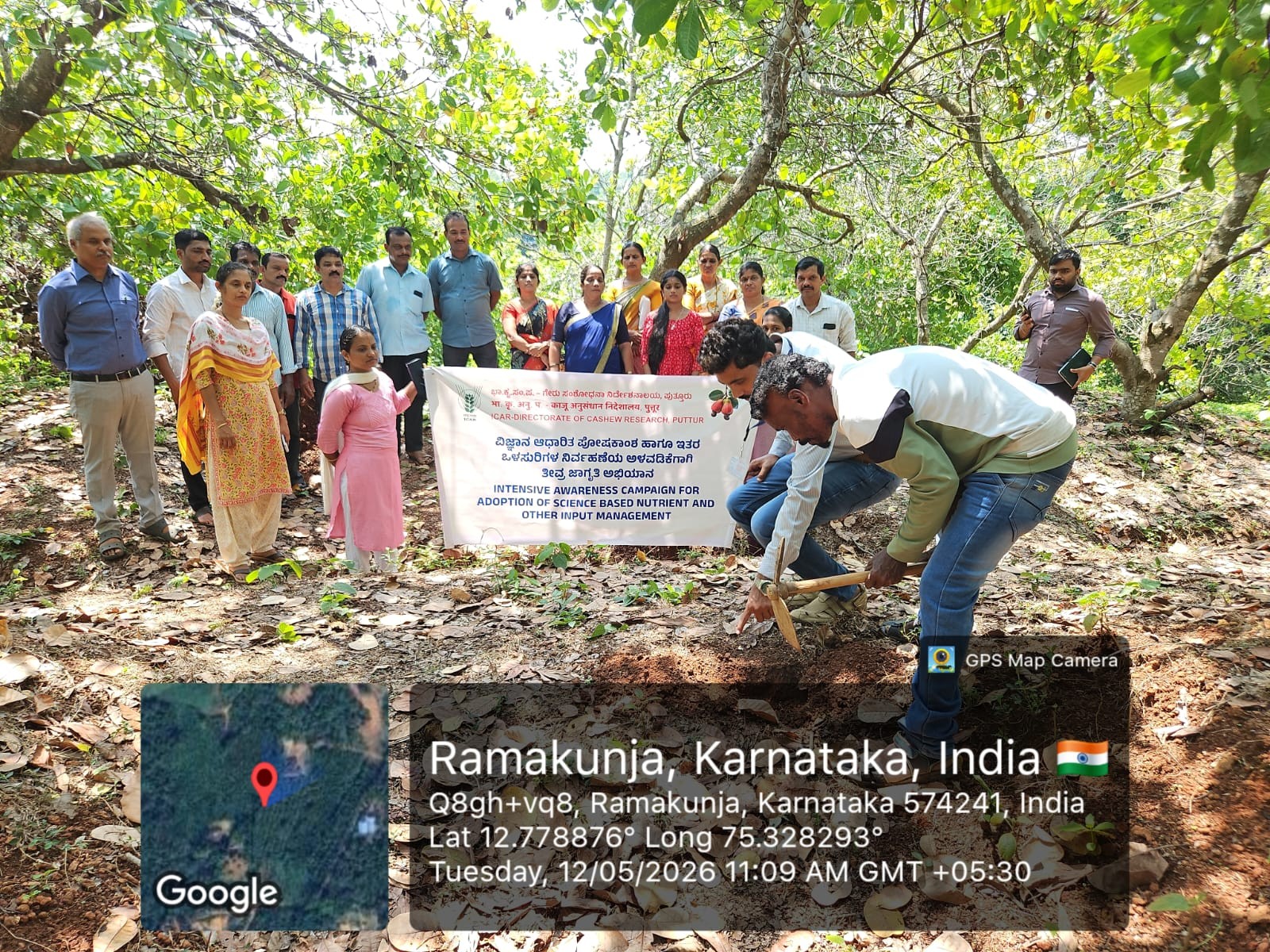
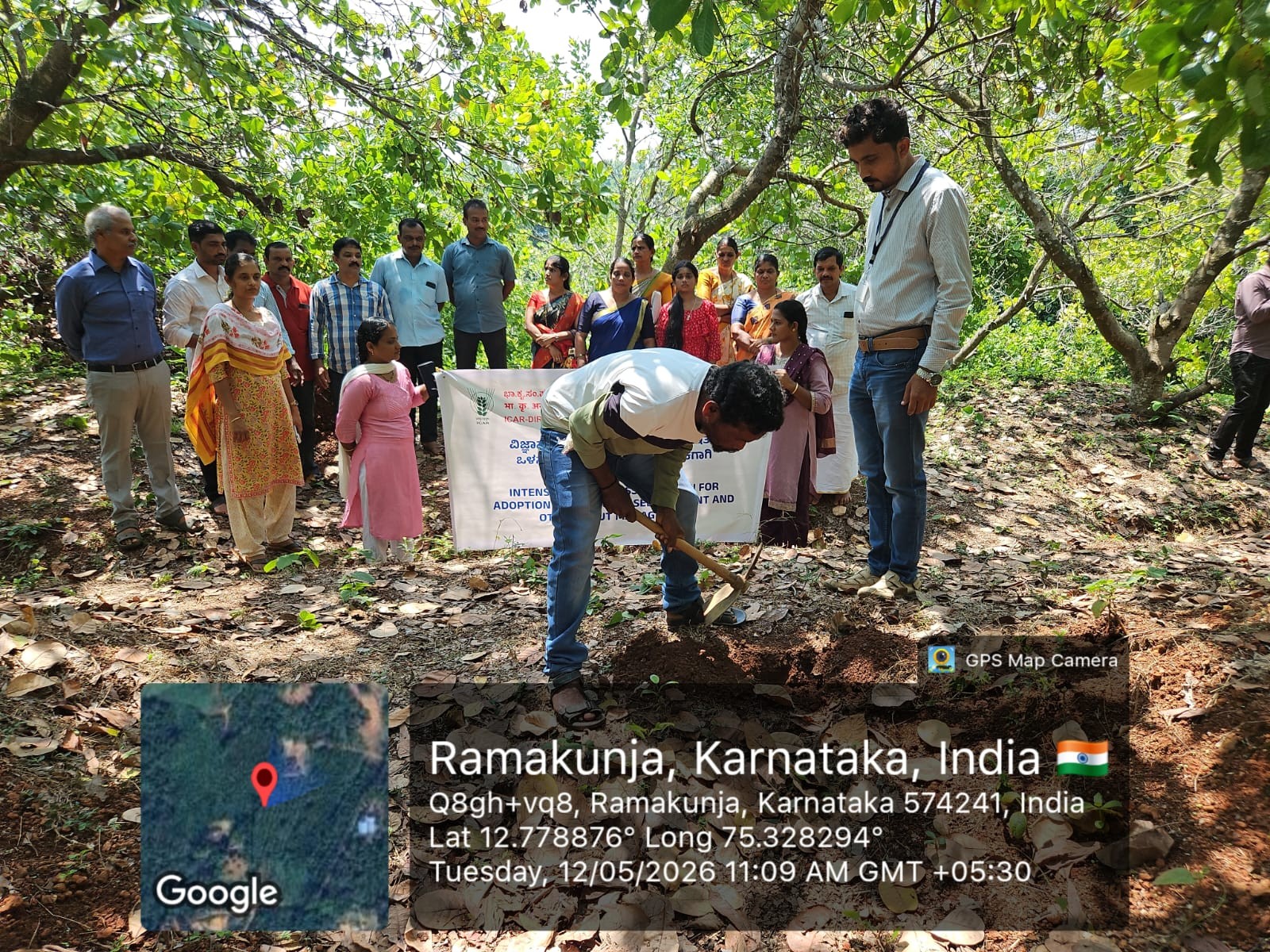
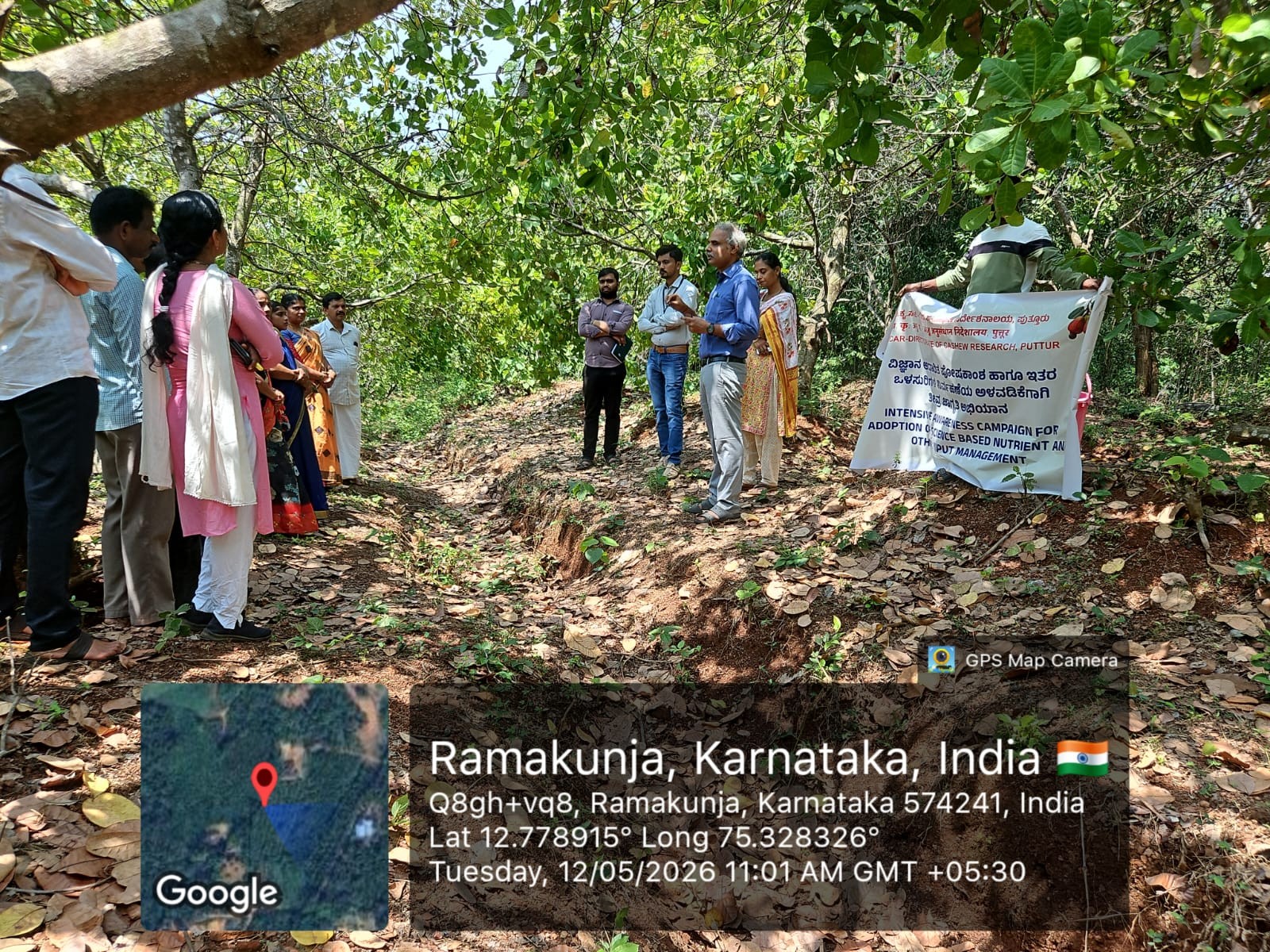
As part of the National Campaign on Balanced Use of Fertilizers, a field-level awareness programme was organized at Ramakunja, Dakshina Kannada, Karnataka, with the objective of promoting scientific and balanced nutrient management practices involving NPK fertilizers, micronutrients, and organic manures for sustaining soil fertility and improving crop productivity. The programme was conducted jointly by a team of scientists comprising Dr. Venkatesh M.S., Principal Scientist and Team Leader, Dr. Vanitha K., Senior Scientist, and Dr. Manjunatha K., Scientist, in association with officials of the Department of Agriculture led by Dr. Shiva Shankar, Deputy Director of Agriculture (DDA), along with Agriculture Officers.
The programme began with a welcome and introductory address by Dr. Shiva Shankar, who explained the significance of balanced fertilizer application and the objectives of the national campaign. Dr. Venkatesh M.S. delivered an expert talk on soil health management. Dr. Vanitha K. addressed the participants on important pests and diseases affecting cashew plantations and the recommended management measures. Dr. Manjunatha K. provided detailed information on importance of soil testing, scientific soil sample collection and suitable cashew varieties, fertilizer recommendations, and nutrient dosage schedules for improved orchard management.
A practical demonstration on scientific soil sampling techniques was conducted by Mrs. Vijetha, YP-II (Soil Science), enabling farmers to gain hands-on experience in proper sample collection methods. Soil samples from farmers’ fields were also collected for laboratory analysis and further recommendations. A total of 22 participants attended the programme, including 13 male and 9 female farmers.
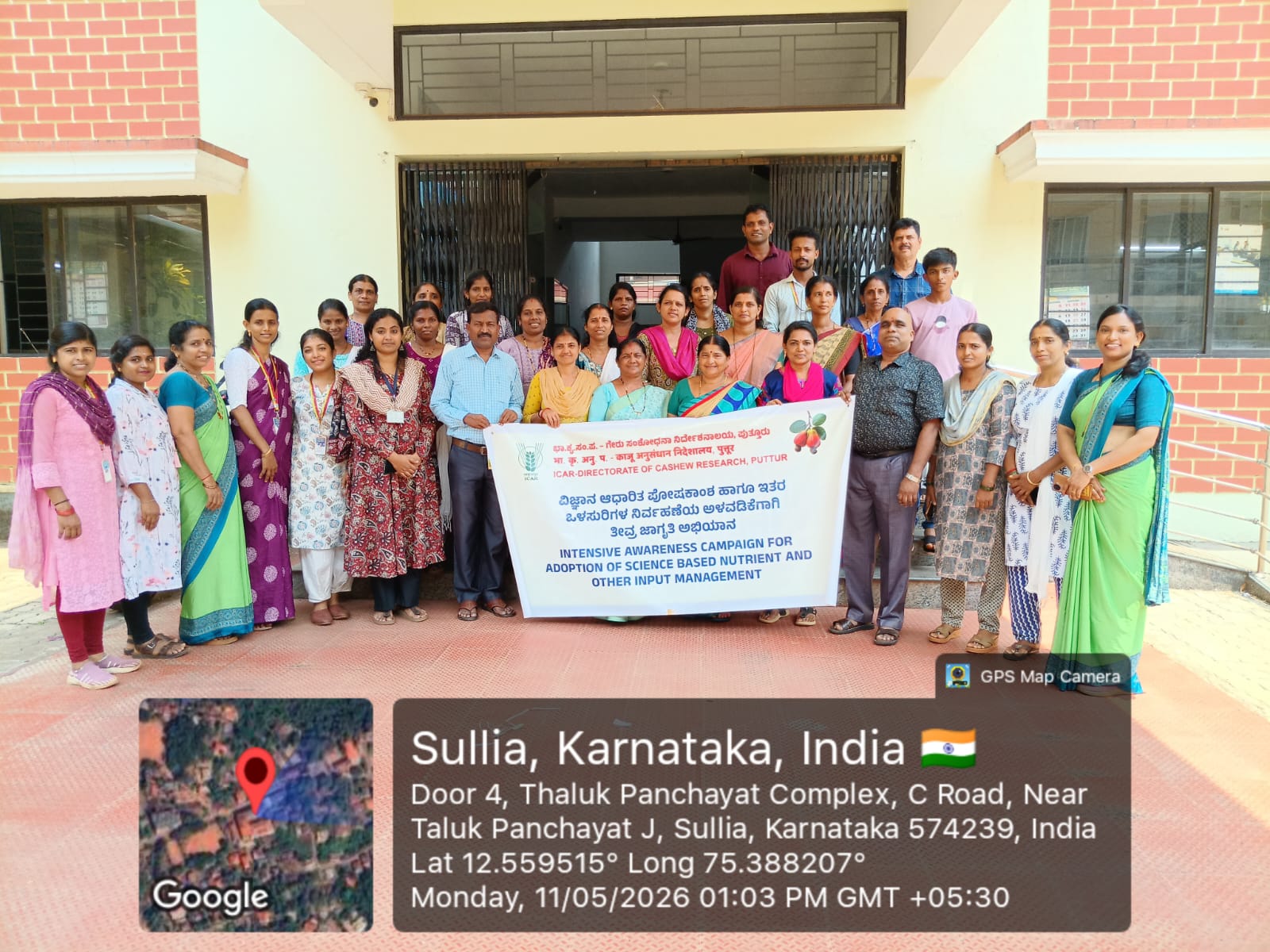
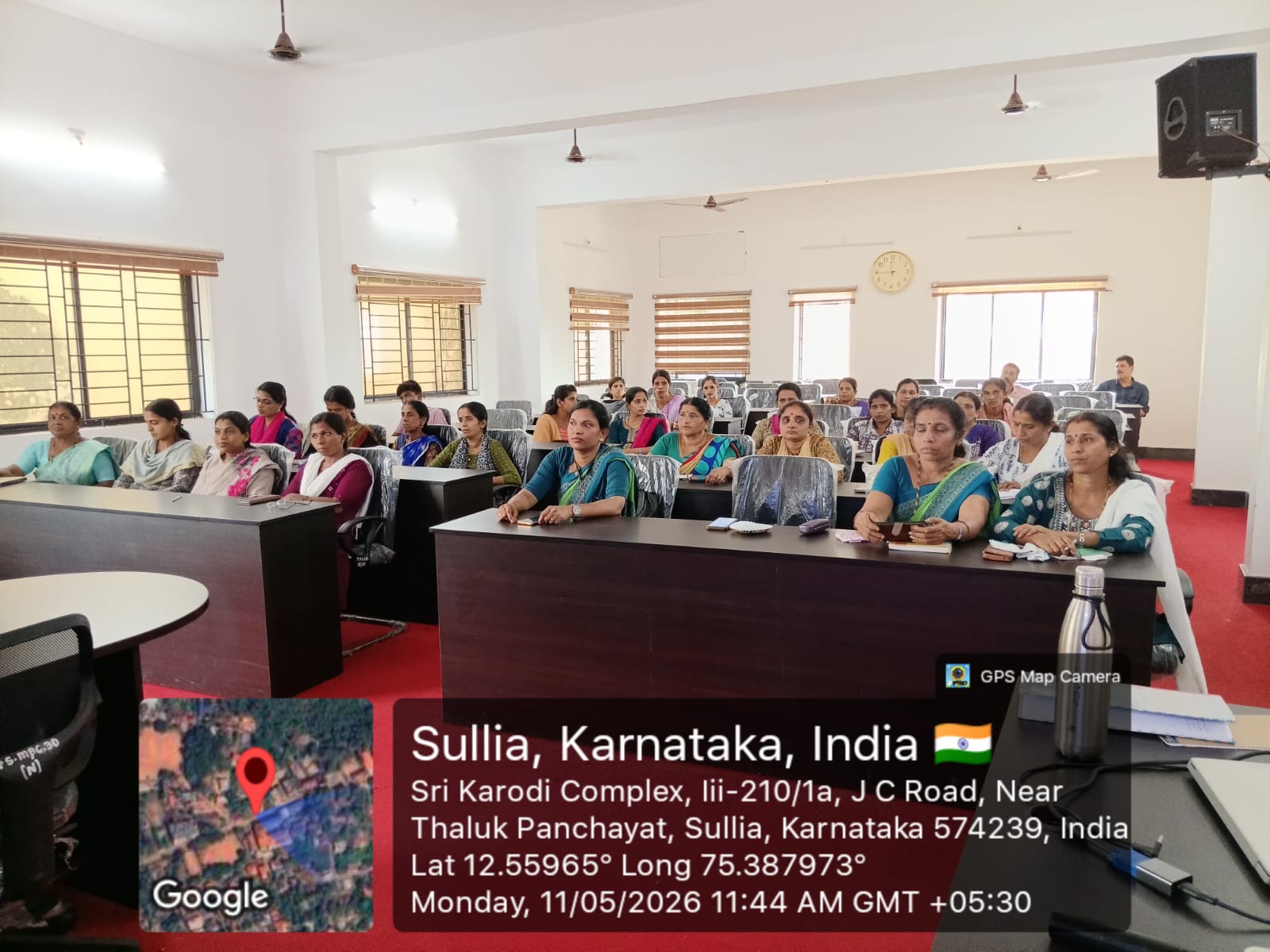
The ICAR -Directorate of Cashew Research, Putturin collaboration with the Sullia taluk panchayat organised an awareness campaign on balanced use of fertilisers for the Krishi Sakhis and Pashusukhis of Sullia Taluk, Dakshina Kannada on 11.05.2026. the awareness class was organised under the aegis of the nationwide campaign on Intensive Awareness Campaign for the Adoption of Science Based Nutrient and Other Input Management organised by the Government of India. It was organised with an aim to sensitise them who are para extension workers on the importance of balanced use of chemical fertilisers, integrated nutrient management using organic fertilisers and biofertilisers. The programme commenced with introductory remarks by Shri. Rajanna who urged the participants to make best use of these information and to take them to the farmers. Dr. Eradasappa E, Principal Scientist, ICAR-DCR, Puttur explained about the need for integrated nutrient management in crops like cashew and arecanut. Dr. Aswathy Chandrakumar, scientist, agricultural extension explained about soil health cards and its importance for need based fertiliser application. A total of 32 participants attended
Scientific Team: Dr. Balasubramanian, D. Principal Scientist, ICAR-DCR, Puttur
Dr. Veena G L., Senior Scientist, ICAR-DCR, Puttur
Dr. Bhagya H P, Scientist, ICAR-DCR, Puttur
Number of participants:20 (Male -8, Femele-12)
Interaction with Input dealer: No
Interaction with Panch/Sarpanch: No
Awareness programmes undertaken during visit:
- Awareness on balanced fertilizer use
- Organic farming for horticultural crops
- Special attention on green manuring and other organic substitutes
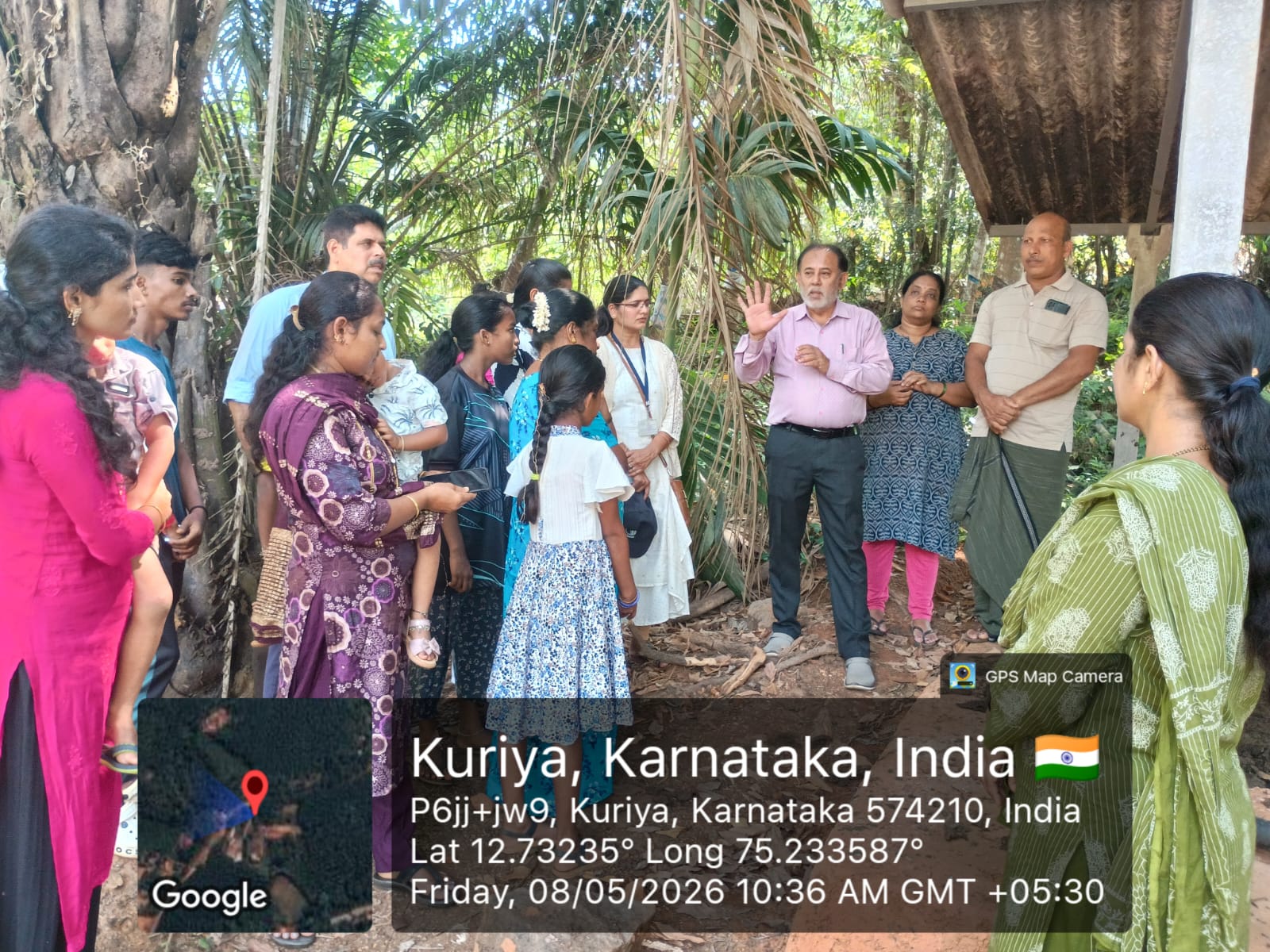
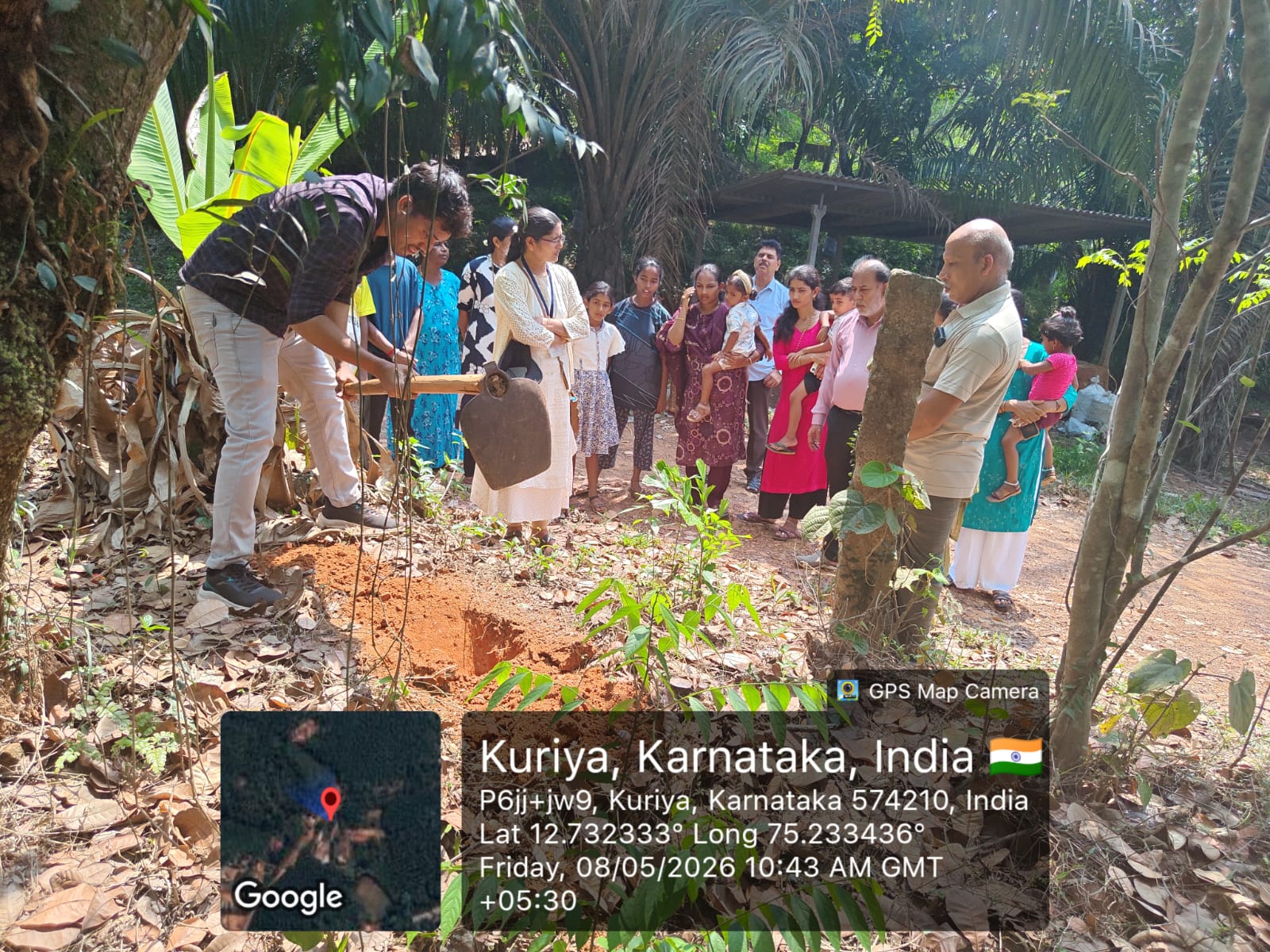
In this awareness program, we emphasized the importance of soil test-based fertilizer application along with the correct soil sampling methodology, particularly for perennial crops. The session highlighted the significance of soil testing in optimizing nutrient management to enhance crop health and yield. We also promoted the use of organic inputs such as compost, biofertilizers, green leaf manuring, and the recycling of farm waste through in-situ decomposition. Additionally, a practical demonstration of soil sampling methodology was conducted specifically in the cashew plantation to provide hands-on learning to the participants.
Any demonstration of green manuring: No
Biofertilizers: Yes
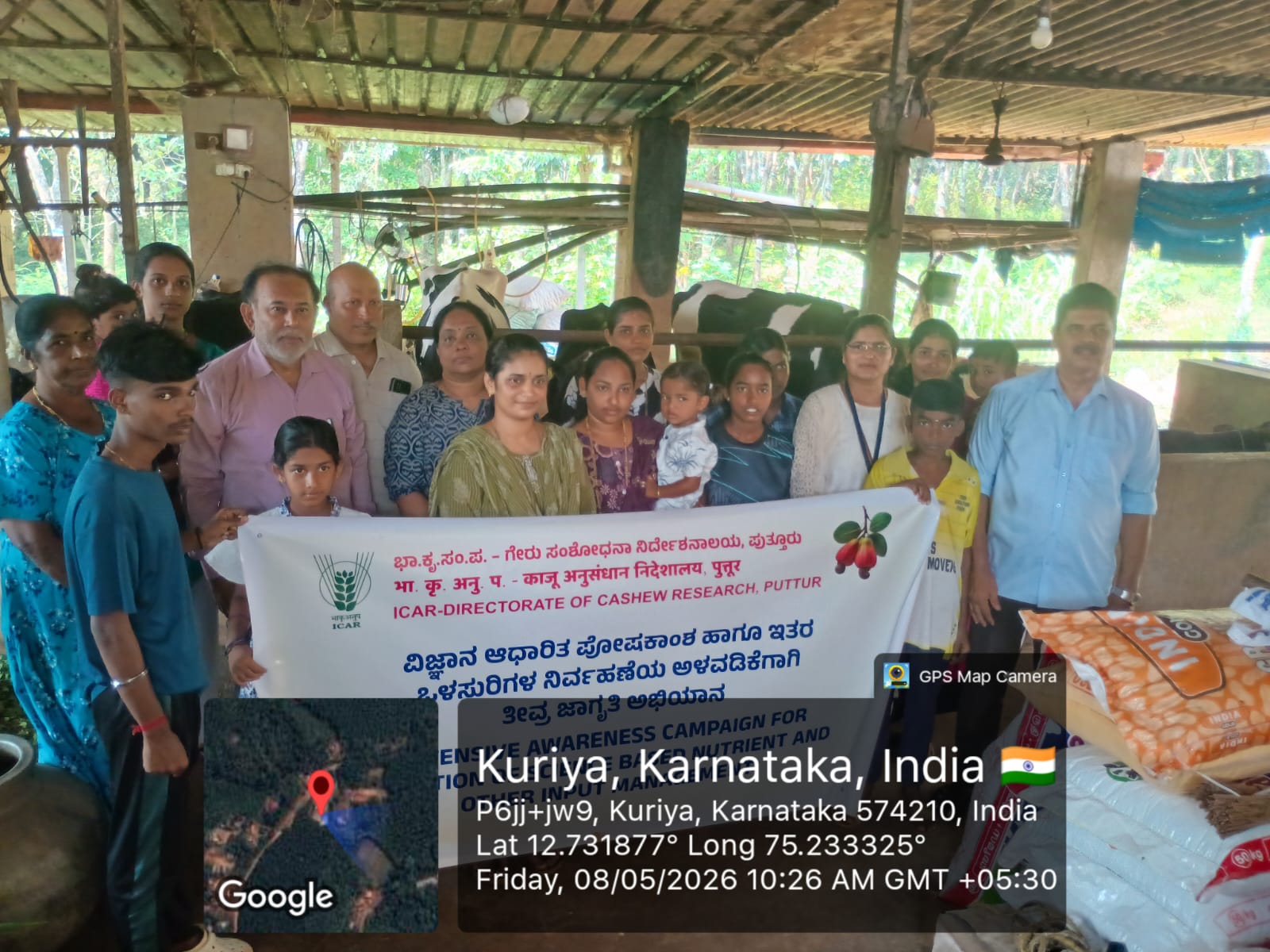
Any Local Learning/Observation Recorded: Mr. Chidannanda (Farmer) is practicing a mixed farming system that integrates poultry, dairy, and organic farming on his plantation. He cultivates a variety of crops including cashew, arecanut, rubber, and oil palm. Additionally, he maintains a kitchen garden where he grows vegetables. This diversified approach enhances sustainability and productivity on his farm.
Number of participants: 17 (M:15, F: 02)
Interaction with the input dealer: No
Interaction with Panch / Sarpanch: No
Awareness programmes undertaken during visit: Balanced application of nutrition and awareness on composting and vermicomposting
Any demonstration of green manuring: No
Biofertilizers: No
Any Local Learning/Observation Recorded: Farmers are mainly relying on chemical based fertilizer
An extension awareness programme focusing on the “Adoption of Science-Based Nutrient and Input Management Practices” was organised on 07 May 2026 at Adoor, Mandekolu, Karnataka with the objective of promoting sustainable and efficient nutrient management among horticultural farmers. The programme created a platform for farmers to understand the scientific basis of fertiliser application and responsible input utilisation for improving crop performance and maintaining long-term soil fertility.
The session began with introductory remarks by Dr. T. N. Raviprasad, who welcomed the participants and explained the relevance of the campaign in the present agricultural scenario. Thereafter, Dr. Rajashekara H. and Dr. Jyoti Nishad addressed the gathering and elaborated on the benefits of scientific nutrient management, balanced fertilisation, and judicious use of agricultural inputs for sustaining productivity and soil quality. Members of the local Panchayat were also present and interacted with the participants during the programme. Farmers actively engaged in the technical interaction session by sharing field-level experiences and raising practical questions related to nutrient application schedules, preparation and use of vermicompost, and appropriate fertiliser dosages. The scientists highlighted the necessity of adopting soil analysis-based recommendations to optimise nutrient use efficiency and minimise indiscriminate fertiliser application.
The programme witnessed the participation of 17 farmers, including 15 men and 2 women. The event concluded successfully with an expression of gratitude to all the participants and organisers.
[Organisers: Dr TN Raviprasad, Dr. Rajashekara H. and Dr Jyoti Nishad].
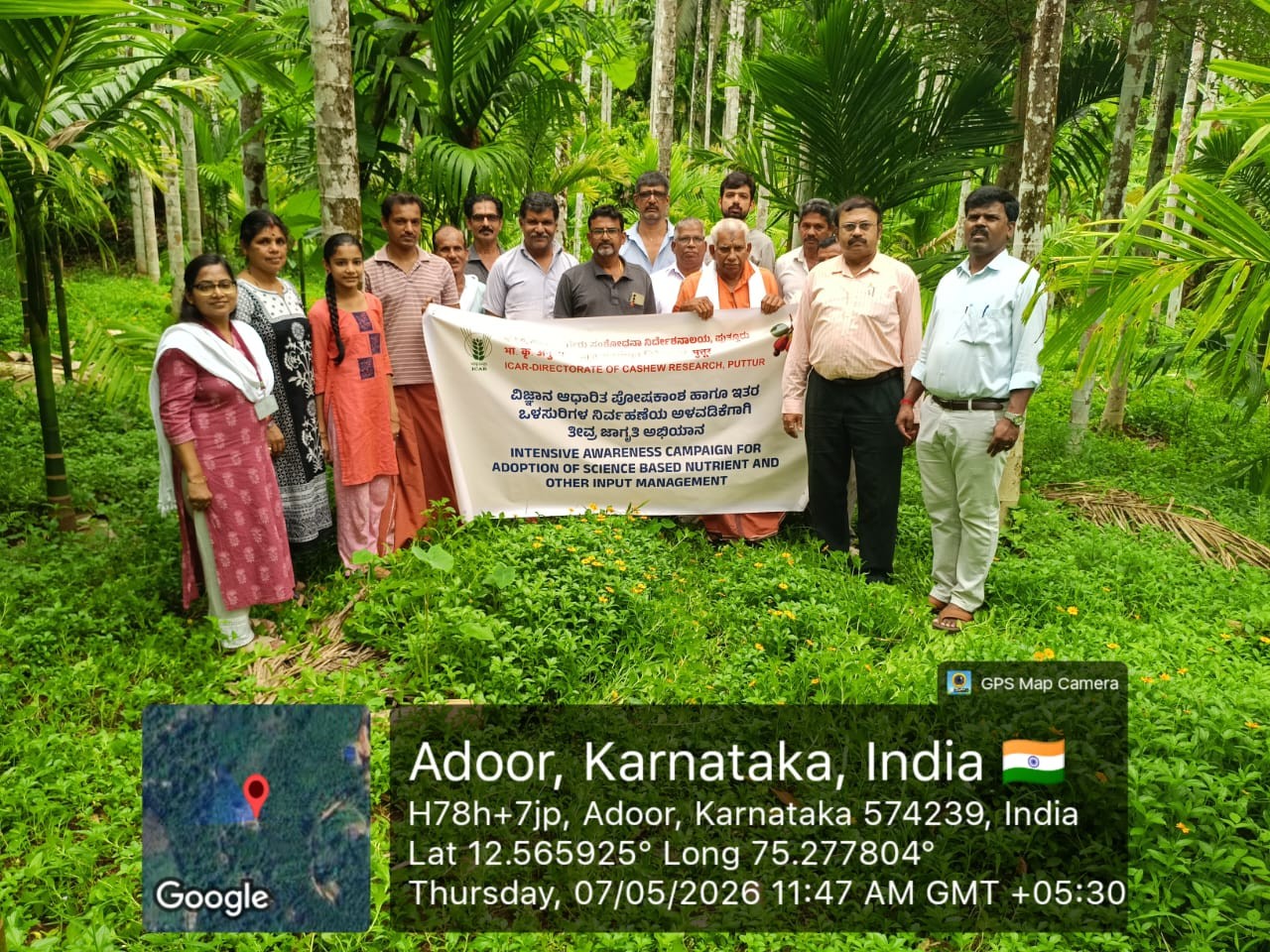
Number of participants: 13 (M:13, F:0)
Interaction with the input dealer: Yes
Interaction with Panch/Sarpanch: Yes
Awareness programmes undertaken during visit: Balanced application of nutrition and awareness on composting and vermicomposting
Any demonstration of green manuring: Yes
Biofertilizers: No
Any Local Learning/Observation Recorded: Nil
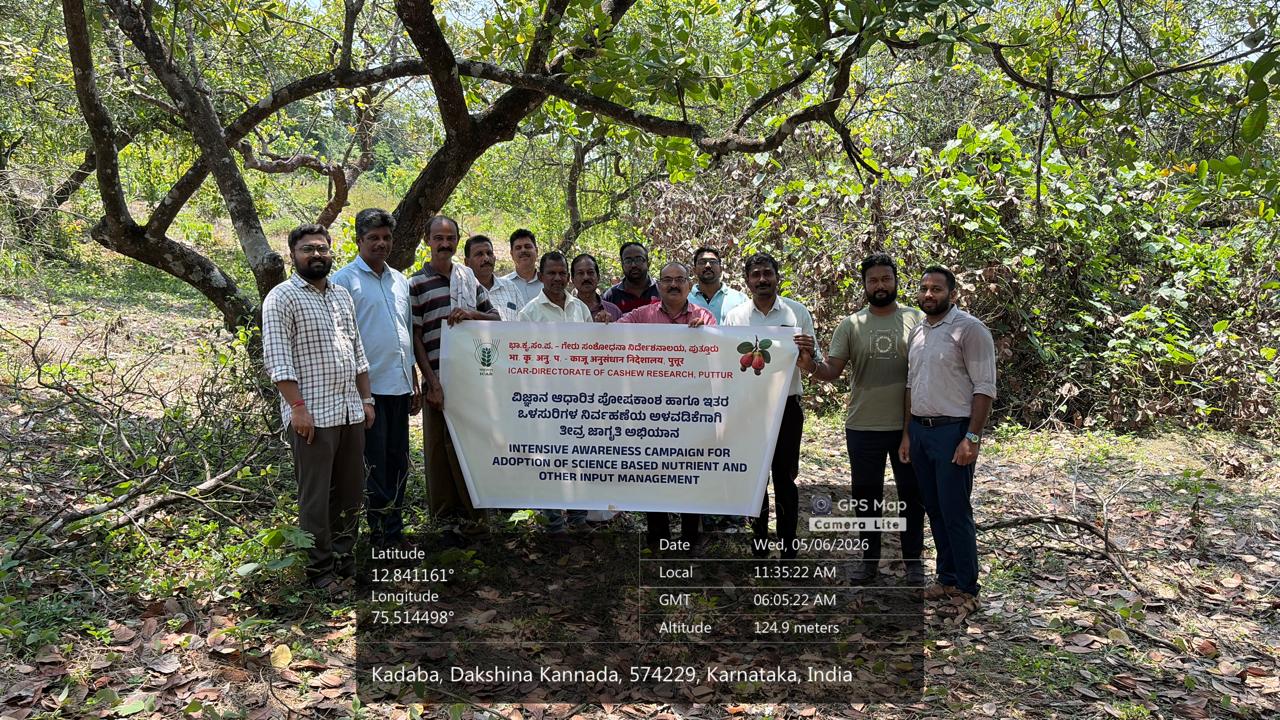
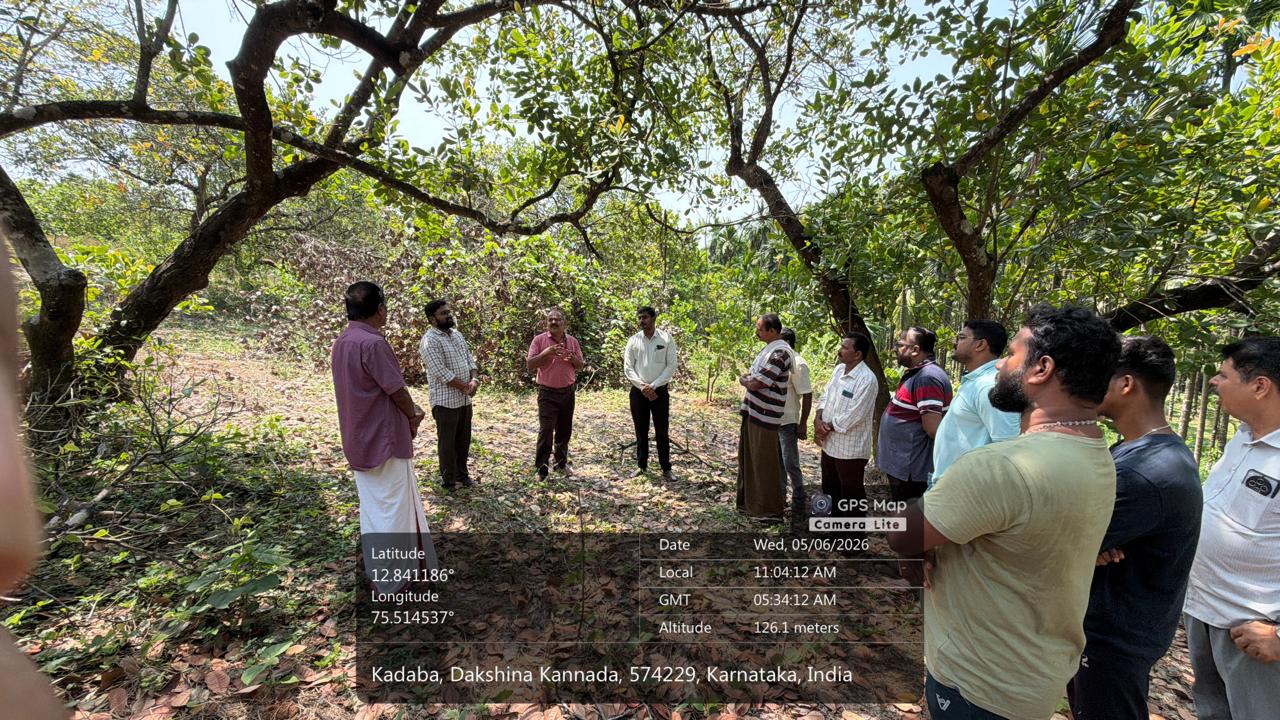
An intensive awareness programme on “Adoption of Science-Based Nutrient and Other Input Management” was successfully conducted at Shiradi village, Nellyadi, Kadaba Taluk, Dakshina Kannada district, Karnataka-574229, on 06-05-2026. The programme was organised with the objective of creating awareness among farmers regarding the importance of balanced nutrient management, scientific input usage, and sustainable agricultural practices, particularly in horticultural crops.
The programme commenced with a warm welcome by Dr. Manjesh, Scientist (SPM&AP), who welcomed all the participants and highlighted the objectives and significance of the campaign. Further, Dr. Mohana G.S. (Principal Scientist, G&C) briefed the gathering about the programme goals and the need for adopting scientific approaches in nutrient and input management for improving production and soil health.
In the interactive session, farmers discussed about time of fertilizer application, organic sources to meet out nutrient requirement, pest and disease control methods. The experts clarified farmers’ queries and emphasised the importance of judicious application of fertilisers.
Furthermore, the participants were sensitized about the importance of vermicomposting and composting techniques as eco-friendly and cost-effective nutrient sources. Detailed information was provided on the preparation, benefits, and field application of organic manures.
As part of the programme, a field demonstration on nutrient management was organised. The demonstration helped farmers understand the practical benefits of integrating green manure crops into their farming systems. Further, the participants were guided to practice the soil test-based nutrition application for crops for effective results.
During the programme, Mr. Jayanth, an input dealer (Salaga agro tech mart) interacted with the farmers and highlighted the available fertilizers, pesticides and organic inputs and its uses.
As a part of the awareness initiative, a booklet on Good Agricultural Practices (GAP) in cashew was distributed to the farmers for their reference.
A total of 13 participants attended the programme (Male: 13; Female: 0), and the programme concluded with a vote of thanks proposed by Dr. V. Thondaiman, Scientist (SPM&AP), who expressed gratitude to the resource persons, participants, and organisers for their cooperation and active participation in the successful conduct of the programme.
[Organisers: Drs. Mohana, G.S., V. Thondaiman and Manjesh G.N].
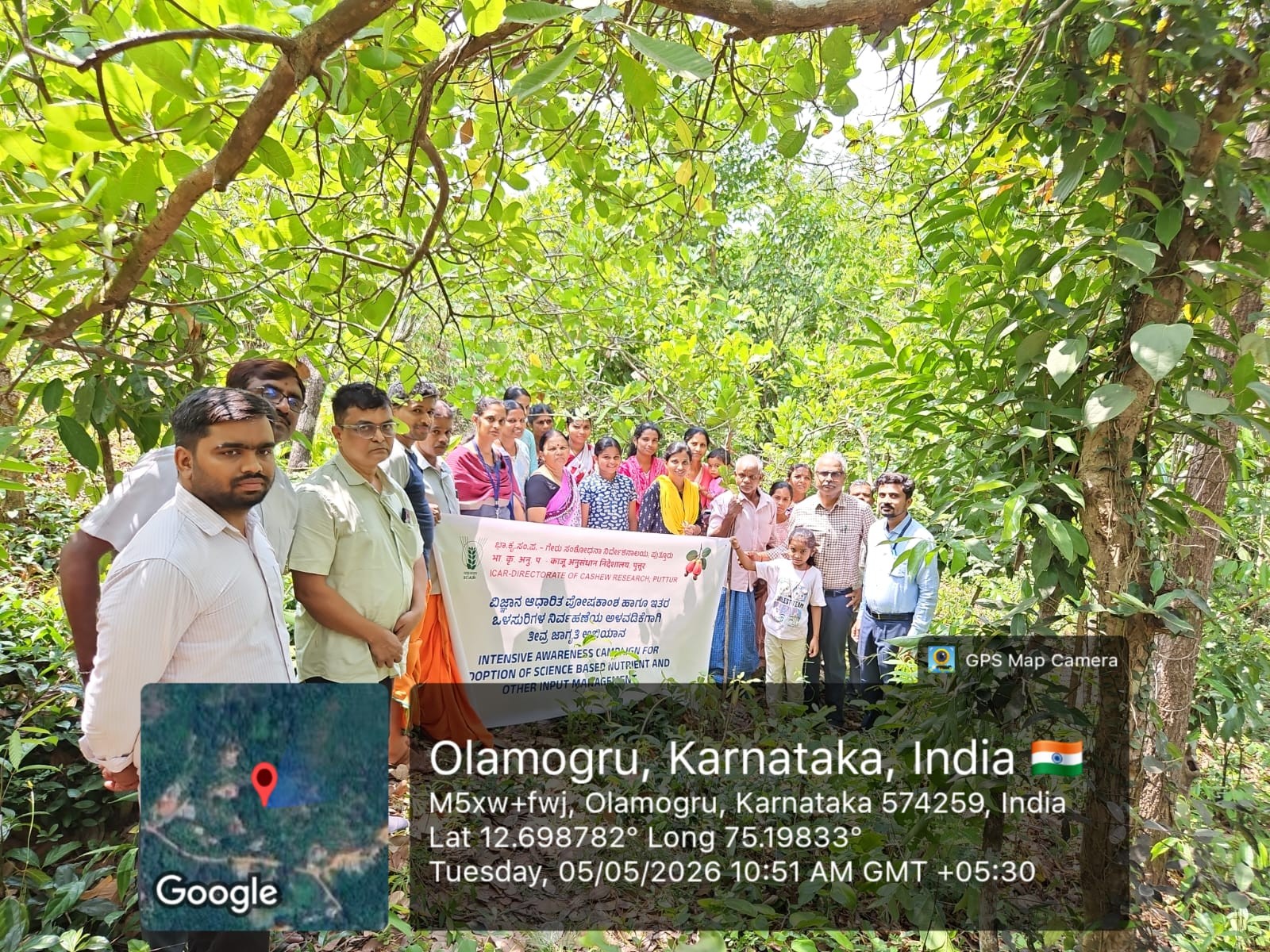
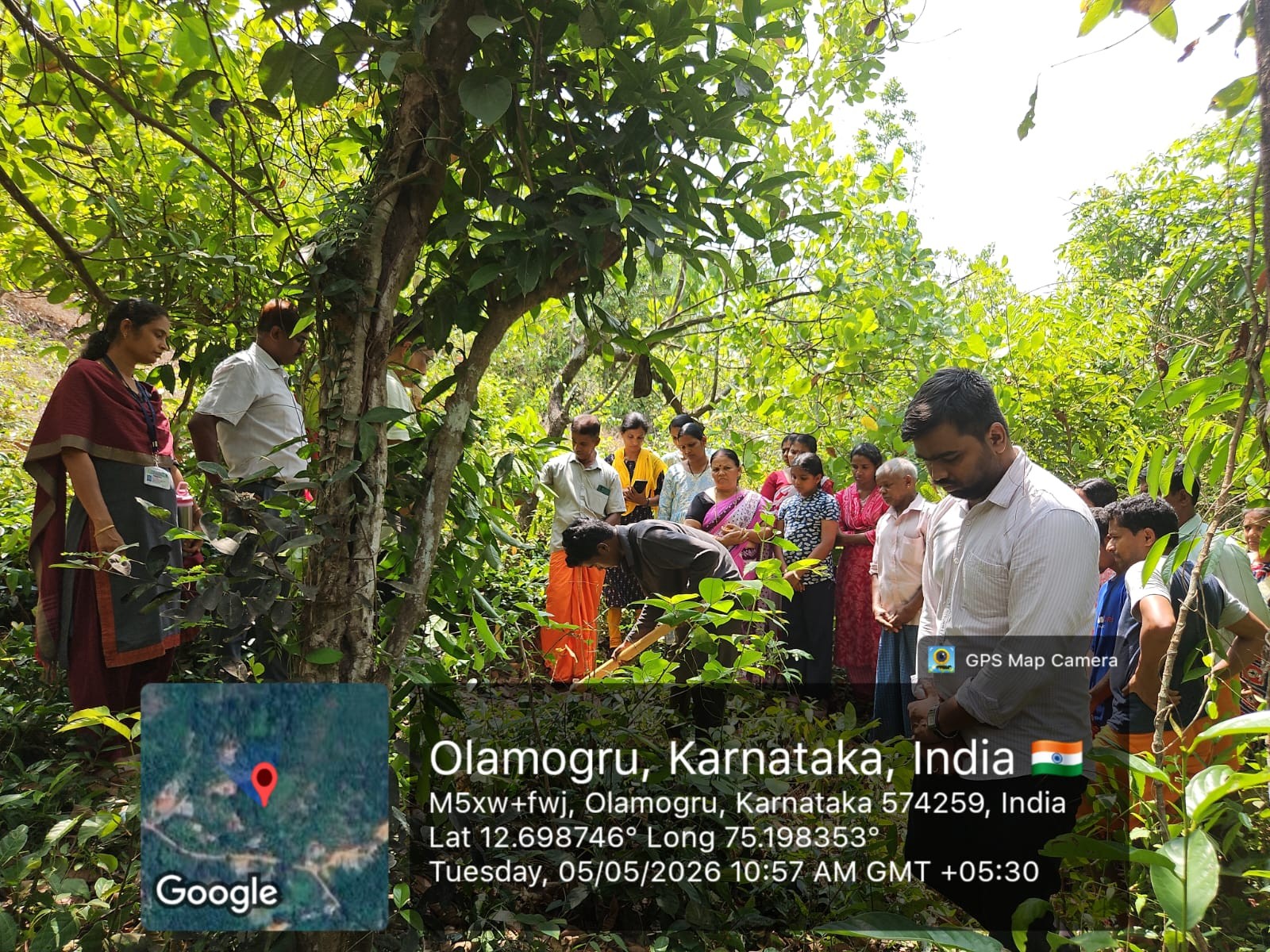
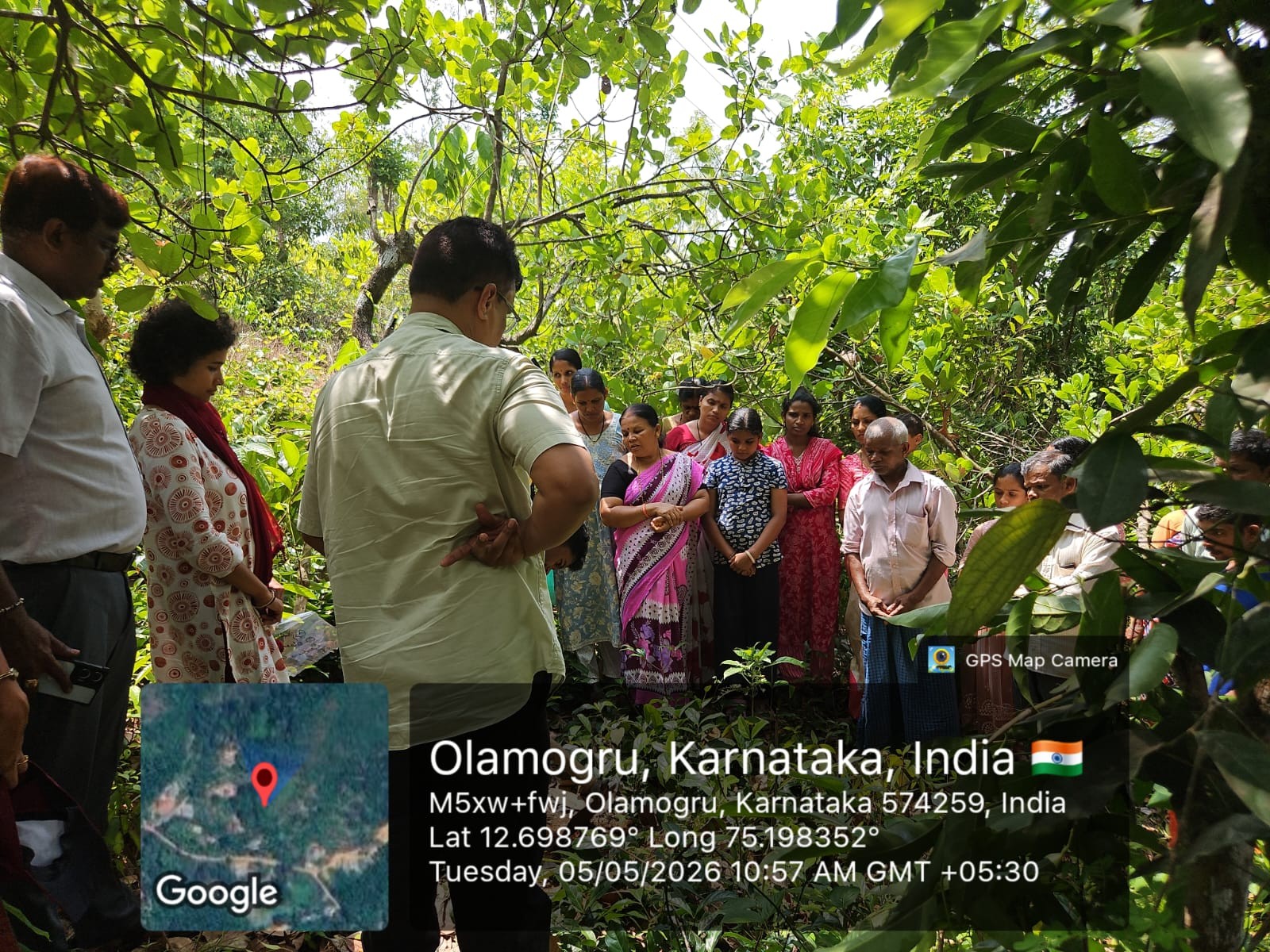
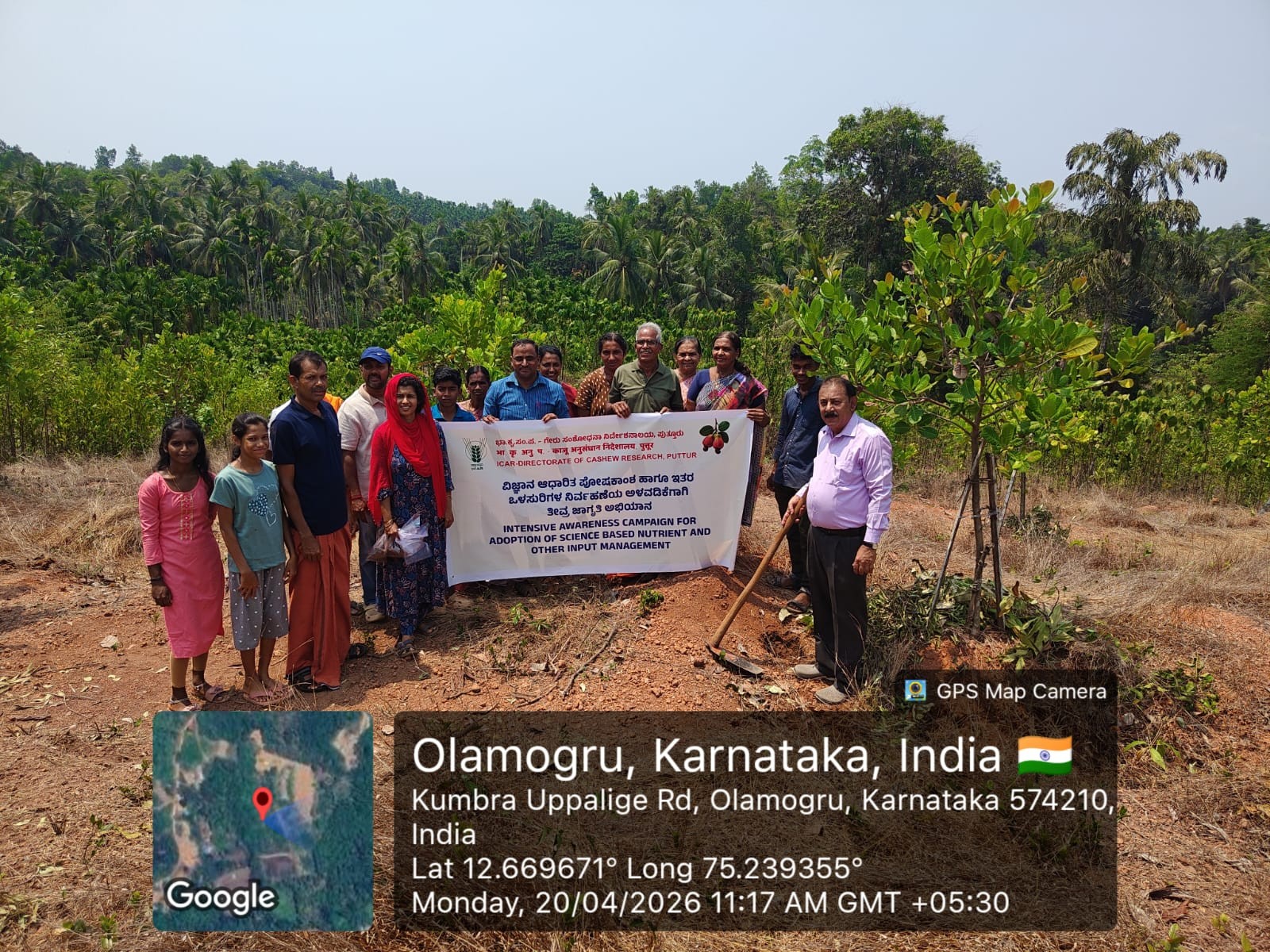
In line with the National Campaign on Balanced Use of Fertilizers, which promotes the judicious and scientific application of nutrients (NPK and micronutrients) along with organic manures to enhance soil health and crop productivity, a field programme was conducted at Ajjikallu Village, Olamogru, Dakshina Kannada, Karnataka. The programme was organized by a team of scientists comprising Dr. Venkatesh M.S., Principal Scientist (Team Leader), Dr. Vanitha K., Senior Scientist (Team Member), and Dr. Manjunatha K., Scientist (Team Member), in collaboration with officials from the Department of Agriculture, including Dr. Shiva Shankar, Deputy Director of Agriculture (DDA), and Mr. Cheluvarangappa, Assistant Director of Agriculture (ADA). The session commenced with an introductory address by Mr. Shiva Shankar, who outlined the objectives of the programme and emphasized the importance of balanced fertilizer use. Dr. Venkatesh M.S. highlighted the significance of soil testing, proper soil sampling methods, and the need for maintaining soil health to ensure sustainable crop production. Dr. Vanitha K discussed major pests and diseases affecting cashew and their management strategies. Dr. Manjunatha K elaborated on different cashew varieties, along with recommended fertilizer schedules and dosage requirements. A hands-on demonstration of soil sampling was conducted by Mrs. Vijetha, YP-II (Soil Science), providing farmers with practical exposure to correct sampling procedures. Soil samples were also collected from farmers’ fields for further analysis. The programme was attended by 25 participants, including 13 men and 12 women. Additionally, the team visited another farmer’s plot to assess land suitability and provide recommendations for cashew cultivation.
Number of participants: 35 (M:29, F: 06)
Interaction with the input dealer: No
Interaction with Panch / Sarpanch: No
Awareness programmes undertaken during visit: Balanced application of nutrition and awareness on composting and vermicomposting
Any demonstration of green manuring: No
Biofertilizers: No
Any Local Learning/Observation Recorded: Few farmers practice vermicomposting and were earlier adopting gobar gas sludge application
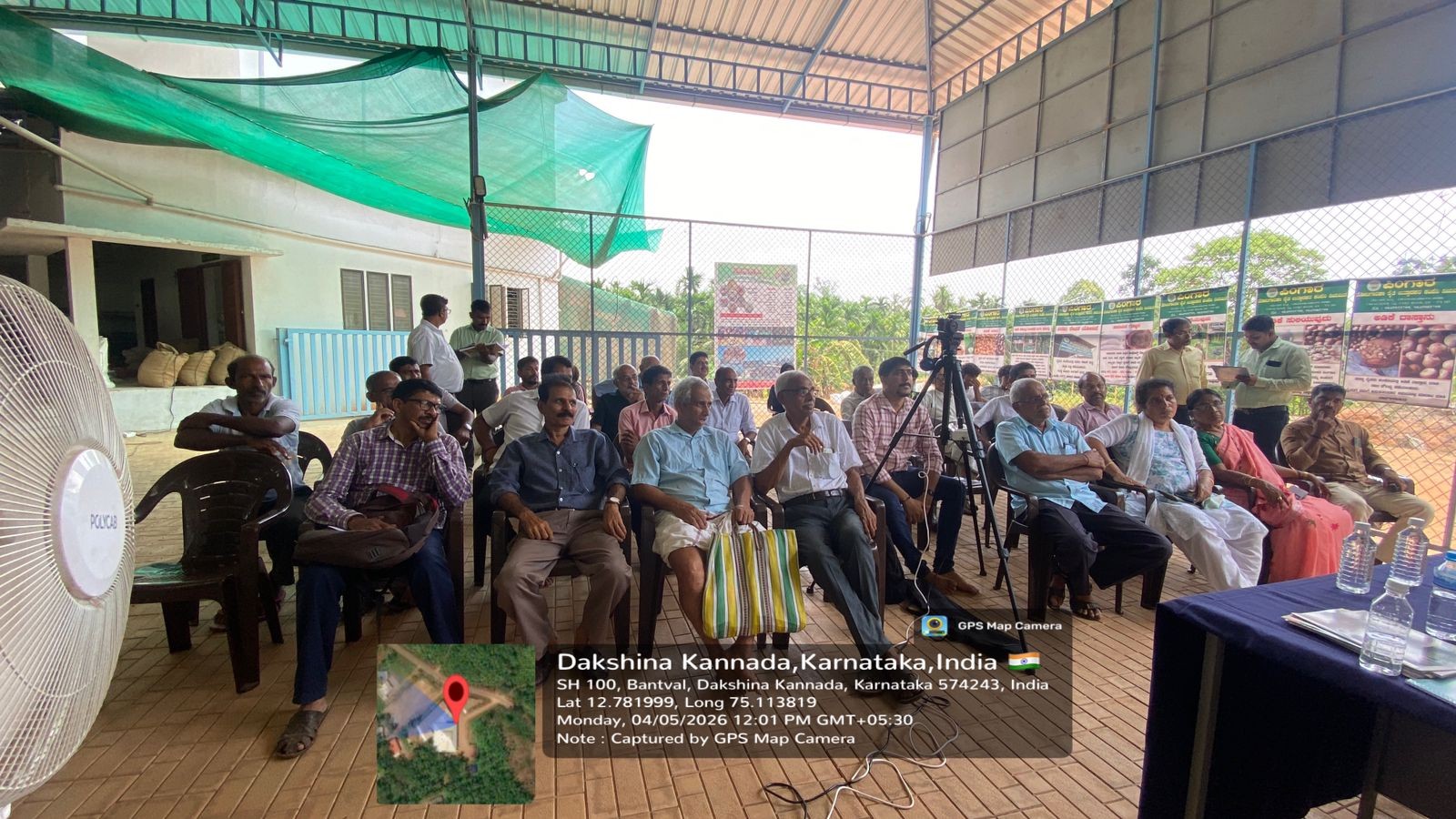
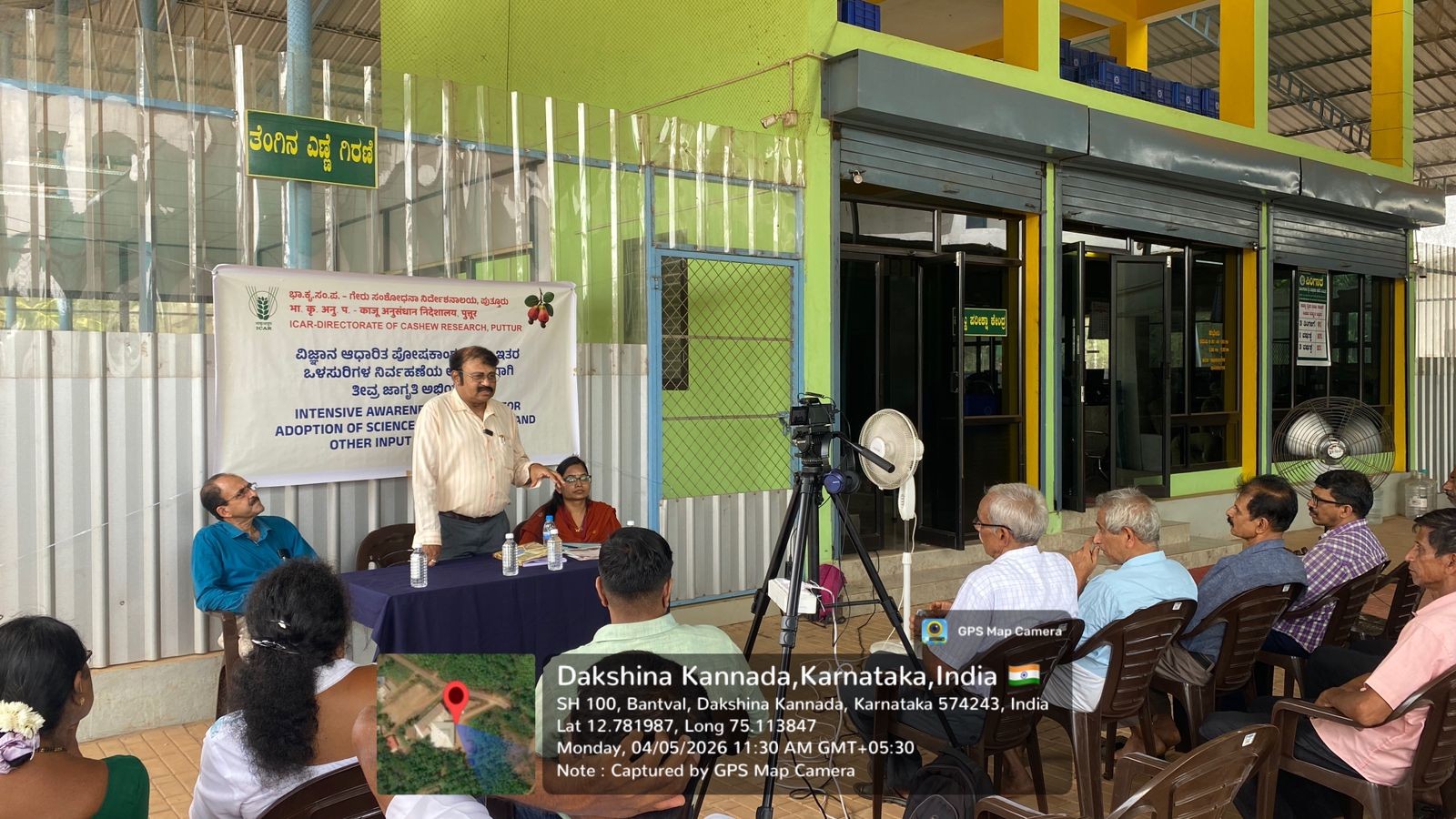
An awareness programme on “Adoption of Science-Based Nutrient and Other Input Management” was successfully conducted on 04 May 2026 at Bolantimugeru, Vitla, Bantwal Taluk, Dakshina Kannada district, Karnataka.
The programme aimed to sensitise farmers on balanced nutrient management, scientific input use, and sustainable practices in horticultural crops. Sri Ramakrishna K., President, Pingara Horticulture Farmer Producer Company Ltd., welcomed the participants and highlighted the importance of the initiative.
Dr. T.N. Raviprasad, Principal Scientist (Agril. Entomology), and Dr. Jyoti Nishad, Scientist (Food Technology), addressed the gathering and emphasised the need for adopting science-based nutrient and input management practices to enhance productivity and maintain soil health.
An interactive session with farmers and members of the Farmer Producer Company (FPC) was a key highlight, where participants discussed their existing fertiliser practices and clarified queries related to application methods, dosage, and timing. Experts underscored the importance of soil test-based nutrient management for improving efficiency and avoiding imbalances.
A total of 35 participants (29 male and 6 female) attended the programme. The event concluded with a vote of thanks.
[Organisers: Dr TN Raviprasad and Dr Jyoti Nishad].
Organizing Institute: ICAR-Directorate of Cashew Research, Puttur, Karnataka
Scientific Team: Dr. Babli Mog, Senior Scientist, ICAR-DCR, Puttur
Dr. Veena G L., Senior Scientist, ICAR-DCR, Puttur
Dr. Bhagya H P, Scientist, ICAR-DCR, Puttur
Number of participants:30 (Male -9, Femele-21)
Interaction with Input dealer: No
Interaction with Panch/Sarpanch: No
Awareness programmes undertaken during visit:
- Awareness on balanced fertilizer use
- Organic farming for horticultural crrops
- Special attention on green manuring and other organic substitutes
In this awareness programme, we have emphasized on soil test-based fertilizer application and soil sampling methodology and importance of soil testing in perennial crops. Usage of organic inputs like compost, biofertilizer, green leaf manuring, panchagavya and recycling of farm waste as insitu decomposition.etc.
Any demonstration of green manuring: No
Biofertilizers: Yes
Any Local Learning/Observation Recorded:
Mr. Radhakrishna, a farmer, is cultivating various vegetables on his farm using organic amendments. His crops include brinjal, cucumber, chilli, bottle gourd, leafy vegetables, and other local vegetables. He also shares his experiences and knowledge about organic vegetable cultivation with other farmers. His future focus is towards organic cultivation of other horticultural crops.
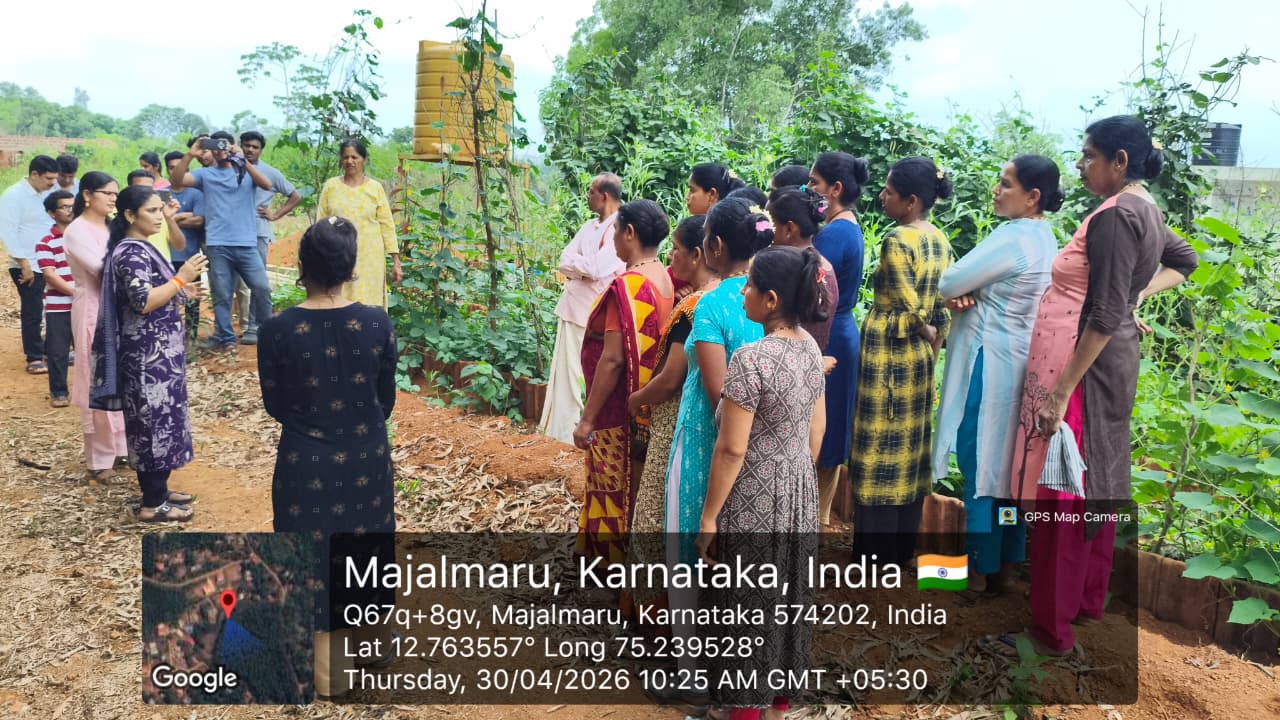
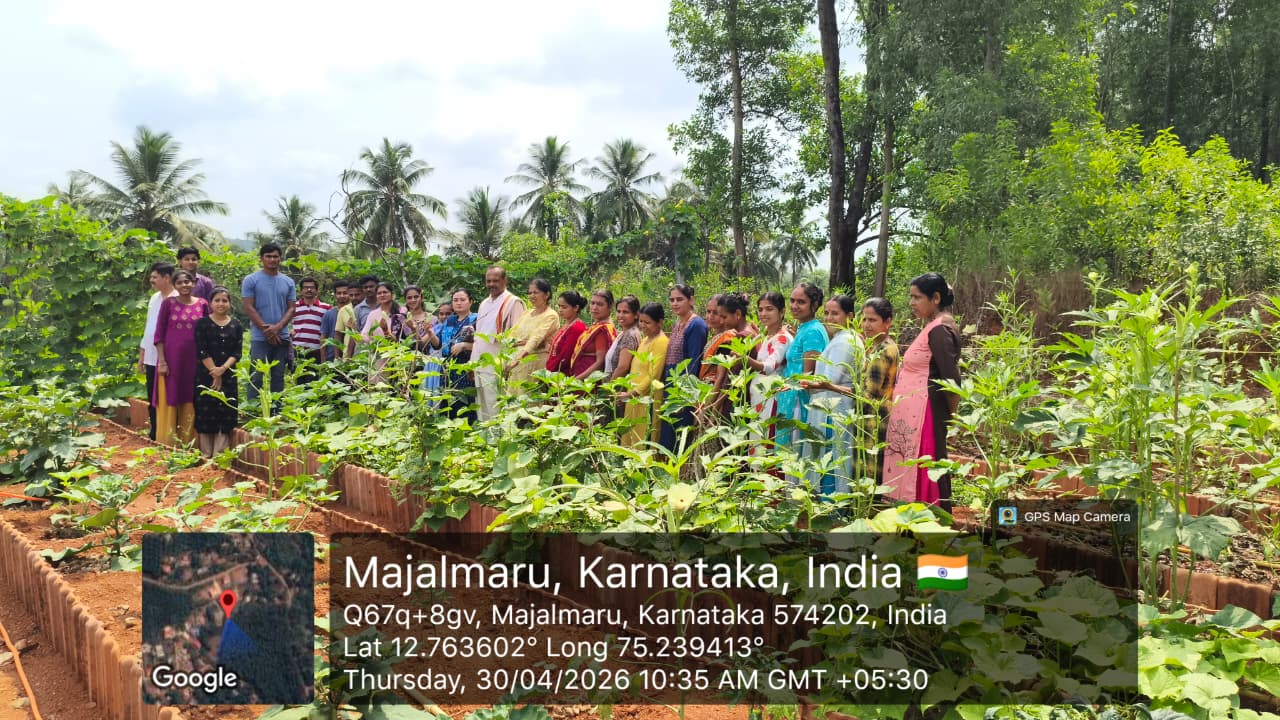
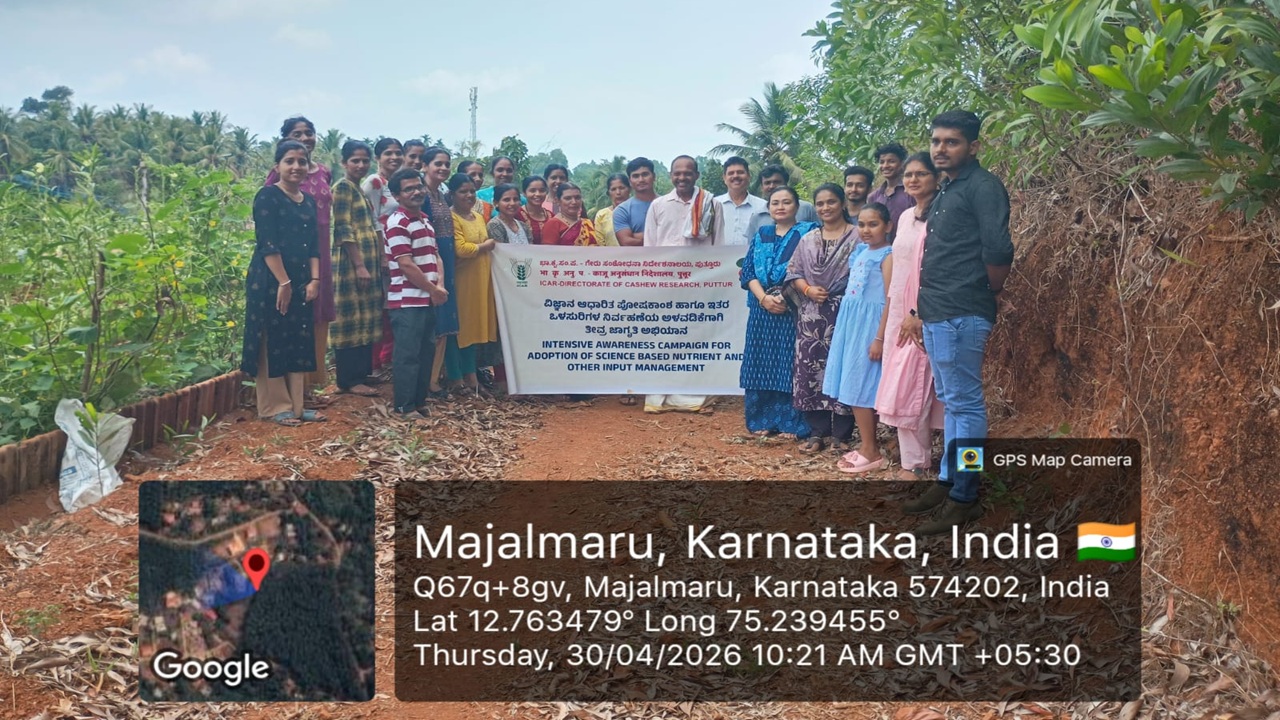
Organizing Institute: ICAR-DCR, Puttur
Number of participants: 27 (M:15, F: 12)
Interaction with the input dealer: No
Interaction with Panch / Sarpanch: Yes
Awareness programmes undertaken during visit: Balanced application of nutrition and awareness on composting and vermicomposting
Any demonstration of green manuring: No
Biofertilizers: No
Any Local Learning/Observation Recorded: Few farmers practice vermicomposting and were earlier adopting gobargas sludge application
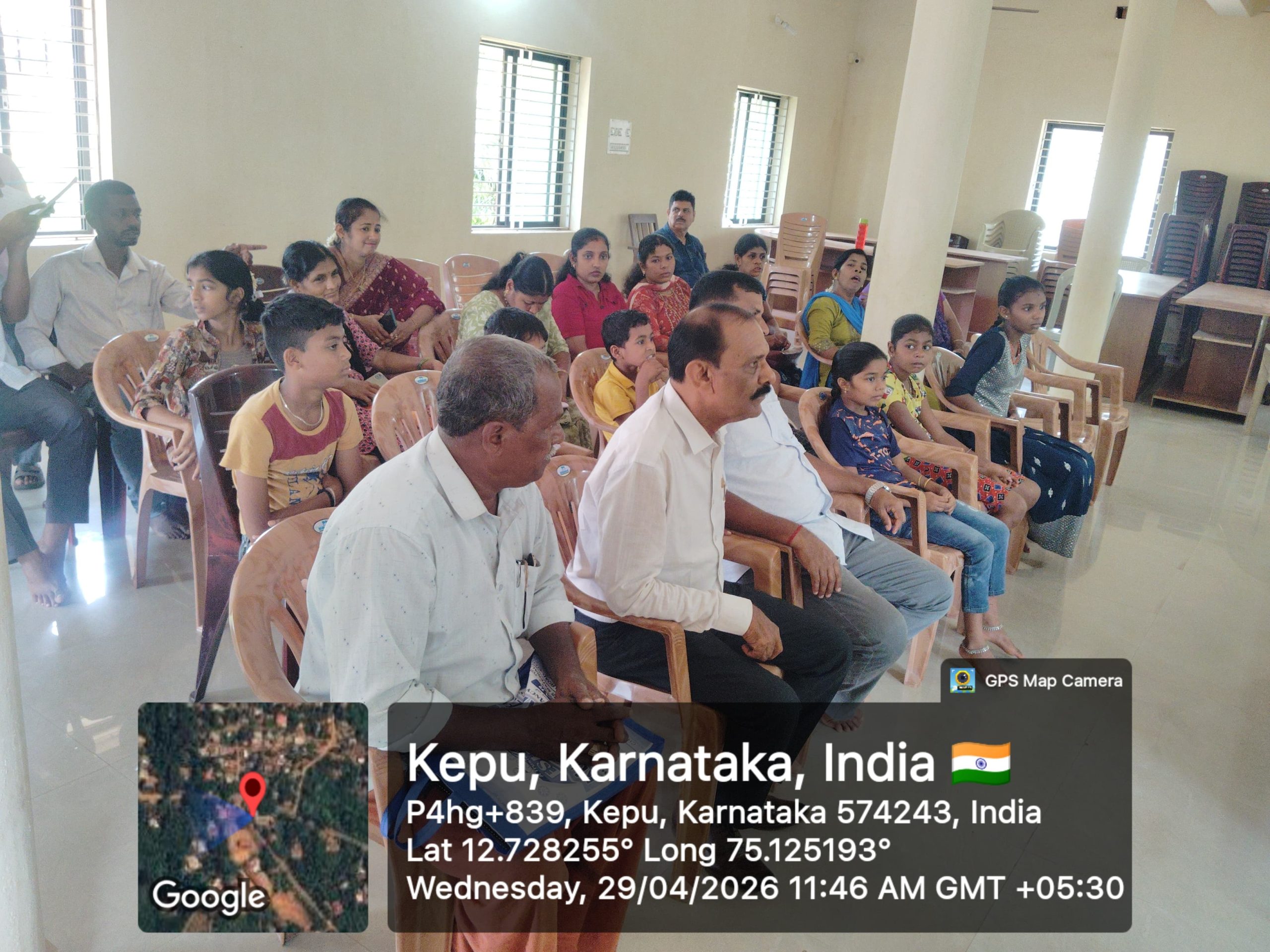
An awareness programme on “Adoption of Science-Based Nutrient and Other Input Management” was conducted at Kepu village, Bantval Taluk, Dakshina Kannada district, Karnataka, on 29 April 2026. The programme aimed to sensitise farmers on balanced nutrient management, scientific input use, and sustainable practices in horticultural crops.
The programme commenced with a warm welcome address by Dr. TN Raviprasad, Principal Scientist (Agril. Entomology), who greeted all the participants and highlighted the purpose and significance of the campaign. Following this, Dr. Rajashekara H. (Sr. Scientist, (Agril. Pathology) and Dr. Jyoti Nishad (Scientist, Food Technology) briefed the gathering about the programme objectives and the need for adopting science-based approaches in nutrient and input management for improving productivity and soil health. The programme was also attended by representatives from the village Panchayat, who actively contributed to the discussions.
An interactive session with farmers and members of self-help groups was a key component of the programme. Participants shared their existing fertiliser practices in horticultural crops and raised queries regarding appropriate application methods, dosage, and timing. The experts addressed these queries and stressed the need for soil test-based nutrient management to avoid imbalance and improve productivity.
A total of 27 participants (Male: 15; Female: 12) attended the programme. The event concluded with a vote of thanks by the Panchayat representative.
Organisers: Dr TN Raviprasad, Dr. Rajashekara H. and Dr Jyoti Nishad.
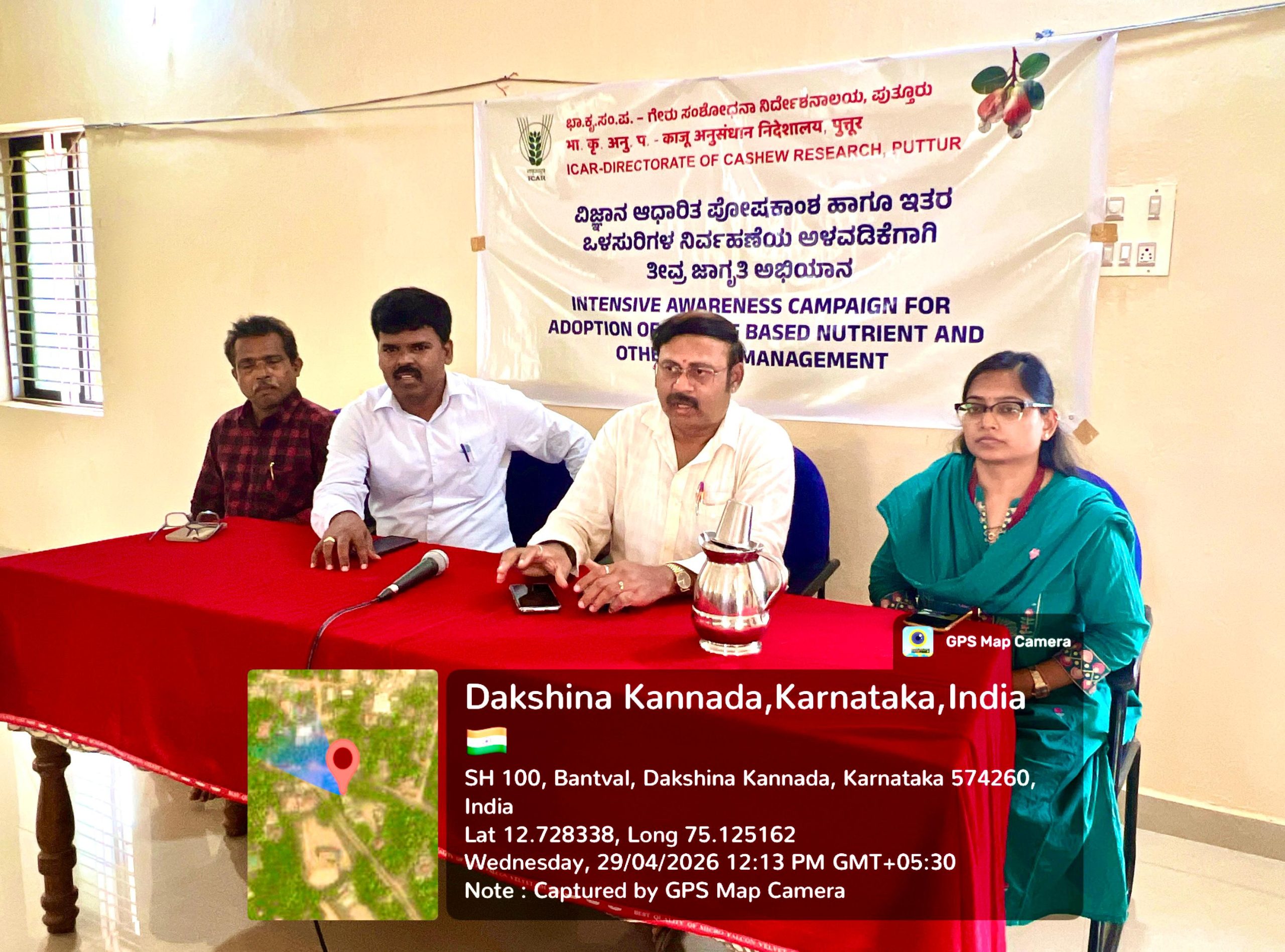
Organizing Institute: ICAR-DCR, Puttur
Number of participants: 27 (M:18, F: 9)
Interaction with the input dealer: Yes
Interaction with Panch/Sarpanch: Yes
Awareness programmes undertaken during visit: Balanced application of nutrition and awareness on composting and vermicomposting
Any demonstration of green manuring: Yes
Biofertilizers: No
Any Local Learning/Observation Recorded: Nil
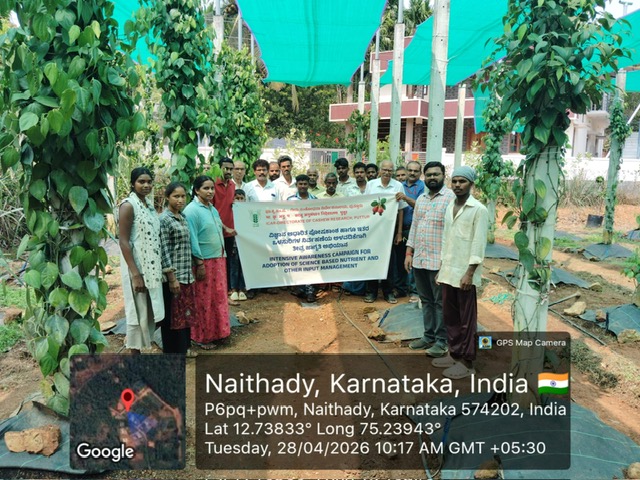
An intensive awareness programme on “Adoption of Science-Based Nutrient and Other Input Management” was successfully conducted at Naithady village, Puttur Taluk, Dakshina Kannada district, Karnataka, on 28-04-2026. The programme was organised with the objective of creating awareness among farmers regarding the importance of balanced nutrient management, scientific input usage, and sustainable agricultural practices, particularly in horticultural crops.
The programme commenced with a warm welcome address by Dr. Manjesh, Scientist (SPM&AP), who greeted all the participants and highlighted the purpose and significance of the campaign. Following this, Dr. Mohana G.S. (Principal Scientist, G&C) briefed the gathering about the programme objectives and the need for adopting science-based approaches in nutrient and input management for improving productivity and soil health. The programme was also graced by the presence of Dr. Yadhu Kumar (Retired Principal Scientist, ICAR–DCR), who contributed valuable insights throughout the event.
A highly interactive session was held with the farmers, where participants actively discussed the current fertiliser practices followed in horticultural crops and raised queries regarding the correct application methods, dosage, and timing. The experts clarified farmers’ doubts and emphasised the importance of using fertilisers based on crop requirement and soil fertility status to avoid nutrient imbalance and soil degradation.
Further, the participants were sensitised about the importance of vermicomposting and composting techniques as eco-friendly and cost-effective nutrient sources. Detailed information was provided on the preparation, benefits, and field application of organic manures. Farmers were also educated about sustainable practices such as mulching and green manuring, highlighting their role in conserving soil moisture, reducing weed growth, enhancing soil organic matter, and improving soil fertility.
As part of the programme, a field demonstration was organised at Yashawini Garden, where farmers were shown the manure crop Mucuna, and its importance in green manuring was explained. The demonstration helped farmers understand the practical benefits of integrating green manure crops into their farming systems. Further, the participants were advised to practice the soil test-based nutrition for crops for better results, maintaining the soil health.
Later, Dr. Yadhu Kumar, Retired Principal Scientist, shared his extensive experience on organic farming, explaining its scope, long-term benefits, and growing importance in horticultural crops. He stressed the need for adopting organic and integrated nutrient management practices to ensure sustainable productivity and maintain soil health.
During the programme, Mr. Kishore, an input dealer, also shared his views on the increasing demand for organic fertilisers and related agricultural inputs. He highlighted the rising farmer interest in products such as humic acid, fulvic acid, vermicompost, vermiwash, and other organic inputs, and discussed the market trend towards eco-friendly nutrient solutions.
As part of the awareness initiative, a booklet on Good Agricultural Practices (GAP) in cashew was distributed among the farmers, providing them with useful guidelines for improved cashew cultivation practices.
A total of 27 participants attended the programme (Male: 18; Female: 9), reflecting good involvement from the farming community. The programme concluded with a vote of thanks proposed by Dr. Thondaiman, Scientist (SPM&AP), who expressed gratitude to the resource persons, participants, and organisers for their cooperation and active participation, contributing to the successful conduct of the programme.
Organisers: Drs. Mohana, G.S., Thondaiman and Manjesh G.N.
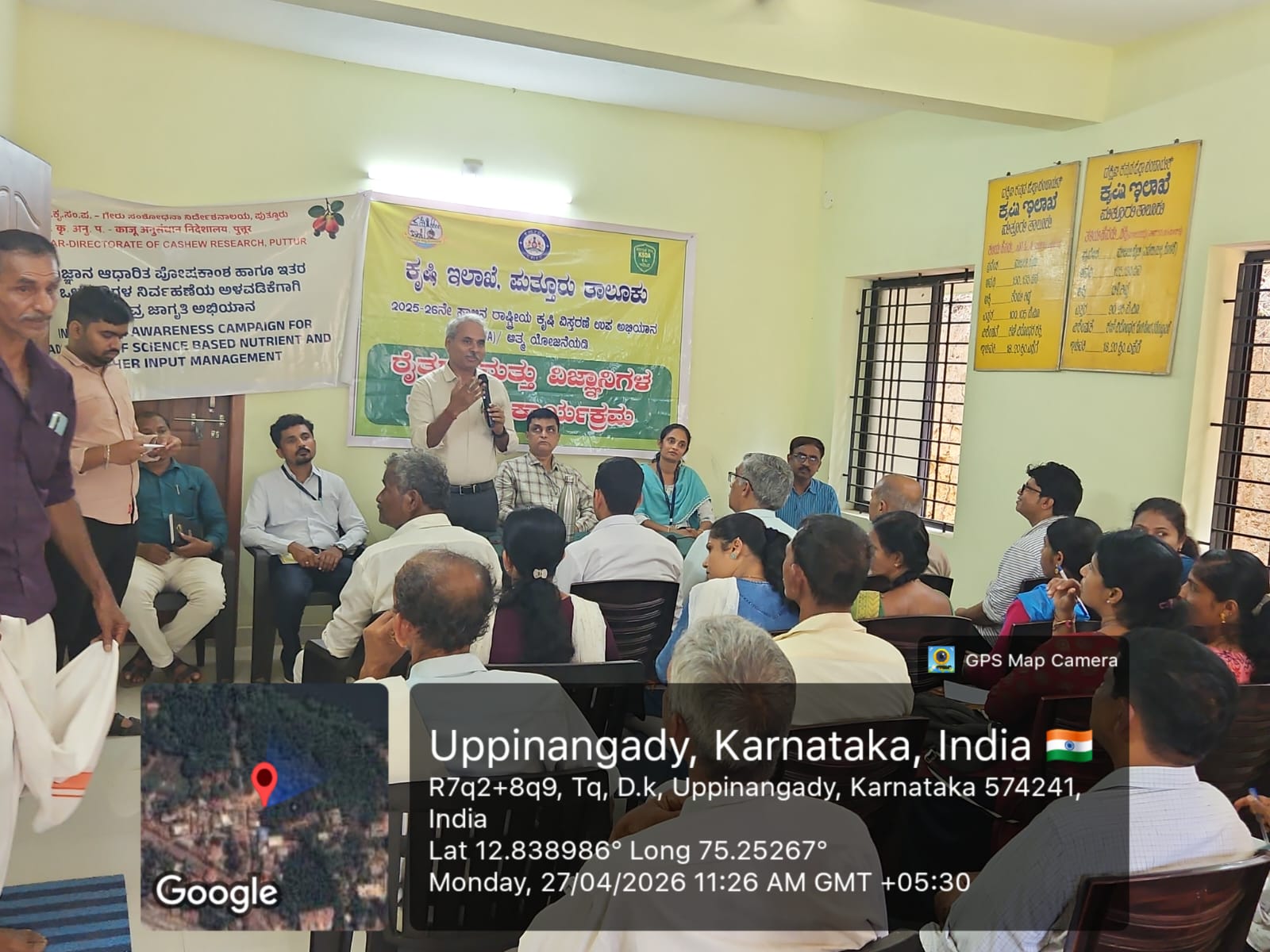
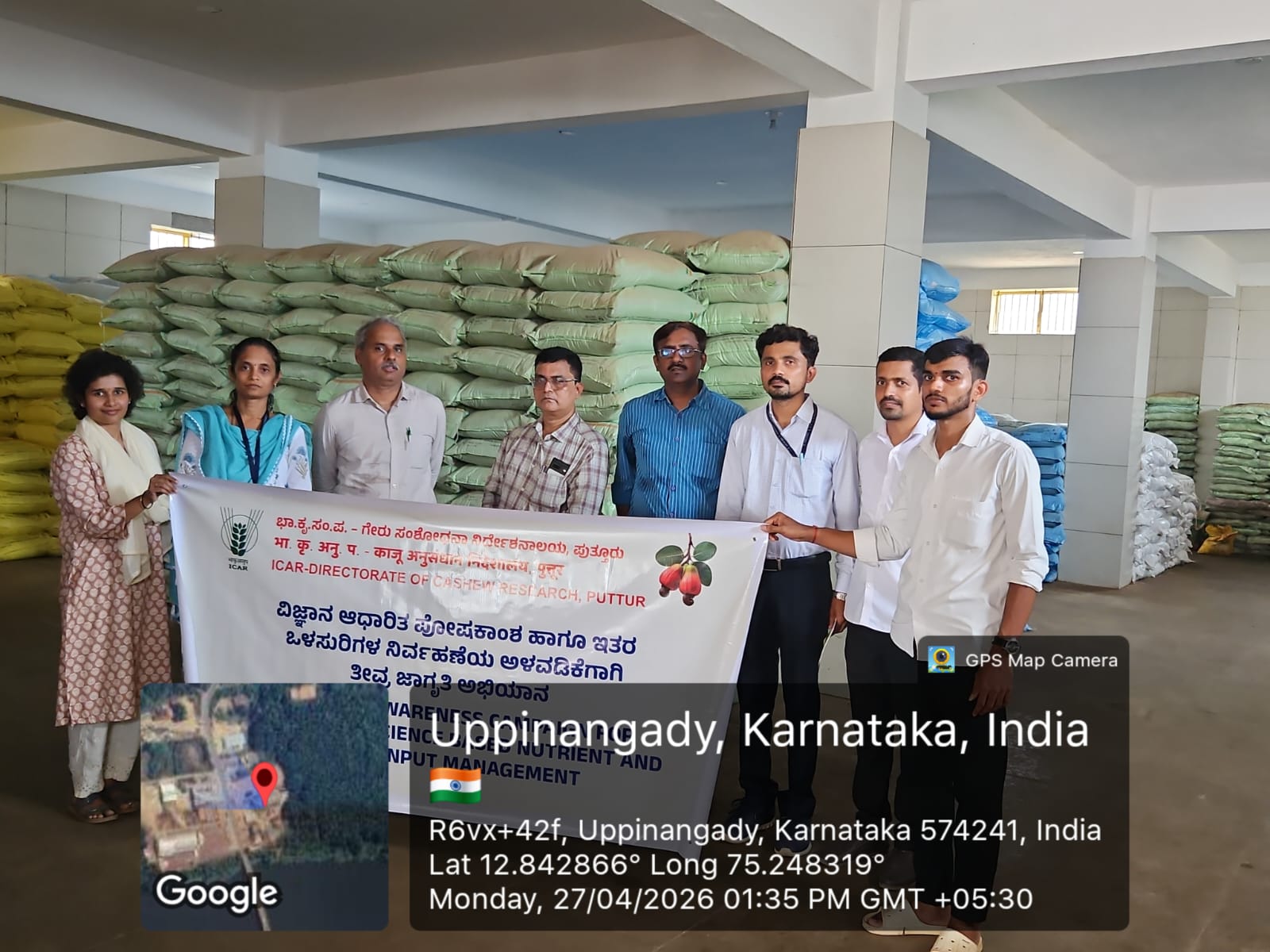
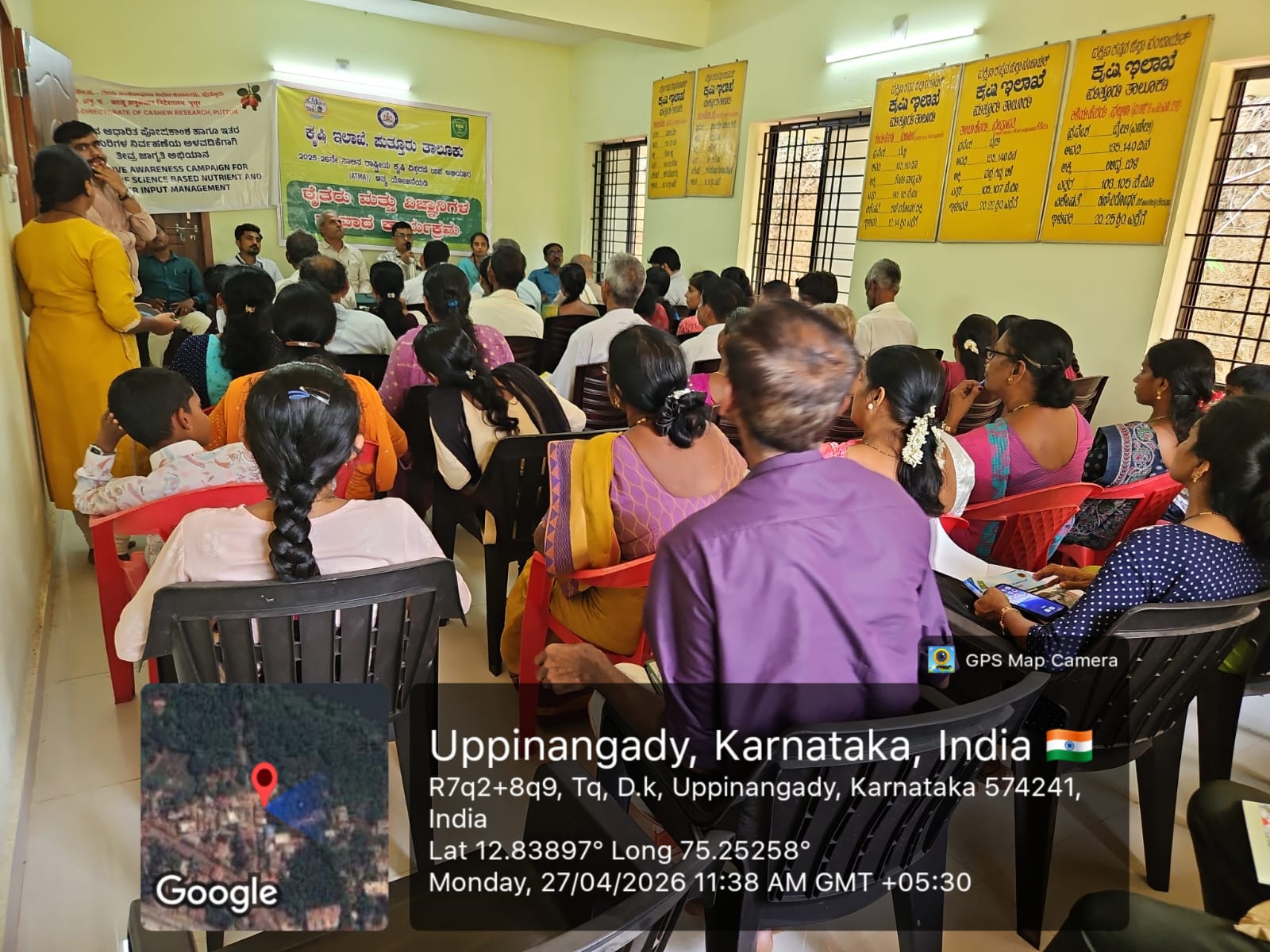
In line with the National Campaign on Balanced Use of Fertilizers, which advocates the judicious and scientific application of nutrients (NPK and micronutrients) along with organic manures to improve soil health and crop productivity, a field programme was conducted at the Raita Samparka Kendra (RSK), Uppinangadi, Dakshina Kannada, Karnataka. The programme was organized by a team of scientists comprising Dr. Venkatesh M.S., Principal Scientist (Team Leader), Dr. Vanitha K., Senior Scientist (Team Member), and Dr. Manjunatha K., Scientist (Team Member), in collaboration with officials from the Department of Agriculture and KVK. The officials included Mr. Shiva Shankar, Deputy Director of Agriculture (DDA), Mr. Cheluvarangappa, Assistant Director of Agriculture (ADA), and Mr. Mallikarjun, Subject Matter Specialist (SMS), KVK Mangalore. The session commenced with an introductory address by Mr. Shiva Shankar, who outlined the objectives of the programme and emphasized the importance of balanced fertilizer use. Dr. Venkatesh M.S. highlighted the significance of soil testing and maintaining soil health for sustainable crop production. Dr. Manjunatha K. discussed the application of micronutrients through drone-based technologies, while Mr. Mallikarjun elaborated on the role of micronutrients, the adverse effects of excessive fertilizer use, and proper soil sampling techniques. A hands-on demonstration of soil sampling was conducted by Mr. Mallikarjun and Mrs. Vijetha, providing farmers with practical exposure to correct sampling procedures. Soil samples were also collected from farmers’ fields for further analysis. The programme was attended by a total of 60 participants, including 29 men and 31 women, of which three were Agro-input dealers. In addition, the team visited local Agro-input dealers’ shops and interacted with them to discuss fertilizer management practices and promote the principles of balanced nutrient use.
Scientific Team: Dr. Eradasappa E, Principal Scientist (Plant Breeding)
Dr. Vanitha K, Senior Scientist (Agrl. Entomology)
Dr. Aswathy Chandrakumar, Scientist (Agrl. Extension)
Number of participants: 38 (28 male +10 female)
Interaction with Input dealer: 1
Interaction with Panch/Sarpanch: 0
Awareness programmes undertaken during visit:
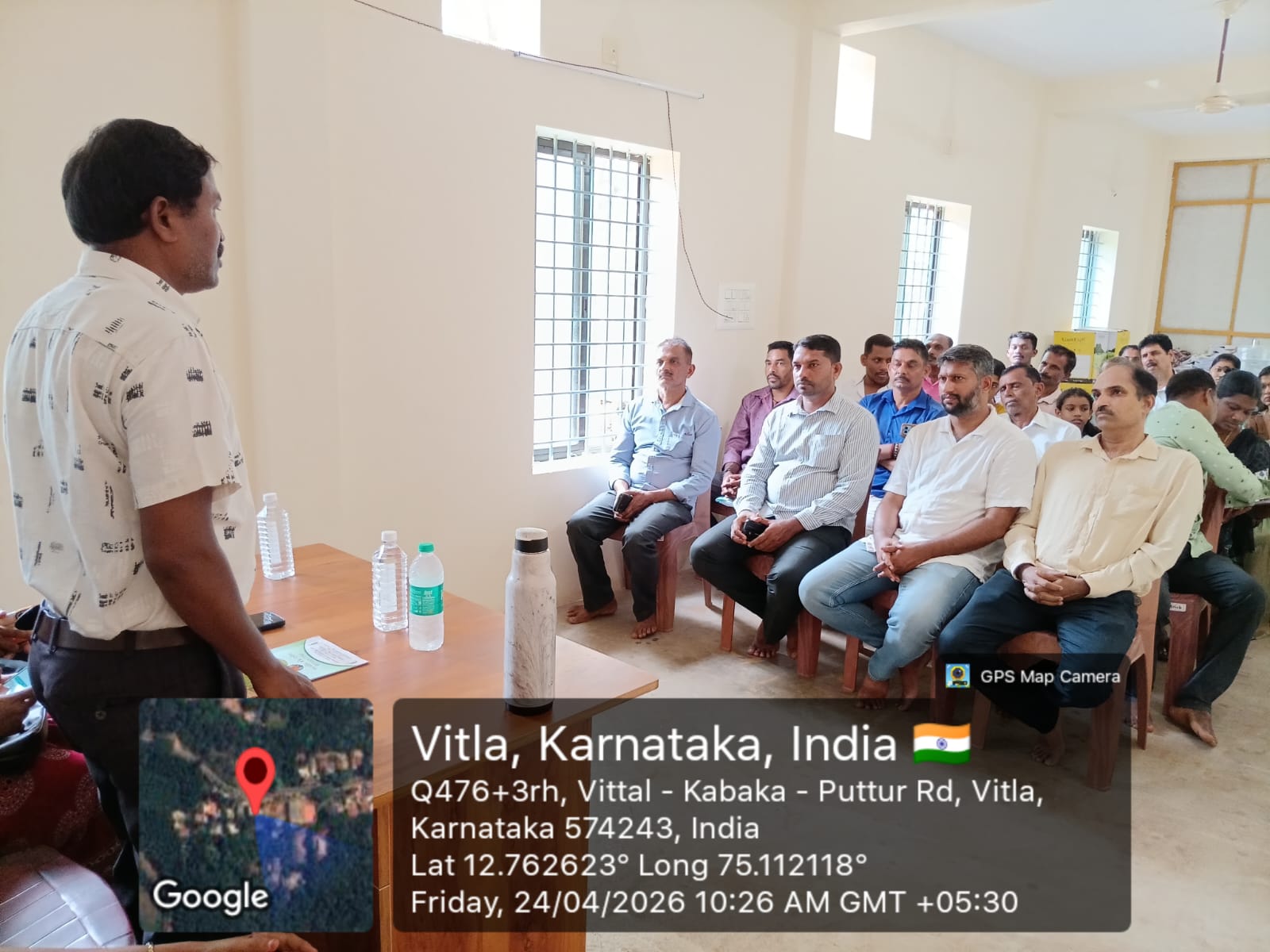
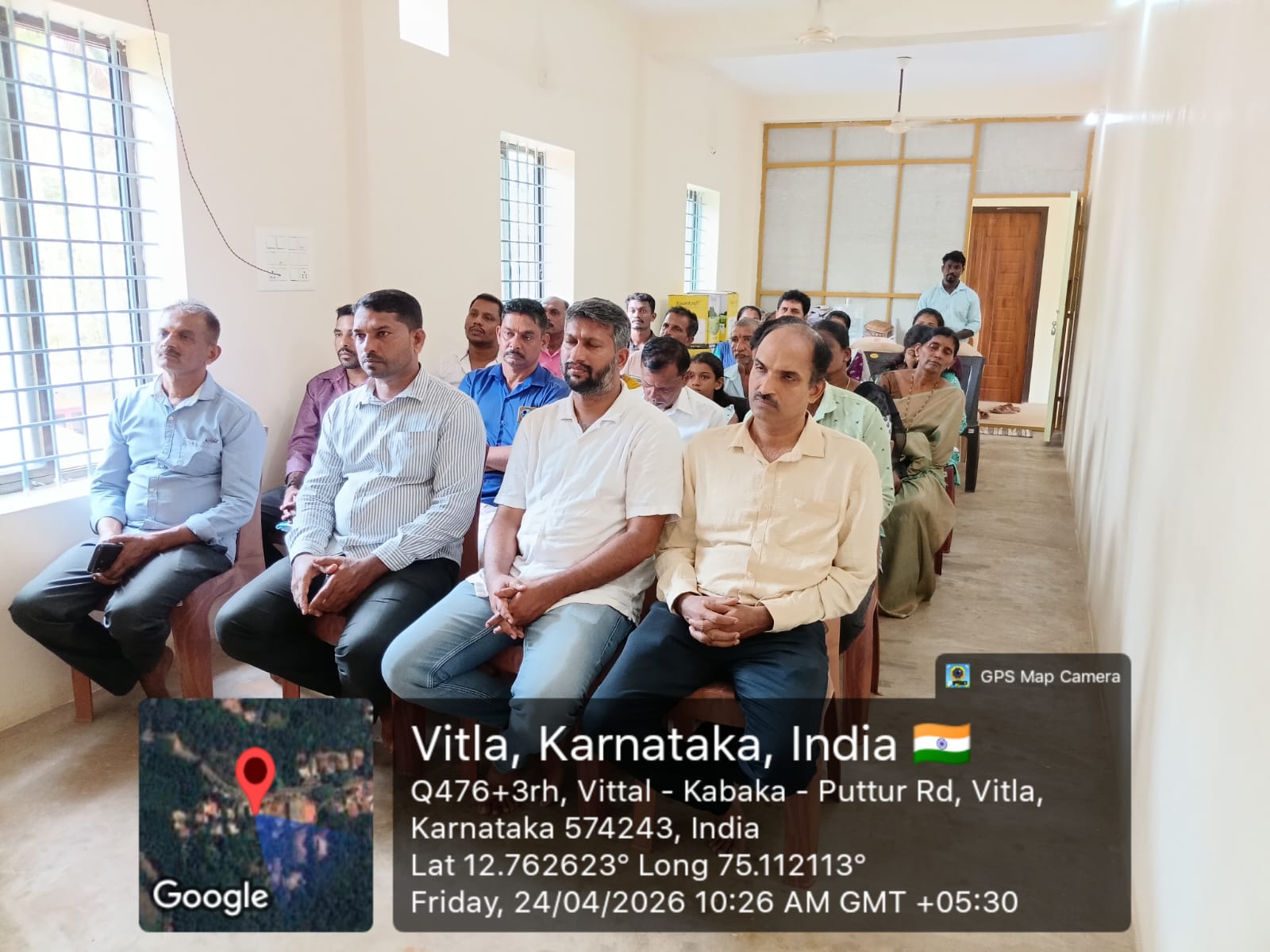
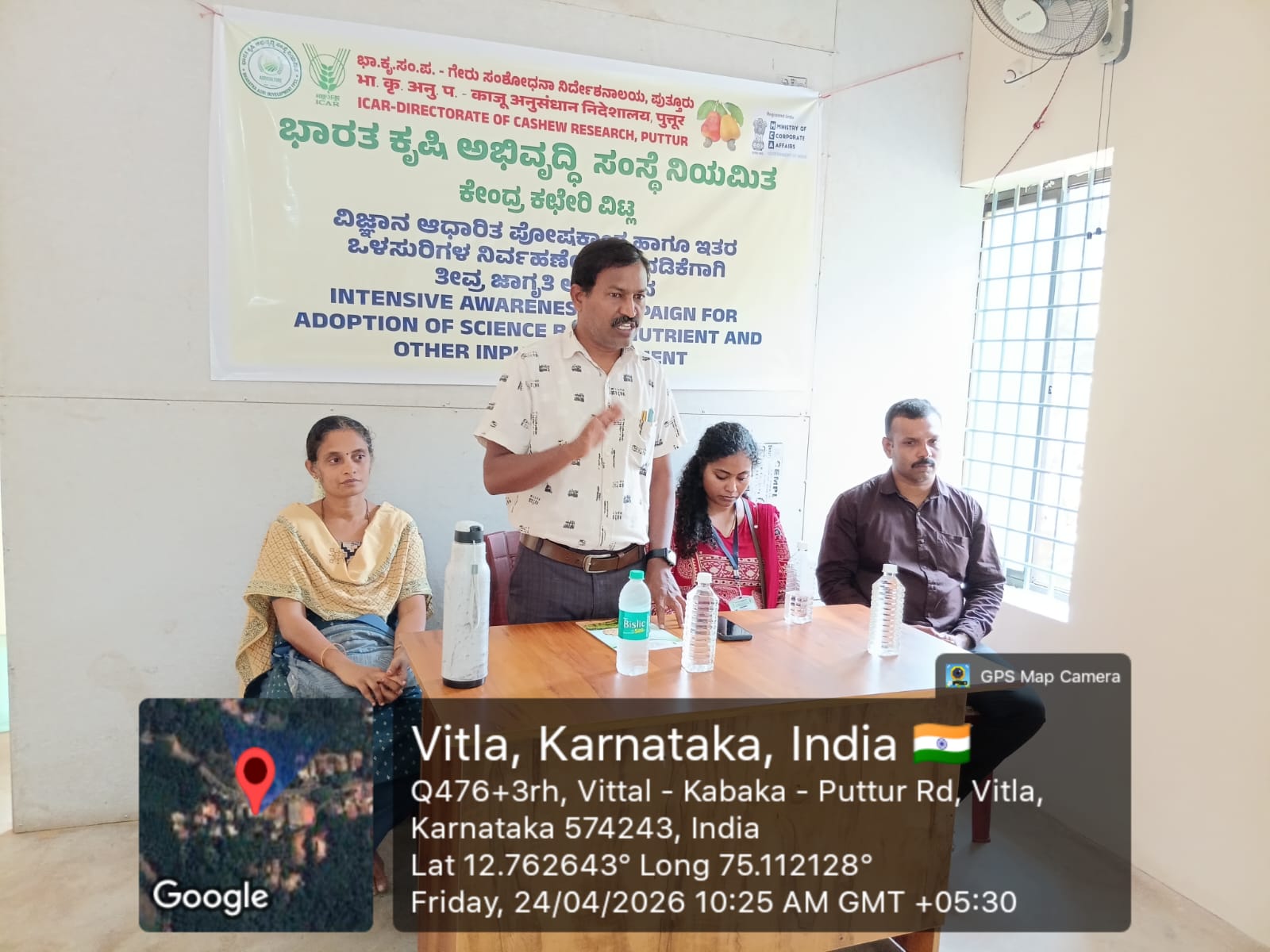
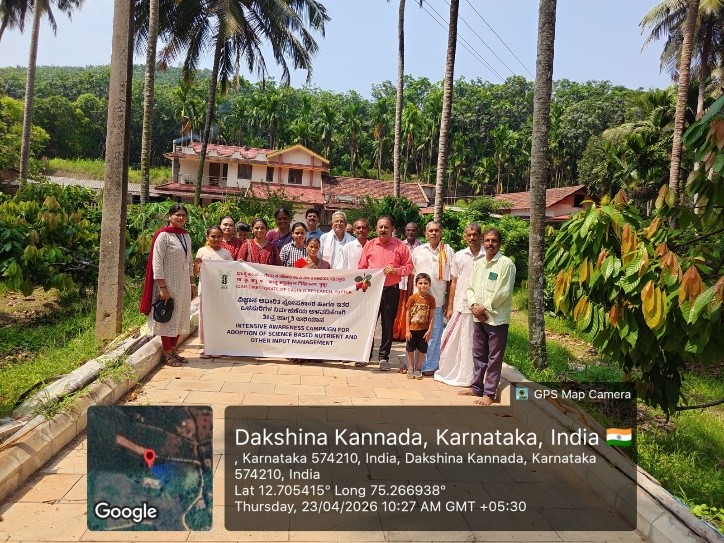
Awareness programme on balanced use of fertilisers was organised at Vittal in collaboration with Bharat Agri Development Farmers Producer Company Ltd. The programme aimed to create awareness among the farmers on the importance of organic manures and biofertilisers in farming and for judicious use of inorganic fertilisers. During the programme, farmers were asked to apply only the recommended dose as per the Package of Practice of each crop to ensure the production of safe foods. The importance of soil testing and soil health cards were also explained during the campaign. Further, the farmers were urged to use cow dung, vermicompost, biofertilisers like pseudomonas and Trichoderma for ensuring sustainability. A total of 38 farmers attended the programme which includes 28 males and 10 females.
Any demonstration of green manuring: No
Biofertilizers: Awareness was given and few progressive farmers were invited to shre their experience of using biofertilisaers.
Any Local Learning/Observation Recorded: Many farmers are using organic manures and biofertilisers of companies like Netsurf.
Organizing Institute: ICAR-Directorate of Cashew Research, Puttur, Karnataka
Scientific Team: Dr. D Balasubramanian, Principal Scientist, ICAR-DCR, Puttur
Dr. Babli Mog, Senior Scientist, ICAR-DCR, Puttur
Dr. Veena G L., Senior Scientist, ICAR-DCR, Puttur
Dr. Bhagya H P, Scientist, ICAR-DCR, Puttur
Number of participants: 37 (Male -17, Femele-20)
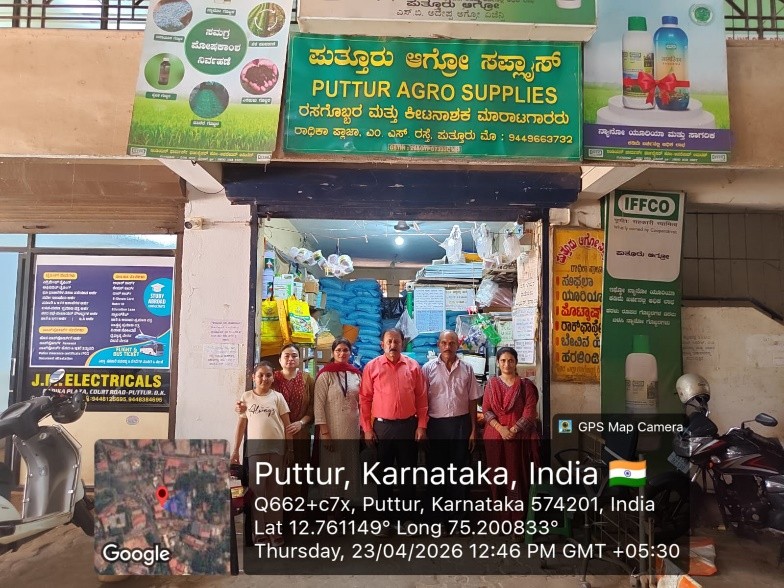
Interaction with Input dealer: Yes- Puttur Agro (1 no.)- Mr. Manjunath
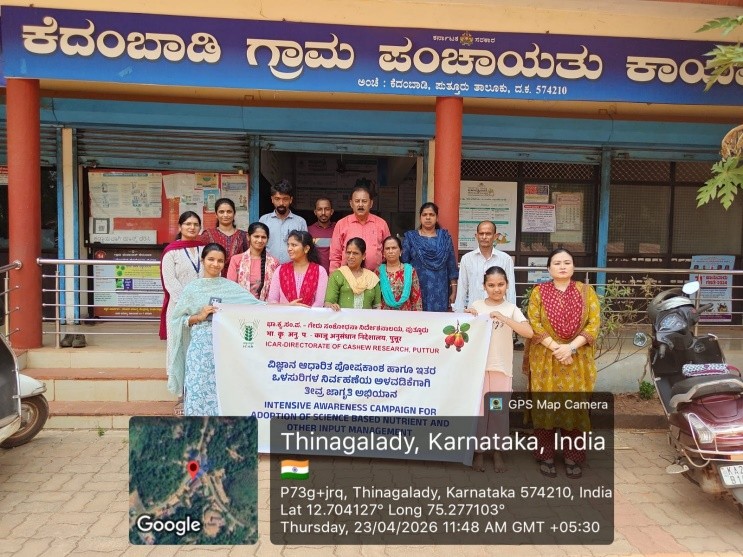
Interaction with Panch/Sarpanch: Yes, Kedambady grama panchayat (1 no.) -Mrs. Lavanya, PDO
Awareness programmes undertaken during visit:
- Awareness on balanced fertilizer use
- Mobilizing farmers
- Special attention on green manuring and other organic substitutes
In this awareness programme, we have emphasized on soil test-based fertilizer application and soil sampling methodology and importance of soil testing in perennial crops. Usage of organic inputs like compost, biofertilizer, green leaf manuring, panchagavya and recycling of farm waste as insitu decomposition.etc.
Any demonstration of green manuring: No
Biofertilizers: Yes- Cashew special for yield improvement in cashew
Any Local Learning/Observation Recorded:
Progressive farmer Mr. Subash Rai has adopted an integrated nutrient management approach, including the recycling of farm waste through insitu composting and he also practices multiple cropping system, maintains a kitchen garden, and has implemented the balanced use of fertilizer in his farm.
Organizing Institute: ICAR-Directorate of Cashew Research, Puttur, Karnataka
Scientific Team: Dr. Eradasappa E, Principal Scientist (Plant Breeding)
Dr. Siddana Savadi, Senior Scientist(Plant Biochemistry)
Dr. Aswathy Chandrakumar, Scientist (Agricultural Extension)
As part of the nationwide campaign launched by Indian Council of Agricultural Research, an awareness programme on the balanced use of fertilisers was organized on 22 April 2026 at Bettampady village in Puttur taluk, Dakshina Kannada district
A team of scientists comprising Dr. Eradasappa E, Principal Scientist (Plant Breeding), Dr. Siddana Savadi, Senior Scientist (Plant Biochemistry), and Dr. Aswathy Chandrakumar, Scientist (Agricultural Extension), visited the village to sensitize farmers on the importance of judicious fertiliser use and sustainable soil management practices.
The programme began with Dr. Eradasappa E briefing the participants on the significance of the national campaign and providing crop-specific fertiliser recommendations for cashew cultivation. Dr. Siddana Savadi elaborated on the role of biofertilisers in improving soil fertility and promoting environmentally sustainable agriculture. Dr. Aswathy Chandrakumar emphasized the importance of soil testing and advocated for fertiliser application based on soil health parameters to ensure balanced nutrient management.
During the session, Smt. Anitha, a progressive organic farmer, shared her practical experiences in cultivating arecanut, rice, vegetables, and cashew using organic manures, inspiring participants to adopt eco-friendly practices.
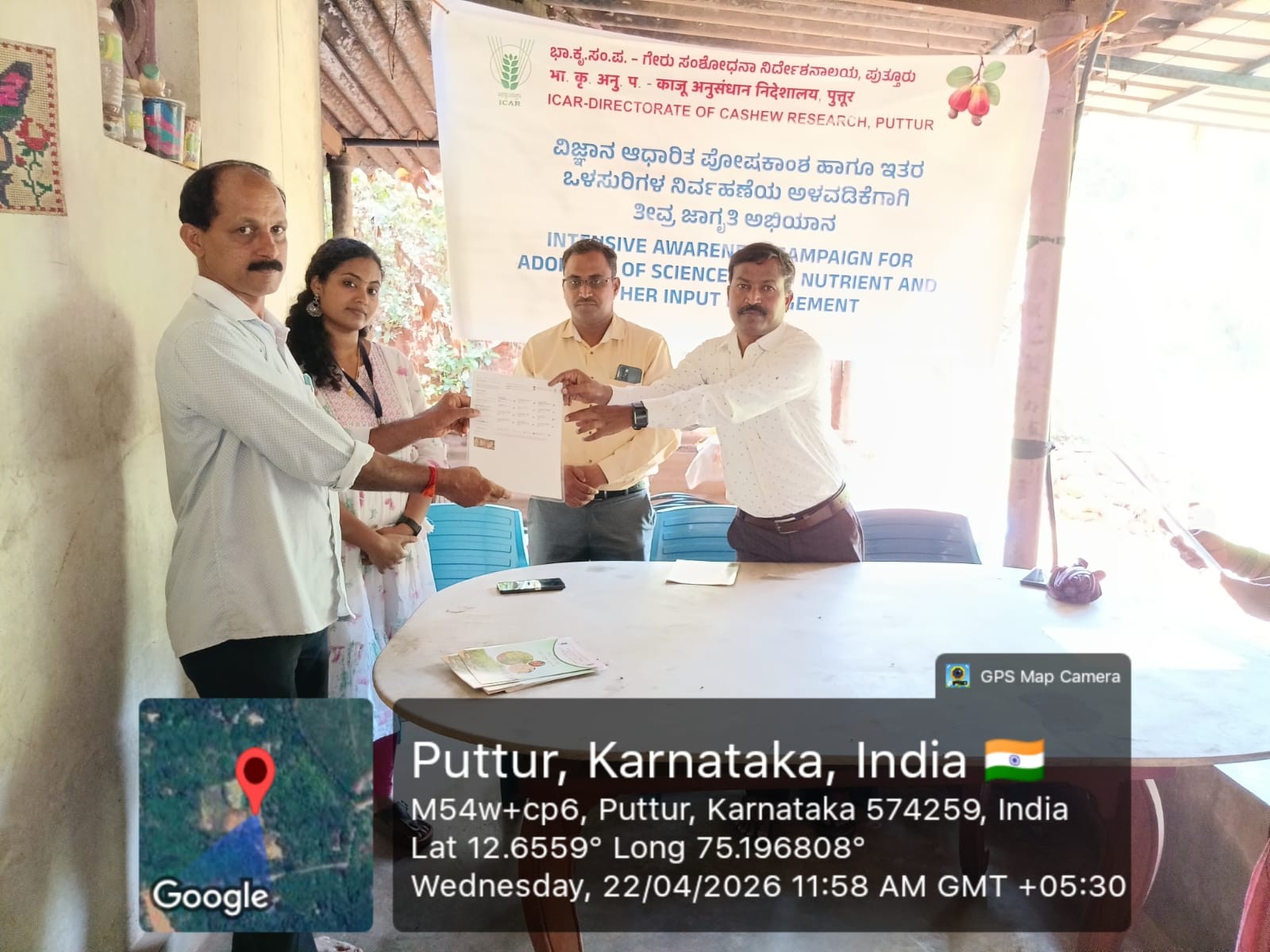
Soil Health Cards, prepared based on soil testing by the Department of Horticulture, were distributed to the farmers to guide them in nutrient management decisions.
A total of 25 participants, including farmers, Krishi Sakhis, and resource persons, attended the programme. Among the farmers who attended, 14 were male and 6 were female farmers. The campaign successfully enhanced awareness among stakeholders regarding the balanced and efficient use of fertilisers for sustainable agricultural productivity.
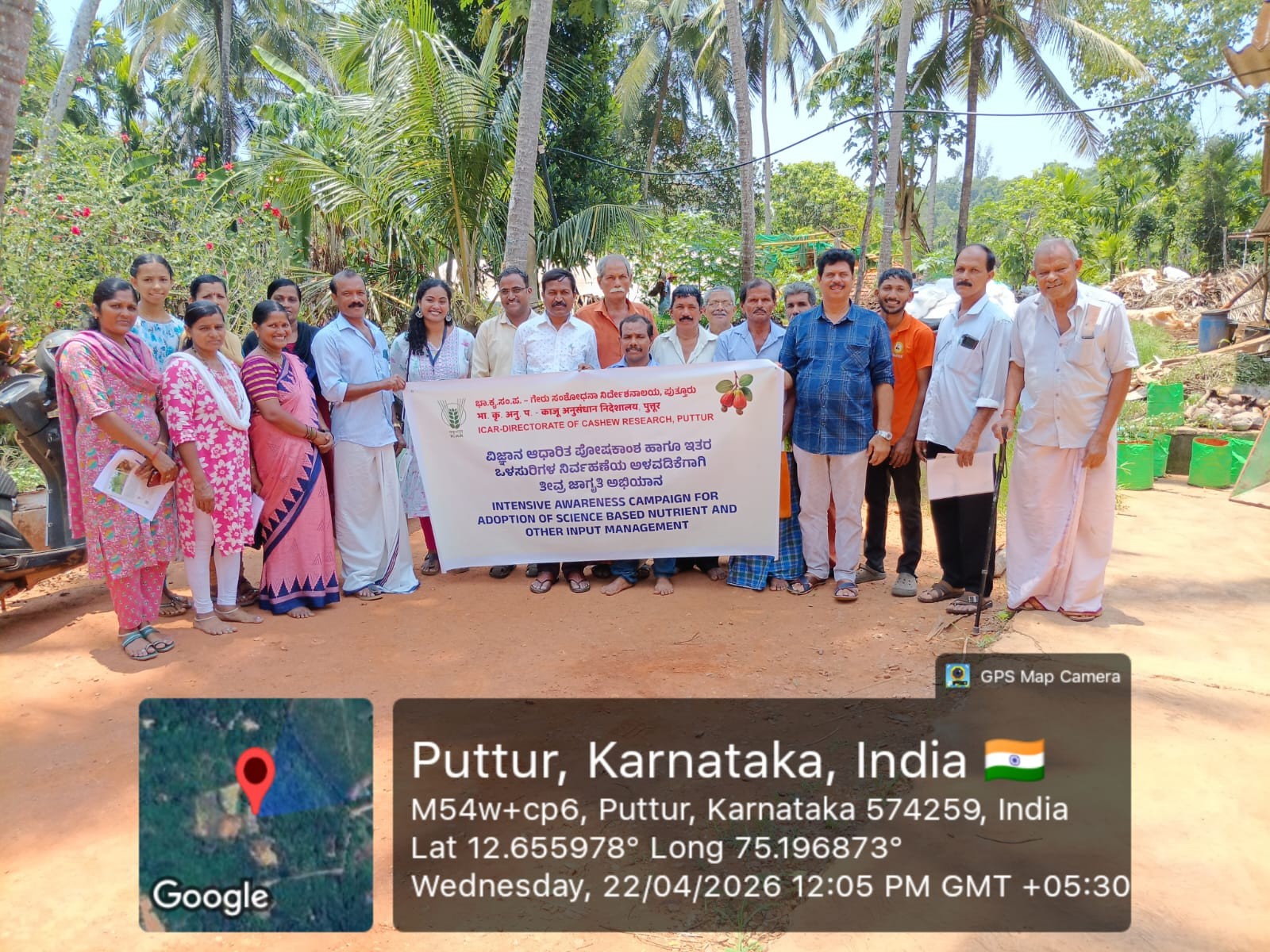
Organizing Institute: ICAR-Directorate of Cashew Research, Puttur, Karnataka
Scientific Team: Dr. Mohana, G.S., Principal Scientist, ICAR-DCR, Puttur
Dr. Thondaiman , Senior Scientist, ICAR-DCR, Puttur
Dr. Manjesh G.N., Senior Scientist, ICAR-DCR, Puttur
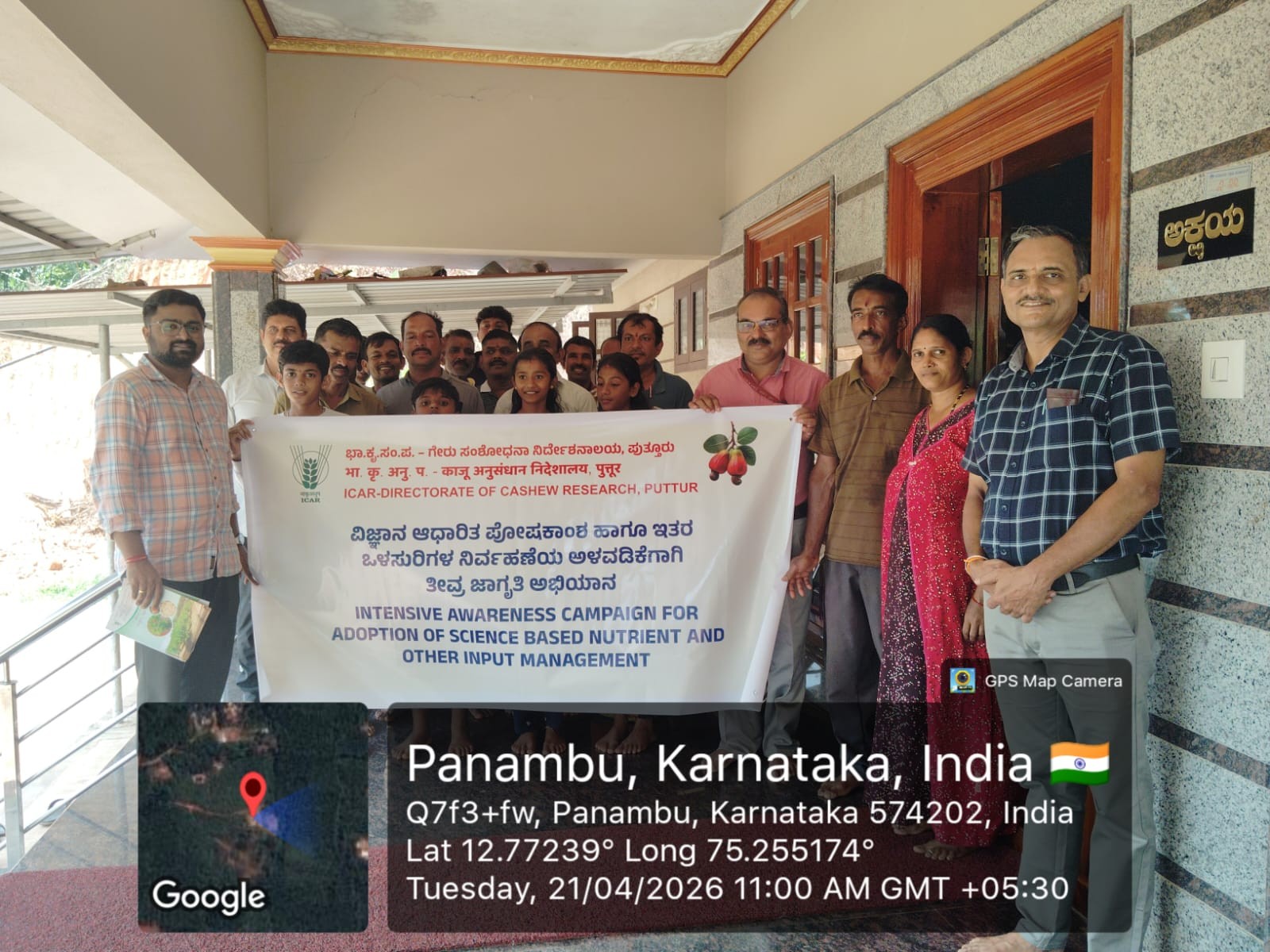
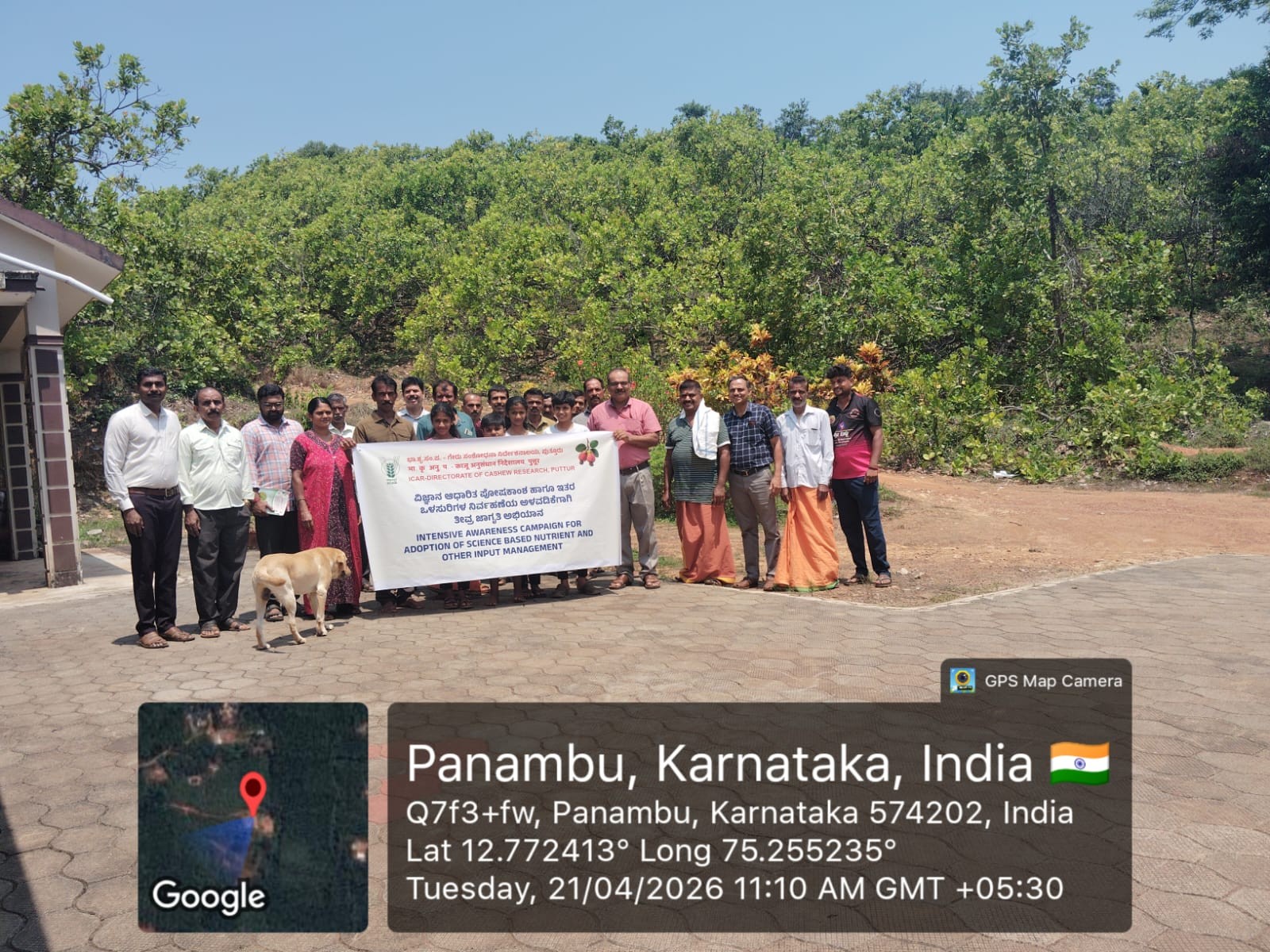
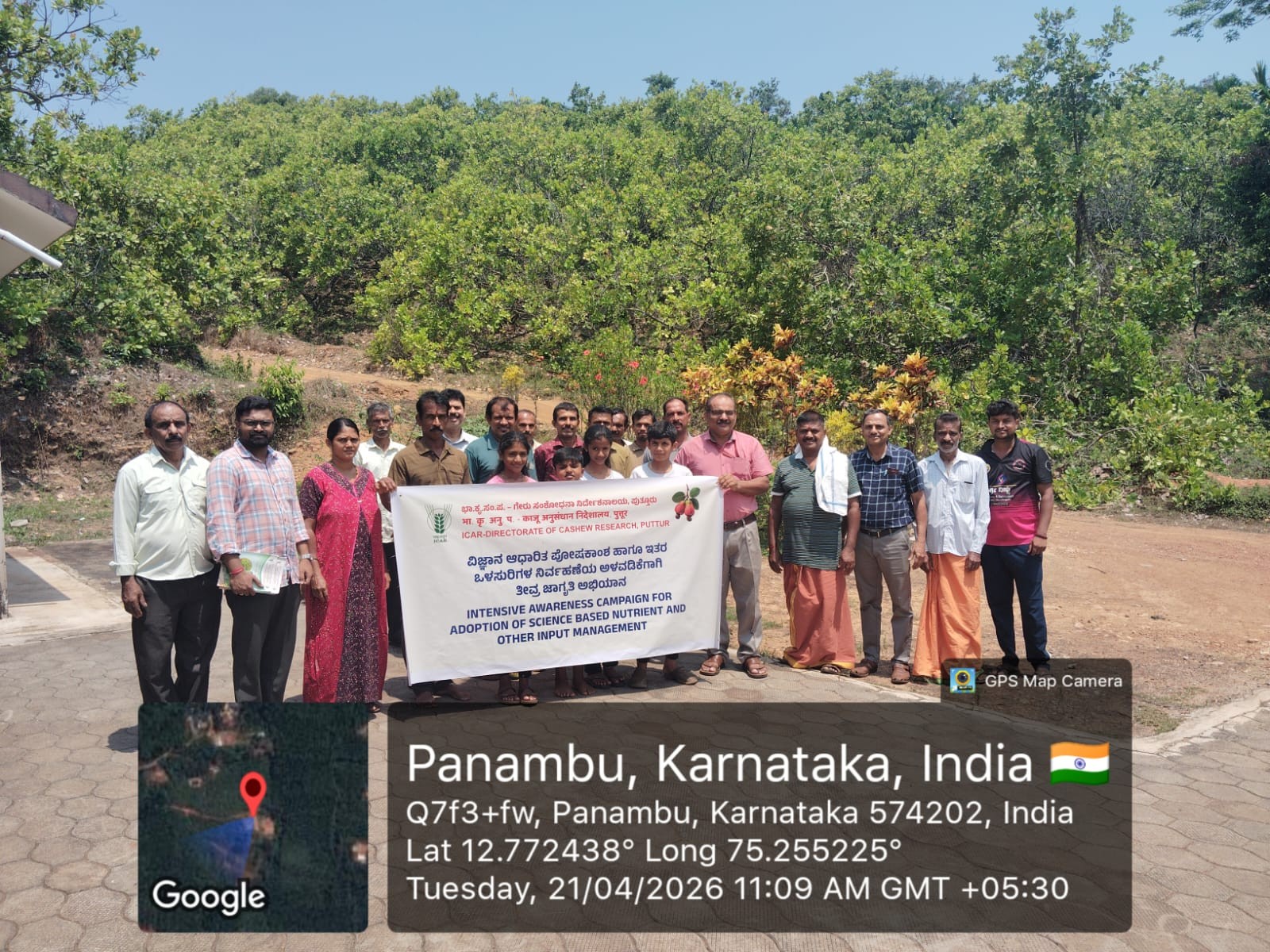
An awareness program on the above subject was conducted in Panambu, Shantigodu village of Puttur Taluk, Dakshina Kannada district, Karnataka state, on 21-04-2026. The program was started with a welcome by Dr Manjesh. This was followed by a briefing about the program by Dr. Mohana GS.
There was an interesting interaction among the farmers regarding the usage of fertilisers in Jagannatha Gowda’s cashew farm, which hosted this meeting. The cashew farm has the Bhaskara variety in 1.4 acres. The farmer uses poultry manure along with chemical fertilisers for cashew. The quantity of fertilisers applied was in line with the recommended dosage by the Directorate of Cashew Research, Puttur. He and other farmers were advised to apply farmyard manure along with the preparation of vermicompost. The booklet on good agricultural practices in cashew was distributed to the farmers.
In addition, the farmers were sensitised to the utilisation of cashew apples, which are largely wasted. The videos and shorts related to cashew apple utilisation were shared. Also, the book on recipes of cashew apple was given.
A total of 23 participants were present during the meeting. In the end, Dr. Thondaiman proposed a vote of thanks.
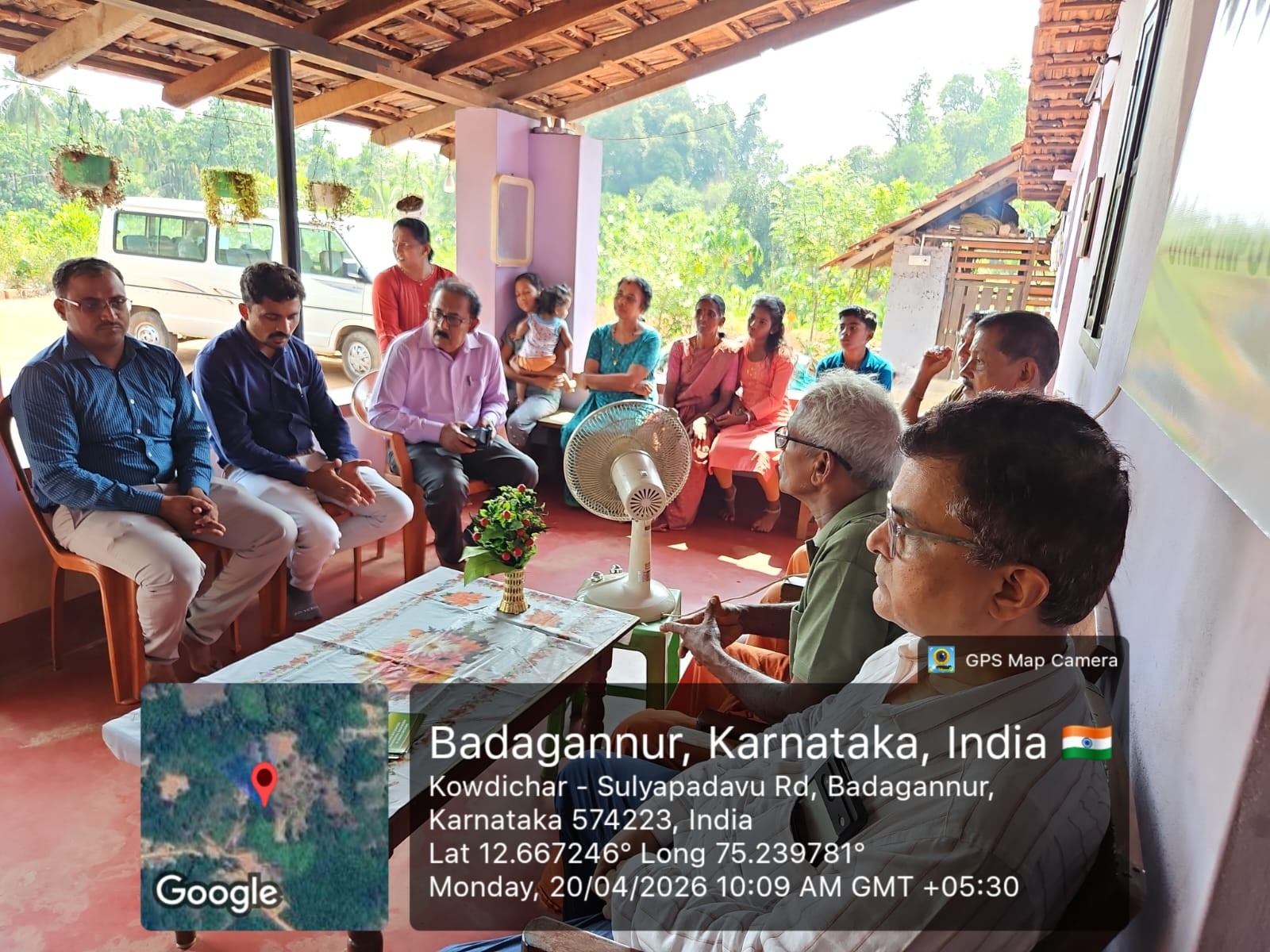
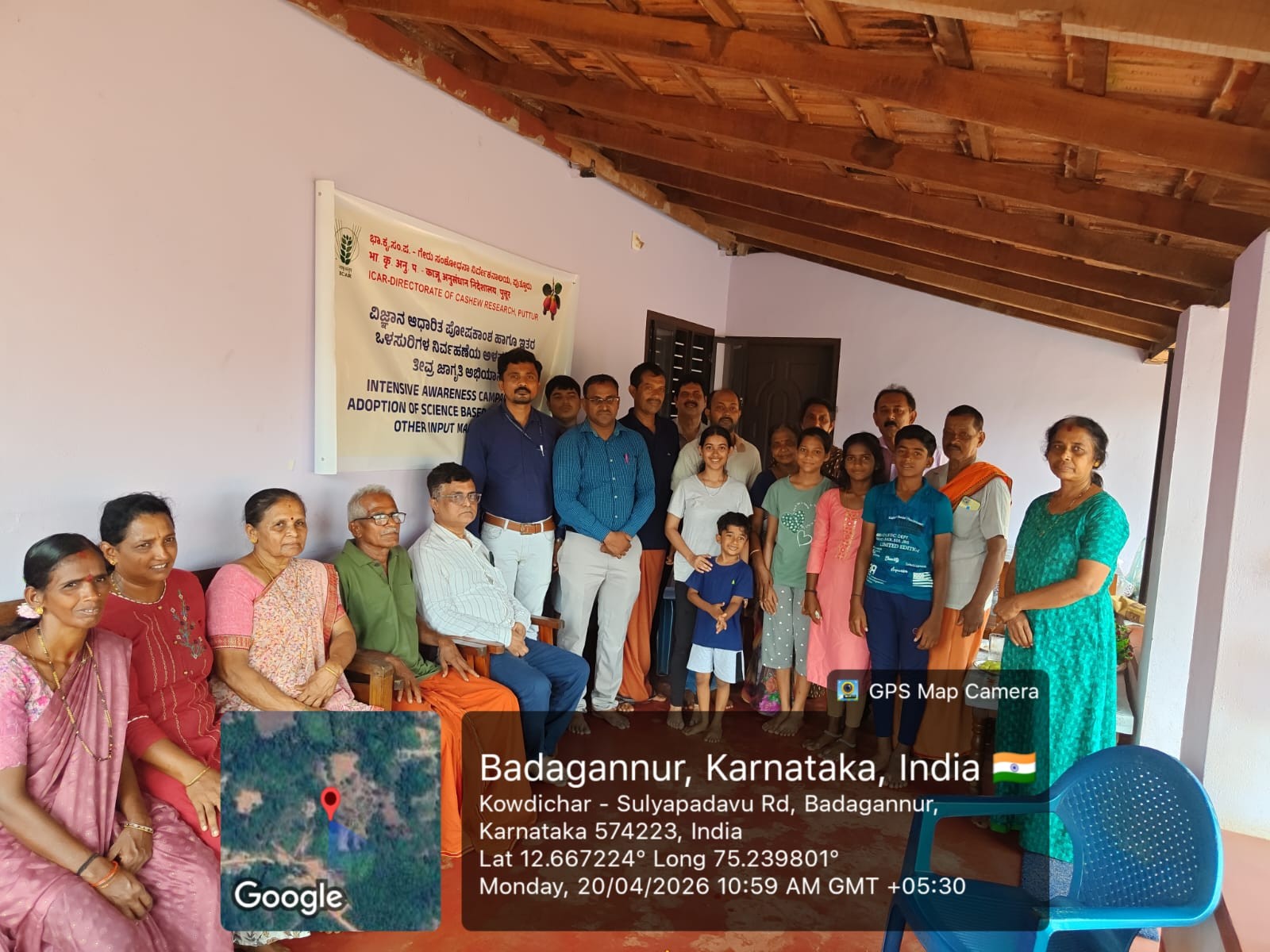
In view of the National Campaign on Balanced Use of Fertilizers, which promotes the judicious and scientific application of nutrients (NPK and micronutrients) along with organic manures to enhance soil health and crop productivity, a field visit was conducted by a team of scientists comprising Dr. Venkatesh M.S., Principal Scientist (Team Leader),
Dr. D. Balasubramanian, Principal Scientist (Team Member), Dr. Siddanna Savadi, Senior Scientist (Team Member) and Dr. Manjunatha K., Scientist (Team Member). The programme was organized at farmers’ fields in Badagannur (Papemajalu), Kowdichar, Karnataka. The session commenced with an introductory briefing by Dr. Manjunatha K. on the objectives of the programme. Dr. Venkatesh M.S. emphasized the importance of soil testing and maintaining soil health for sustainable crop production. Dr. D. Balasubramanian elaborated on the balanced use of chemical fertilizers in combination with organic manures. Dr. Siddanna Savadi highlighted the role of micronutrients and the adverse effects of excessive fertilizer application. A practical demonstration on soil sampling techniques was conducted by Mrs. Vijetha, enabling farmers to understand proper sampling methods. Soil samples were collected from farmers’ fields for further analysis. The programme was attended by 24 participants, including 13 men and 11 women.
Organizing Institute: ICAR-Directorate of Cashew Research, Puttur, Karnataka
Scientific Team: Dr. D Balasubramanian, Principal Scientist, ICAR-DCR, Puttur
Dr. Babli Mog, Senior Scientist, ICAR-DCR, Puttur
Dr. Veena G L., Senior Scientist, ICAR-DCR, Puttur
Dr. Bhagya H P, Scientist, ICAR-DCR, Puttur
Number of participants: 28
Major crops: Cashew, Coconut, Arecanut, Cocoa and Black pepper
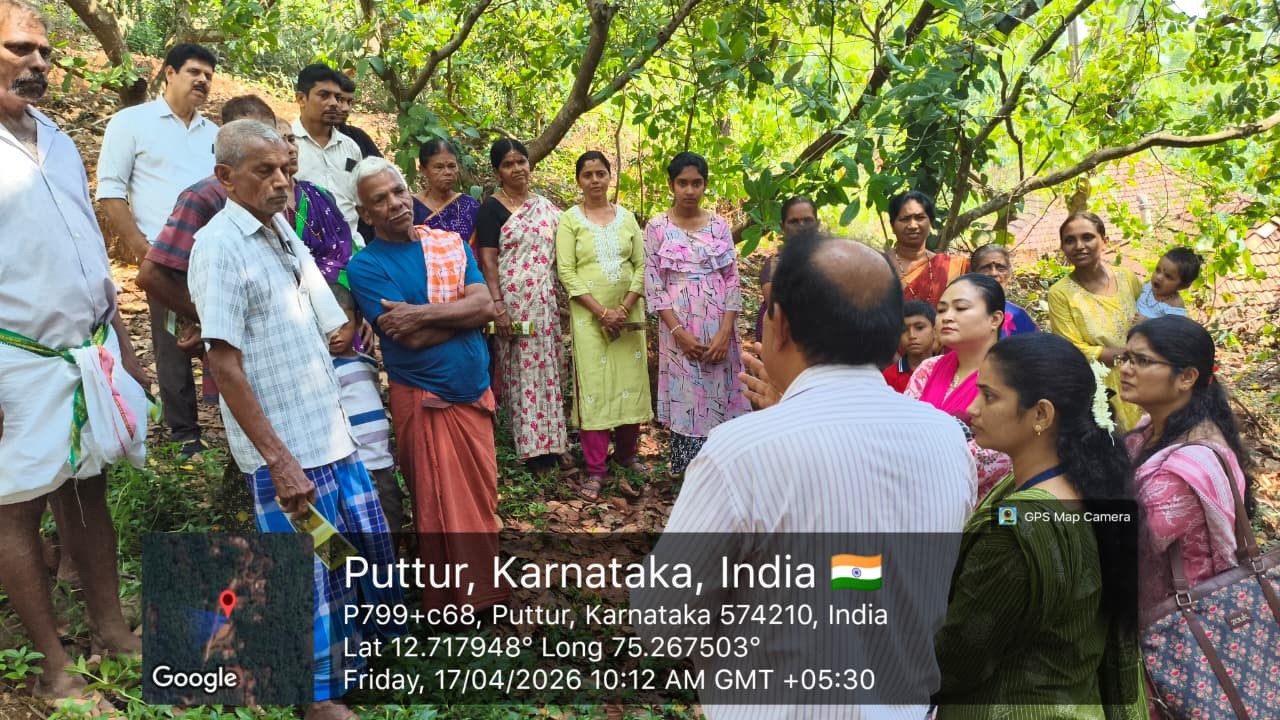
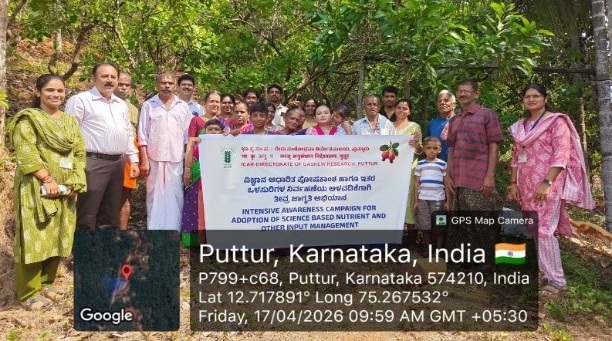
As a part of the intensive awareness campaign for the adoption of science-based nutrient and input management, a technical team from ICAR-DCR, Puttur, visited Kedambady village on April 17, 2026, to conduct an awareness programme for local farmers. The session focused on the balanced application of nutrients for a diversified range of crops, specifically cashew, coconut, arecanut, black pepper, and cocoa, emphasizing the vital importance of maintaining soil health through soil-test-based nutrient applications. The farmers were briefed on the integration of organic inputs, including farmyard manure, poultry manure, green leaf manure, and vermicompost, as well as the strategic use of biofertilizers to ensure long-term soil fertility and sustainability. Furthermore, the team demonstrated various science-based tools and standardized technologies developed by ICAR-DCR, Puttur, specifically designed to optimize cashew cultivation. The programme concluded by highlighting the necessity of preserving soil ecosystems and minimizing reliance on inorganic inputs, encouraging a shift toward scientific management practices to ensure the continued health and productivity of the farmers diversified crop holdings. A total of 28 farmers attended this programme.
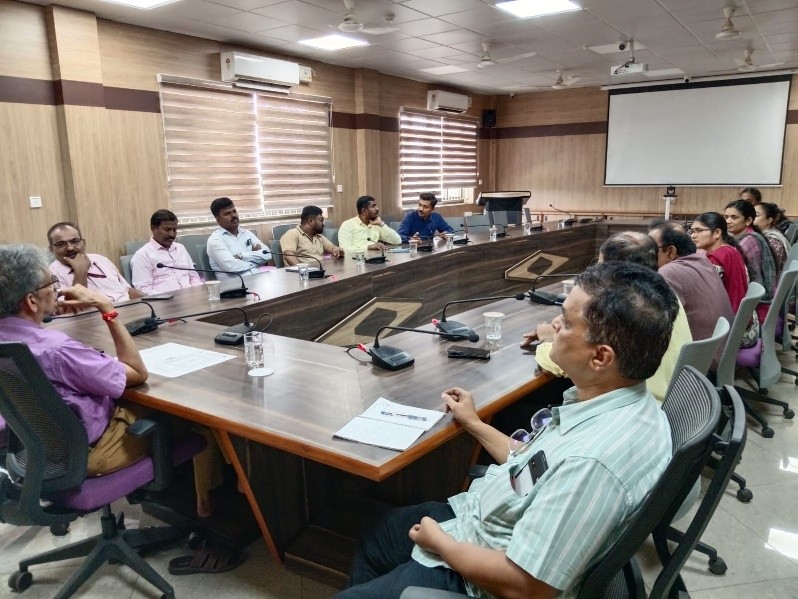
Intensive Awareness Campaign for the Adoption of Science Based Nutrient and Other Input Management “meeting, held under the chairmanship of Dr. J. Dinakara Adiga, Director, ICAR- DCR, Puttur, held on April 16, 2026, at 9.30 AM in the Video Conference Room and all scientist of Directorate were participated and five teams were formed for implementing the awareness programme in effective way. The programme for implementing awareness programme was discussed and finalized.